Global climate change is one of the hottest topics out there. Are humans the cause? Are we in real danger? There is lots of scientific evidence out there, but how much do we really know about climate change?
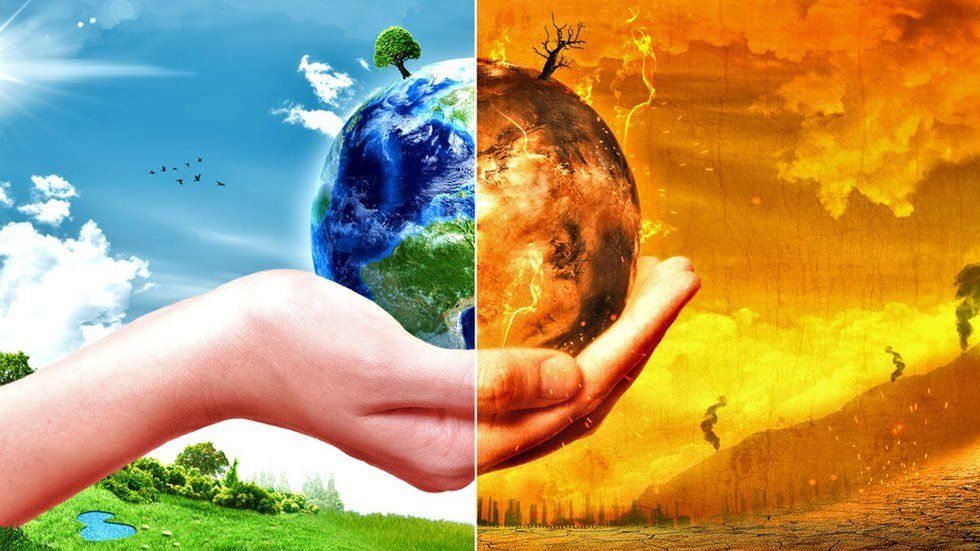
Human activity and natural activity are both the causes of climate change. However, since the Industrial Revolution, one is significantly stronger than the other. Climate change will not end the world, but it will hurt Earth when our children and grandchildren are living on it. The truth is that although the current inhabitants of the Earth are currently feeling the dangerous effects of a rising global temperature, we have not seen the worst of it. We seem to be saving that for our descendants.
Those who oppose climate change action claim that the temperature naturally rises and falls over thousands of years due to natural changes. Yes, after every warming period, there is said to be a cooling period. That is true if you look at what paleoclimatologists have gathered about the temperatures during the Medieval Warming Period — caused by natural forces possibly such as decreased volcanic activity and increased solar activity —, which was followed by what is known as the Little Ice Age, an immediate cooling period. Although the aforementioned information is true, global temperatures today have exceeded what they reached in the Medieval Warming Period. In fact, according to the National Climatic Data Center, “The last 20 years (since 1988) stand out as very likely the warmest 20-year period, accounting for the calibration uncertainty and decreases in proxy data quality before the calibration period.” The last two decades are the warmest stretch of years we have ever had, and even if there is a cooling period in the future, if it continues to get warmer, our descendants will be living on a disgusting planet.
Why is it getting so warm though? Increasing amounts of greenhouse gases, such as carbon dioxide, nitrous oxide, methane and halocarbon, are exceeding the natural capacity. Through activities such as using fossil fuel for transportation, building heating, manufacture and deforestation, carbon dioxide in the atmosphere is at an all-time high. Fossil fuel burning and the use of fertilizer increase Nitrous oxide in the atmosphere. Furthermore, due to the increase of these gases in the atmosphere, global temperatures are increasing, causing ice to melt in places like Alaska, where methane hides under the ice. When the methane is released from the ice, global temperatures increase even more. It is a cycle that we need to act on, fast because unfortunately, these facts are undeniable. These activities are all things that we, as humans, take part in.
Many people choose to remain indifferent about the issue. "It is what it is," they say. Many people don’t even know what climate change is or its effect on the Earth. They aren’t aware of the future dangers that we should all be fearing, not for ourselves, but for our grandchildren. Then, there are people out there who remain in opposition to the topic. There are politicians such as Donald Trump who believe that climate change is not a threat and that it is not worth any economist’s time to determine how to fund climate change action. Business Insider reported, “In response to a question about his views on climate change, Trump implied that the U.S. shouldn't waste ‘financial resources’ on climate change and should instead use them to ensure the world has clean water, eliminate diseases like malaria, increase food production or develop alternative energy sources.” Trump's perspective confuses me because climate change is the reason for unclean water, many diseases, decreased food production and the obvious need for alternative energy sources. Trump also said he would dismantle the Paris Agreement. According to the United Nations, the Paris Agreement builds upon the Convention and — for the first time — "brings all nations into a common cause to undertake ambitious efforts to combat climate change and adapt to its effects, with enhanced support to assist developing countries to do so ... it charts a new course in the global climate effort,” which is perhaps the closest we have come as a country to taking the next steps toward climate change action.
According to a book published by the United Nations in 2007, “...greenhouse gas emissions could rise by 25 to 90 percent by 2030 relative to 2000 and the Earth could warm by 3°C this century. Even with a temperature rise of 1 to 2.5°C the IPCC predict serious effects including reduced crop yields in tropical areas leading to increased risk of hunger, spread of climate-sensitive diseases such as malaria, and an increased risk of extinction of 20 to 30 percent of all plant and animal species.” Furthermore, future implications of climate change include changes in precipitation patterns, more droughts and heat waves, stronger, more intense hurricanes, and higher sea levels. Unfortunately, some of these expectations are becoming evident. Ocean levels are rising in the northeast due to climate change. Hurricane Matthew was the first Category 5 Atlantic Hurricane since Felix in 2007. Additionally, Alaska had the warmest spring on record this year, 32 degrees Fahrenheit, smashing the previous warmest record in 1998 of 30 degrees Fahrenheit. Many bird and animal species are threatened with extinction, thus threatening our dependence on biodiversity in Earth — an overwhelmingly under-appreciated subject. The threats go on and on.
Amazingly, the United States entered into the United Nations Paris Agreement, which means that we agreed to put forth efforts to sustain our climate where it is and contribute to a global effort to not allow our temperature to increase as much as 1–2.5 degrees Celsius, where anywhere beyond that point brings danger. Our government officials are the ones who decide what efforts we put forth to follow through with the agreement. Alternatively, they can also be the people who decide to withdraw from the agreement altogether — just something to keep in mind with Election Day in a week.
It is obvious that the climate is changing and that there are serious effects being felt already. Scientists have warned us about the effects that climate change will have on us since the 1970s. It is the general public who chooses not to listen. Sure, maybe there will be a cooling period when it is all said and done. OK, climate change probably will not end the world. Nonetheless, that is not to say that the dangers of climate change will not wipe out future generations. We have nothing to worry about now, you might think, but our descendants certainly do.