

In 2008, a team of United States and Greek archaeologists discovered stone tools on the Island of Crete dating deep into pre-history. In research done by Providence College and the Greek Ministry of Culture; tools were found by Thomas Strasser and Eleni Panagopoulou that date back 130,000-700,000 years ago. http://archive.archaeology.org/1101/topten/crete.h...
Additionally, tools and stone artifacts found in a Greek archaeological site, was discovered by geoarchaeologist Vangelis Tourloukis of Eberhard Karls Universitӓt Tübingen in Germany. Along with collaboration by geoarchaeologists Panagiotis Karkanas of the American School of Classical Studies in Athens and Jakob Wallinga of Wageningen University in the Netherlands; evidence for the site was shown to be 206,000 years old. This site has been dated it to be one of the oldest site inhabited on the Islands of Greece by hominid species. https://www.sciencenews.org/article/ancient-homini...
While this is not necessarily recent news, it is still something of great significance for humanity to realize.
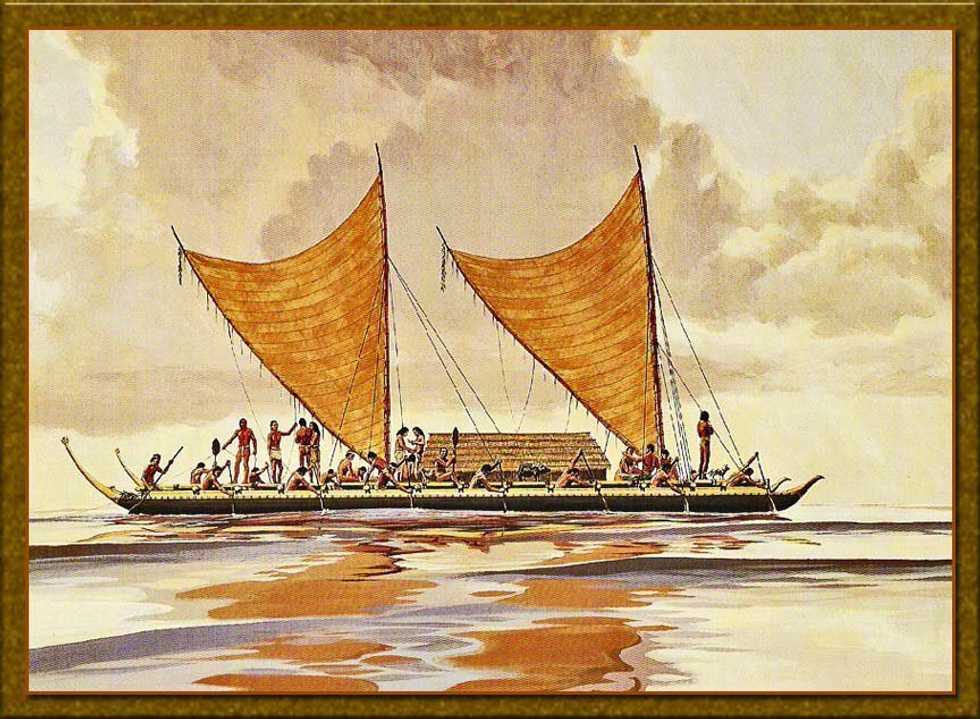
Naval travel was one of the earliest and greatest conquests of complexity humanity ever achieved. Civilization explicitly grew at the productive rate it did because humans were close to water. The fact that the initial ventures of our species happened well over 130,000 years ago is beyond simple notation in a textbook. This increases the perspective of human complexity for civilization by at least a magnitude factor of ten. We commonly accept that our first civilizations started within the last 10,000 years. But with this new perspective of our tool sophistication being advanced enough for naval travel hundreds of thousands of years ago; and in some cases nearly one million years ago. The idea that a form of social construct, that takes on many aspects of the construct we call "civilization"; may have happened deep in prehistory. This is completely revolutionary to our comprehension of our history as a global civilization and as a species.
In studying and recognizing our prehistoric past, we can erase and make obsolete the contradictory paradoxes which stall the progression of our civilization today. The notion of an unalterable "human nature" becomes obsolete when investigation into our deeper history shows that behavior patterns are not always present. The idea, such as the ones recently espoused by a sitting US House of Representative member Steve King (Iowa); that suggests all of our advanced civilization components are strictly due to Western, Christianized, white pigmented peoples. Is completely discredited by these ancient discoveries. http://www.nbcnews.com/card/rep-steve-king-defends...
In essence, discoveries such as these can provide a reassessment of our knowledge of ourselves. And can allow new insight into problems that have plagued us for millennia. With these new insights, it could be possible to redirect the course of our civilization towards one that show greater appreciation for human creativity, engineering, and potential as a species.