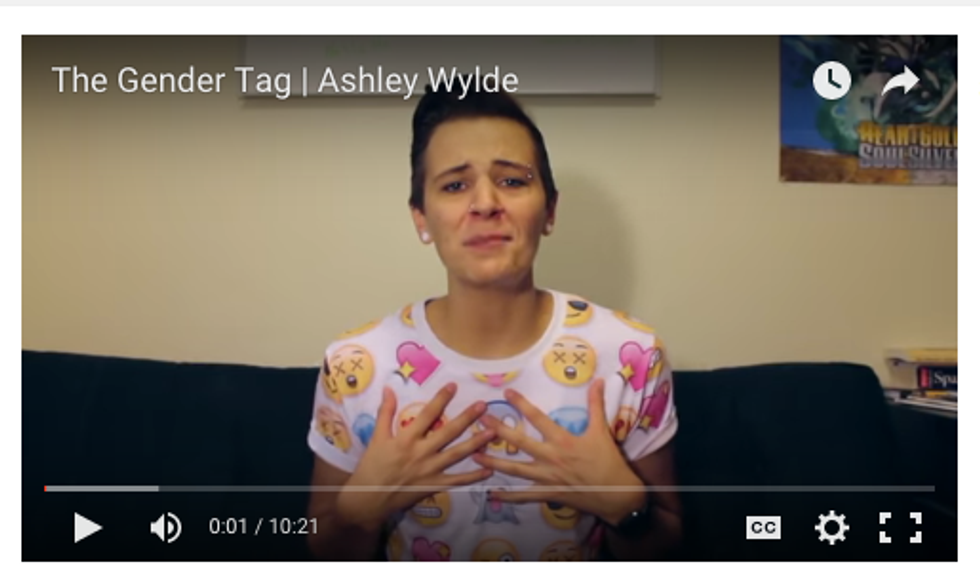
The Gender Tag Project is a YouTube tag video that encourages individuals to answer a set of prompts relating to their experience with gender in the form of a YouTube video posted to their personal channel. The project was started by YouTuber Ashley Wylde as a way for people from all backgrounds and genders to tell their story in a way that we all can understand
I believe that this project is important, not only so people can share their experiences, but to educate a population that isn't very knowledgeable when it comes to gender identification and sexuality. For the larger majority of people, unless you have gone through something like this, you don't really understand what these people have experienced. So a project like this can become very helpful to help others understand the struggle of gender.
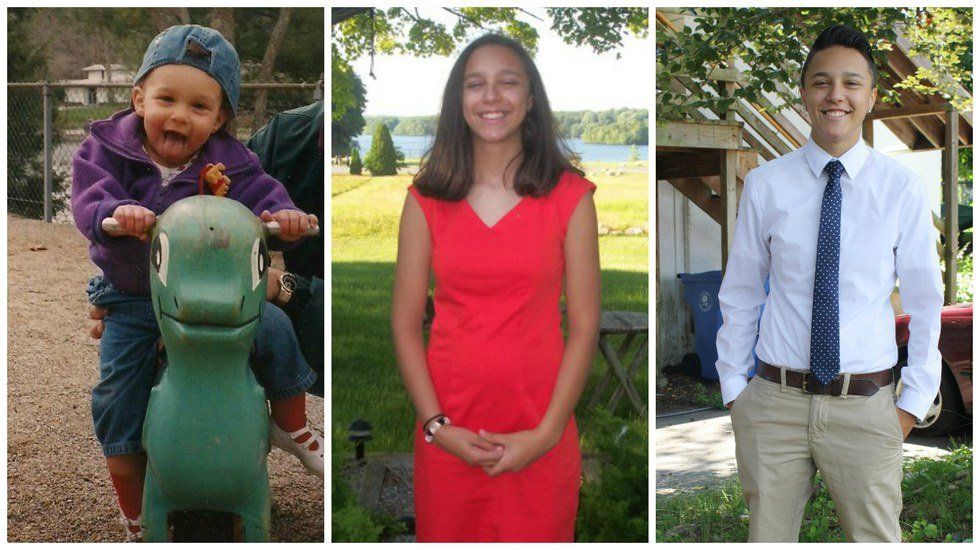
A perfect example of why we need this project is something that happened to me at work. I was helping a customer and she asked me what my name was. When I told her my name is Emma, she gave me a puzzled look for a moment, then flat out asked me if I was a boy. When I responded no, the same puzzled look returned to her face before she asked if I wanted to be a boy. I again answered no. The woman then smiled and said, "It's okay. You're young; you'll figure it out" and walked away. She truly did not understand that I can identify as a woman, but present in a masculine fashion. This is why we need the Gender Tag Project.
When talking about gender, it's important to understand how you self-identify, to figure out what that definition means for you. I identify as a female. While I do not choose to dress in the way the society has taught girls how to dress, I have always known that I am a female. To me, being a female means that when I wake up in the morning, I don't have any type of question in my head as to whether or not I'm a female. I know that I am a female as confidently as I know that my name is Emma.
Also, since language isn't always gender neutral, learn which pronouns honor your gender identity. As a female, the pronouns she/her honor me. Do not call me 'it!' If you cannot tell someone's gender, whatever you do, do not call them 'it.' Using "it" as a pronoun dehumanizes the person and strips them of the things that make them a person and turns them into an object. If you cannot tell someone's gender, use the pronouns they/them. These are gender neutral pronouns and will not offend them.
People express their gender identity in a variety of ways, but clothing can be the most visible form. The style of clothing that you most often wear is a reflection of your gender. I choose to wear men's clothes because that's what I feel comfortable in. All the clothes I wear come out of the men's section: shirts, pants, shoes, underwear. The only thing I wear that comes from the other side of the store is my sports bras.I pride myself on being someone who can switch up my style. For example, during the day, I could wear a button-down, sweater, and a nice pair of boots, and then at night, I could wear a t-shirt, jeans, sneakers, and a snapback hat and still be able to pull it off.
When it comes to cosmetics, some women, and men, choose to wear makeup and paint their nails which are considered gendered behavior. I do not wear makeup of any kind. The only time that you can catch me wearing any kind of makeup is when I lose a dare to my friends and let them put makeup on me as a joke. I do not paint my nails at all. I don't even like the clear nail polish because that is too shiny for me.
One of the biggest challenges that can come with being gender-nonconforming is being misgendered, which can happen often when people don't understand the difference between gender expression and gender identity. I get misgendered at least once a day, if not more. I cut my hair short just over two years ago and since then, misgendering has become such a common occurrence for me that it doesn't really bother me anymore. When I first cut my hair short, I used to get so mad when people would misgender me. Over time, however, I have come to realize that they honestly just don't know that I am a girl, so I can't get mad at them for it.
Misgendering someone becomes a problem when it is done on purpose. When I was in high school, I got my hair cut short in the early part of my senior year. One of the things that made me happy about my haircut was that I was finally able to wear hats. There was a boy in my English class who would come up to me on days where I would wear a hat and take it off my head and throw it down the hallway and then say, "Someone get him his hat back". All class he would refer to me as a guy and use male pronouns for me. This is when misgendering is not ok, because when I first cut my hair, misgendering was a very big deal for me. The acts of this boy really hurt me then, whereas now, I have the self-confidence to say something and stand up for myself.
One of the questions from Wylde's video is whether you experience dysphoria, and how does that affect you? Let me begin to answer this question by first explaining what dysphoria is for those who don't know. Dysphoria is a state of unease or generalized dissatisfaction with life. Gender dysphoria is the strong feeling that a person is a different gender than what they are labeled at birth or currently identify as.
While I identify as a female, there are some days that I have strong feelings of dysphoria. On these days, I feel especially self-conscious about my body. Being a fairly androgynous (partly male and partly female in appearance) person, I enjoy dressing in clothing that makes me look like a male. On the days I'm feeling dysphoric, I get very aware of the curve of my hips or the way my breasts make my shirt fall in an unnatural way. Nothing fits right and I don't want to leave my room.
In Wylde's video, she also touches on the topic of having children. Some of the questions include, "Are you interested in having children?" "Would you want to carry a child if that were an option for you?" "Do you want to be the primary caretaker for any children you may have?" I honestly cannot wait to have kids, even though I know that part of my life is still far away. The one thing that I do know is that I will not be the one to physically give birth to my child or children. It's not that my body won't allow me, it is just that the idea of having someone come out of me is not something that interests me.
The one thing people need to understand about gender is that you don't have to understand someone's gender, but you do have to respect their choice to identify as whatever they want. I'm not even going to pretend like I understand how the mind of someone who, for example, is transgender works. However, I do respect their choice.