


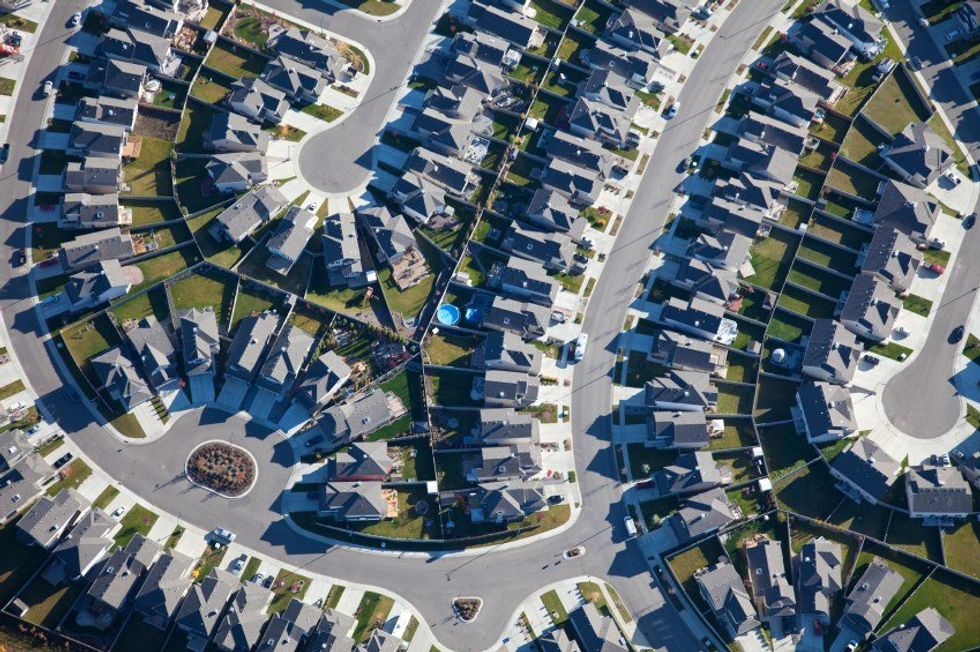
Born out of the desire for upward social mobility that attracted so many people to this prosperous nation, the post-WWII manifestation of the American Dream has contributed significantly to the creation of a dismal, dystopian, nightmarish culture of isolation and consumerism that has completely overtaken the United States.
For the purpose of this article, I will be using a practical definition of the American Dream, separated from the idealistic concept and focused on the physical manifestation of this so-called "dream," which is defined as follows: the hope that one day, you will get married, take out a mortgage, have kids and save for retirement. Implicit in this dream is that your family will embody the spirit of consumerism and spend significant time and resources on purchasing goods and services, since a central component of the American Dream is spending money. Spending money on a house, on new cars every few years and on countless goods and services through the years, as if material goods are the key to happiness and fulfillment. Now, one might ask at this point, how on earth this has ruined America?
The answer, two words: urban sprawl.
After WWII, the financial system was restructured in order to allow households to take out 30 year mortgages on homes with relatively small down payments. This in turn has allowed millions of [white] Americans to “escape” the inner city and achieve this “dream” by obtaining a house in the suburbs. As a result, the archetype of the American nuclear family became defined by familial home ownership in a quiet suburb.
Intended or not, the consequences of this trend were dire. Today’s American cities are hopelessly inefficient, soullessly monotonous and highly stratified, both socially and economically. American cities are designed for cars, not people, and have exploded in growth as a result of millions of [white] people leaving the inner city to the suburbs, in search of the American Dream and completely unaware of its superficiality and emptiness. In the suburbs, life is atomized: we’re isolated from our neighbors thanks to our large yards and detached houses. We’re isolated from the public as we travel around town in our cars. The degree of social isolation that is so central to life in the suburbs is truly dystopian.
In the suburbs, there is a high degree of economic segregation as each suburb contains houses that are roughly the same price, therefore each suburban development contains people of roughly the same socioeconomic status. Since we are isolated from different segments of American society, and thus from the conflicts that prompt political participation, we have grown apathetic towards politics in general. Civic engagement has experienced a stark decline in the past 50 years, because ultimately, we do not face the conflicts that in the past, when social isolation wasn't a primary characteristic of American Society, urged people to participate in politics. Thus, we are much less inclined to be engaged politically.
These priva-topias that have taken over nearly every American city have stifled civic life and exacerbated inequality and segregation.
The suburbs also promote a sedentary lifestyle. Since the horrendous urban design of the suburbs has rendered entire cities totally un-walkable, people must use cars to get everywhere. It is impossible to have a livelihood in the suburbs without a car; we are totally dependent on cars to live normal lives. That requires spending hours of your day sitting down. The suburban lifestyle involves an extremely unhealthy amount of sitting. The obesity epidemic continues to plague this country and the necessity to drive everywhere, and therefore sit down so much, only contributes to this plague.
Suburbanization has created places not worth caring about. The proliferation of shopping malls, chain stores, massive parking lots, freeways and strip malls are completely forgettable and are nearly identical everywhere you go. They are soulless and meaningless. If you’ve seen one, you’ve seen them all. It doesn’t matter whether you’re in Los Angeles, St. Louis, Miami or Cleveland: the suburbs, more or less, look the same.
Urban sprawl is also extremely wasteful. The amount of resources it takes to construct and maintain the suburbs is appalling, not to mention the gasoline required to take your car back and forth between your house and work every day. The sheer scale of the waste that our lifestyles and city organization creates is both a national and humanitarian disgrace.
This is the situation in nearly every American city. New York City, parts of Chicago and San Francisco are quite literally the only exceptions. American cities are hopelessly unsustainable and public discourse on this vitally important issue is tragically silent.
While there are many factors that have contributed to urban sprawl, it is the consumer’s taste, driven by the American dream, that made it all possible. Hopefully we will learn our lesson very soon.
















