


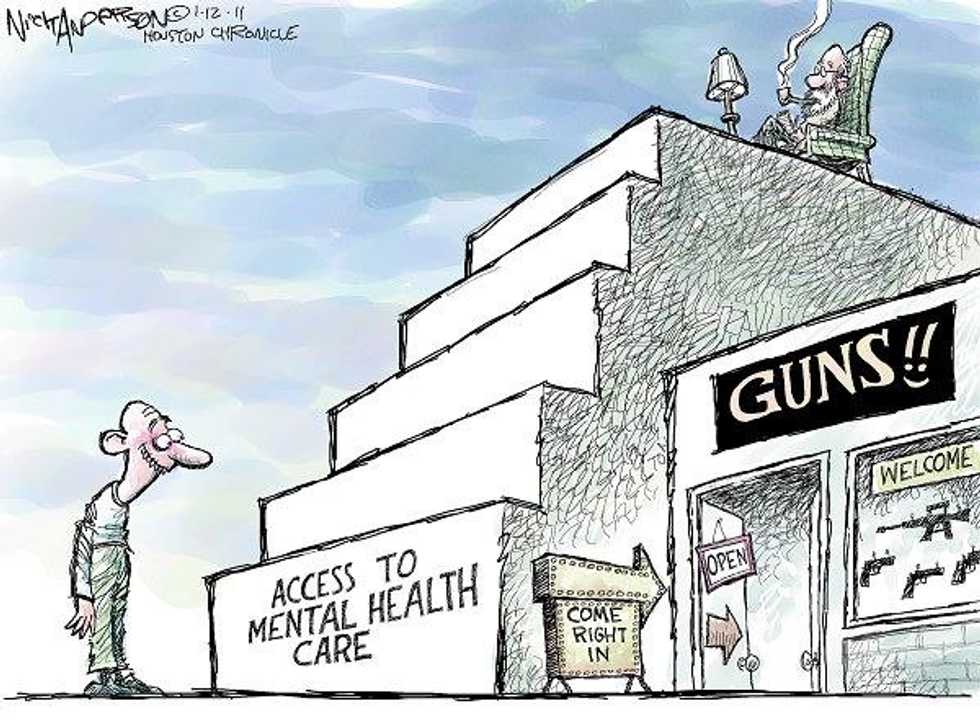
In 2013, New York passed the SAFE Act following the Connecticut shooting at Sandy Hook Elementary School. The SAFE Act requires mental-health professionals to report patients who are “likely to engage in conduct that would result in harm to self or others,” so once they are identified, they are restricted from purchasing or owning guns. This Act has tackled a broad issue, as the term “mental illness” changes with the times. Homosexuality was deemed a psychological disorder until 1973; under New York’s Safe Act, homosexuals would have been unable to purchase or own firearms. Surely, this circumstance seems ridiculous nowadays, which begs the question: does a mental disorder justify taking away someone’s fundamental second Amendment right to bear arms?
A study of over 10,000 subjects was administered to find the connection between violence and mental health. This study was conducted by Jeffrey W. Swanson, a professor in psychiatry and behavioral sciences at Duke University’s School of Medicine and an author or coauthor of over 200 publications focused on the epidemiology of violence and serious mental illnesses. He concluded that mental disorders can solely account for a mere 4% of violent incidents. Alternatively, violent behavior could be predicted without the presence of mental disorders if the perpetrator was male, low-income or experienced substance abuse. Swanson explains that his experiment debunks two myths: “One: people with mental illness are all dangerous. Well, the vast majority are not. And the other myth: that there’s no connection at all. There is one. It’s quite small, but it’s not completely nonexistent.”
In relation to health and gun control, there is a correlation, but not as predictive as many believe. A study of 34 male subjects conducted in 2001 to “identify demographic, clinical, and forensic characteristics” of adolescent mass murderers found that less than one in four adolescent mass murderers had a psychiatric history and only 6% were psychotic at the time of the mass murder. On the other hand, 70% of mass murderers are described as loners, 61.5% had issues with substance abuse, and 43.5% have been bullied. These factors are much more probable than a mental disorder, yet people experience confirmation bias. That is, they listen to news sources that often discuss school shootings and mental health interchangeably because it confirms their belief that there is a strong correlation, despite the evidence against this theory. Despite the low probability of a shooter being mentally ill, the public associates violence and mass murders with mental health, thus stigmatizing disorders and creating an unjust violent characteristic.
When we besmirch and villainize those with mental disorders, we are inadvertently shaming them from seeking treatment. Surely it is more hazardous to have an undiagnosed mental disorder than one that is treated by professionals. If we replaced the stigmatization with a safer environment for people to explore their mental health, we could enhance our overall quality of life by treating mental disorders and releasing patients from unjust stigmatization.
Perhaps the conversation should veer away from case studies and instead focus on assessing the correlation for what it is. News sources cover school shootings with the labels “loner” and “bullied” and “mentally ill” as if they are synonymous, but in actuality, the perpetrators are much less likely have mental disorders in relation to the prevalence of reports claiming so. While it is imperative to save lives and prevent future school shootings, it is conceivably more meaningful to understand the true statistics behind mental health.















