This past week the Gamma Iota Chapter of Alpha Phi Alpha Fraternity Inc. hosted a debate entitled “Hood Politics.” The statement of debate read: “Hip- hop artists should have more of a responsibility to positively impact crime-ridden communities than elected political figures.” For the debate, one team of four was to defend this statement and the opposing team of four argued against the statement. Before proceeding with the arguments that followed to either support or oppose, go ahead and form your own opinion. Do you support the statement that hip-hop artists have more of a responsibility to positively impact crime-ridden communities or do you feel as though elected political figures should be held more responsible?
There are two definitions of hip-hop music. The first is: "The stylized rhythmic music that commonly accompanies rap; also, rap together with this music," and the second definition is: "An urban youth culture originating in the 1980s in New York City, involving such forms of expression as hip-hop music, b-boying, and graffiti art?" One definition speaks to the style of music, which helps to explain why hip-hop and rap are often used interchangeably. The second definition makes a phenomenal argument for the supporting team. The subculture of hip-hop originated from the Bronx in the 1980’s. This was their way to artistically express the poor state of the communities of color. Secondly, the statement “crime-ridden communities,” may have been used to indirectly reference “black” communities, however, these phrases are not synonymous. 60 percent of crimes are committed by white men and women. In this case, hip-hop may or may not be the chosen genre of music that “speaks” to the community. The Universal Zulu Nation started from a man in the midst of the new hip-hop culture arising in the South Bronx by the name of Afrika Bambaataa. Street organizations such as the Black Spades came together to promote peace, unity, and love and they include pro-black teachings in the lyrics of their hip-hop songs.
The supporting team made the point that crime-ridden communities do not relate to politicians or see the impact that voting has. The question now becomes: do we think that this is something that should be mended or do we just find new leaders?
Despite the fact that hip-hop culture was derived from political awareness, what is to say that these artists should be stretched out of their specific role to raise awareness creatively, as opposed to our politicians? Why should we not hold leaders accountable for not doing their jobs? If many demand that the police receive required diversity training why shouldn't we demand the same for our politicians? If you support a system of anarchy then will hip-hop artists be artists or politicians? If both, which aspect should receive more attention?
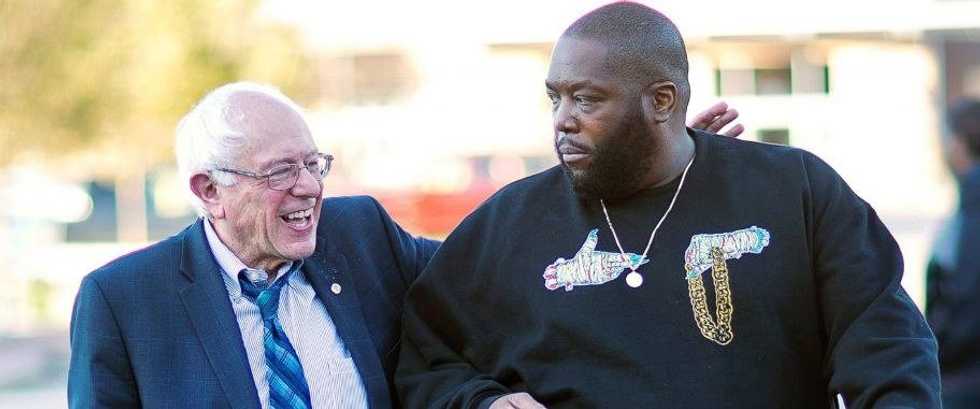
My argument, as a member of the opposing team, is that if we say hip-hop artists have more responsibility, then all 519, 682 elected political figures are less responsible for their own jobs. Killer Mike’s recent endorsement of Bernie Sanders was symbolic to the partnership that needs to be forged between the needs of the people and the power to implement long-term policy allowing needs to be met. What I did not mention during the debate, however, is that working with radical, progressive, and preferably black or Latino (not like Carson and Rubio) elected figures and lawyers who are down for the cause, is essential. Hip-hop artists are not educated to maneuver policy, but the collaboration could be powerful.
The counter-argument to this made by the supporting side was that artists could still aid in crafting policy? Again, does this deem them hip-hop artists or policy makers? More so, the question was not who has the most responsibility, but who should.
If the history of hip-hop is based on a lack of something, who should have been doing their jobs? People think hip-hop artists have more of a responsibility to replace the current system because of a fault in people they think should have more responsibility.