

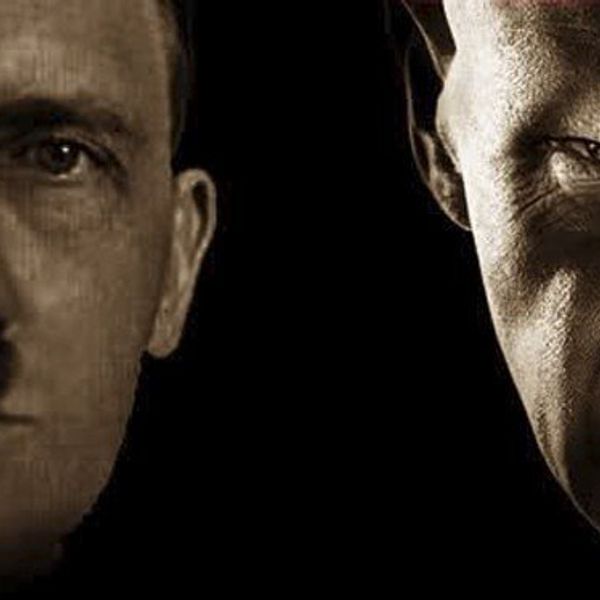
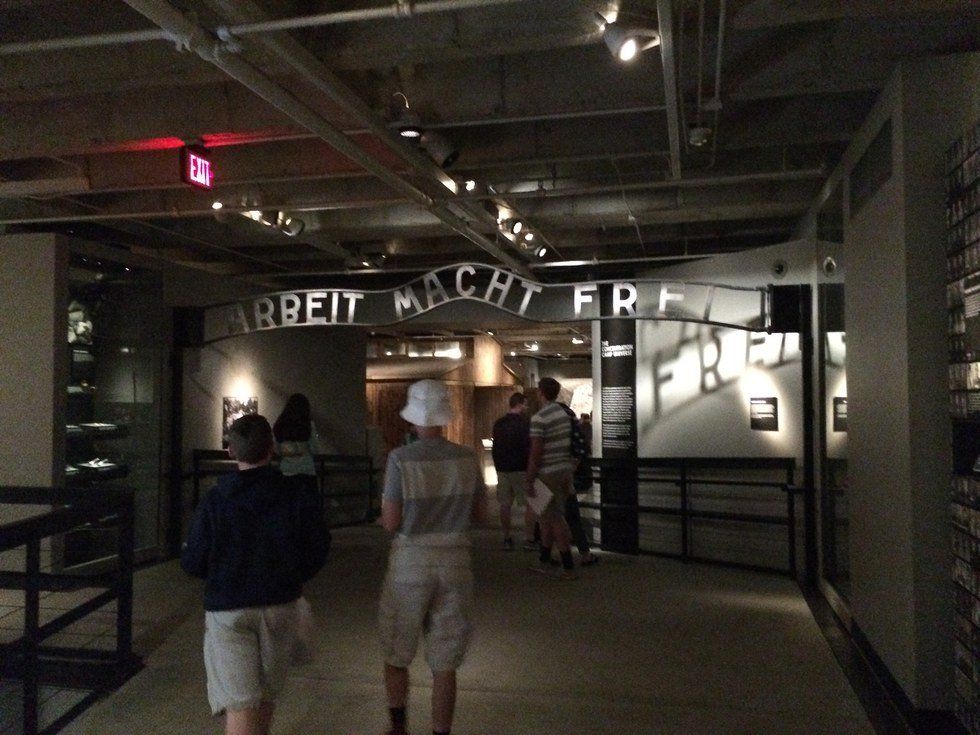
The horrors of the Holocaust are innumerable and sickening to think of. The sheer fact that more than six million men, women, and children were slaughtered at the orders of a madman is nearly unimaginable today. (Contrary to popular belief, the victims of the Holocaust were not limited to the Jewish people by a long shot. Other targeted groups included homosexuals, people with physical and mental disabilities, people of African descent, Jehovah’s Witnesses, etc.) But was Hitler really as mad as we say he was?
Depending on your opinions of literary analysis on the real world, the answer may surprise you. In “Thinking as a Hobby,” William Golding classifies people into three different groups depending on their “grade” of thought which denotes how “basic” they are. They are, from lowest to highest, third-grade thought (or the emotional girl that always has her mascara running), second-grade thought (or the hypocritical backstabber), and first-grade thought (or the overachiever who gets all of the awards). Typically, people only fall into one level or maybe two, but it is exceptionally rare to find people that fit into all three.
Let’s start with the lowest and most basic level of thought, third-grade thought. This level consists of 90 percent and occurs when people act solely upon their emotions. This seems to fit Adolf Hitler like a tailored suit. For proof, look to the massacre on the night of June 30, 1934. Hitler, who was already the Chancellor of Germany, became increasingly paranoid about the matters of state (such as blaming the burning of the Reichstag- the German Parliament building- in February 1933 on the German Soviet Party) and used his influence to convince the president von Hindenburg to restrict the rights of the people. But on June 30, 1933, he finally snapped and the product was the “Nacht der langen Messer” or the “Night of the Long Knives.” Afraid that some members of the Nazi Party would become too powerful and would try to overthrow him, he ordered the savage eradication of a significant number of his own supporters. The most notable target was the predecessor to the SS- the SA- and its leader, Ernst Röhm. In doing so, Hitler demonstrated the third-grade of thought by letting his emotions overtake his rational thought and murdering his supporters, with no regard to the possible support they could have given him. Although it doesn’t really matter in the long run, considering he would become the sole leader of continental Europe and parts of Africa.
Next we move to second-grade thought, which is the detection of contradictions. This is something Hitler was quite of fond of. In one notable instance in January 1942, he was noted to have said about these United States; “I don't see much future for the Americans ... it's a decayed country. And they have their racial problem, and the problem of social inequalities ... my feelings against Americanism are feelings of hatred and deep repugnance…” (Shirer, William L. The Rise and Fall of the Third Reich: A History of Nazi Germany. New York City, New York: Simon & Schuster, 1960. Print.) Not only does this show how he pointed out contradictions, but it also shows how hypocritical he was… Just some food for thought.
And finally, we have first-grade thought, which is made up of those who see problems and actively set out to fix them. In this case, the problem being the many targeted groups I mentioned before. Although feelings of hatred against these groups (i.e. homophobia, antisemitism, racism, etc.) have a long history in Europe dating all the way back to the Middle Ages and the Crusades, the Nazi Party took it to a whole new level to enforce the “final solution” spear-headed by the Führer himself. In dark, cramped, disgusting cattle cars, these people were ripped out of the life they knew and were essentially shipped into the hell that was the Nazi death camps. Some of the most infamous examples include Chelmno, Sobibor, Treblinka, and the largest of all, Auschwitz-Birkenau. Here, under direct orders from the highest reaching officials in Nazi Germany, the officers of the camp would gas, shoot, and cremate thousands of people on a daily basis. And while the Auschwitz crematorium and ovens lie in ruins, the United States Holocaust Memorial Museum in Washington, D.C. has recreated what they may have looked like, shown below.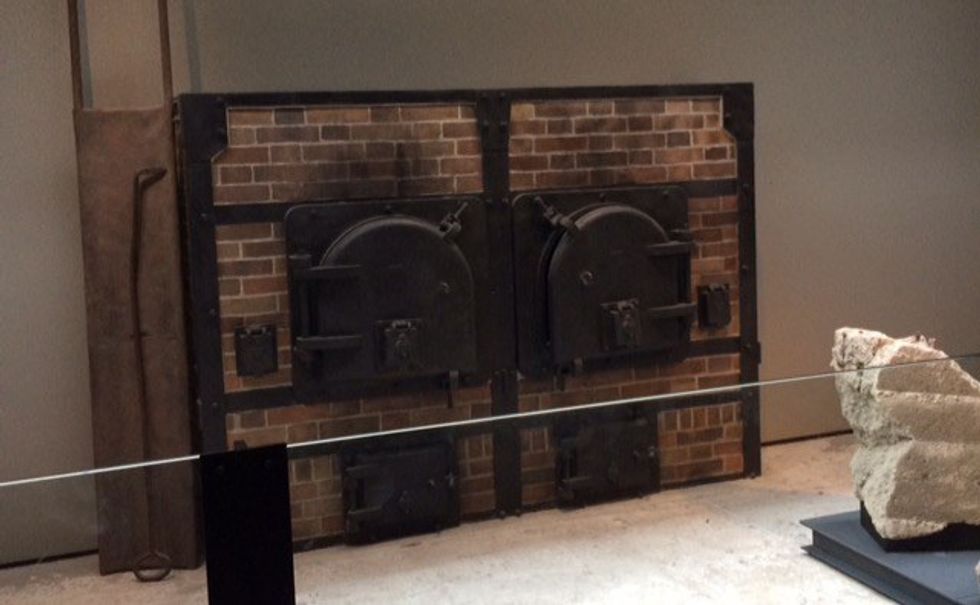

The simple fact of the matter is that Hitler saw a problem (albeit a very sick and twisted problem, but a problem) and actively tried to fix it. In doing so, he demonstrates his possession of first-grade thought.
As I mentioned before, most people only fall under one category, it is rare that people get two, and even more so for all three. The fact that Hitler falls under this exceptional category shows how smart he really was. Whether we call him Führer, madman, genius, dictator, or evil, we can all agree that he most definitely had a profound impact on the world. And regardless of our thoughts on that legacy, it’s still there, and those who fail to learn from it will be destined to repeat it.















