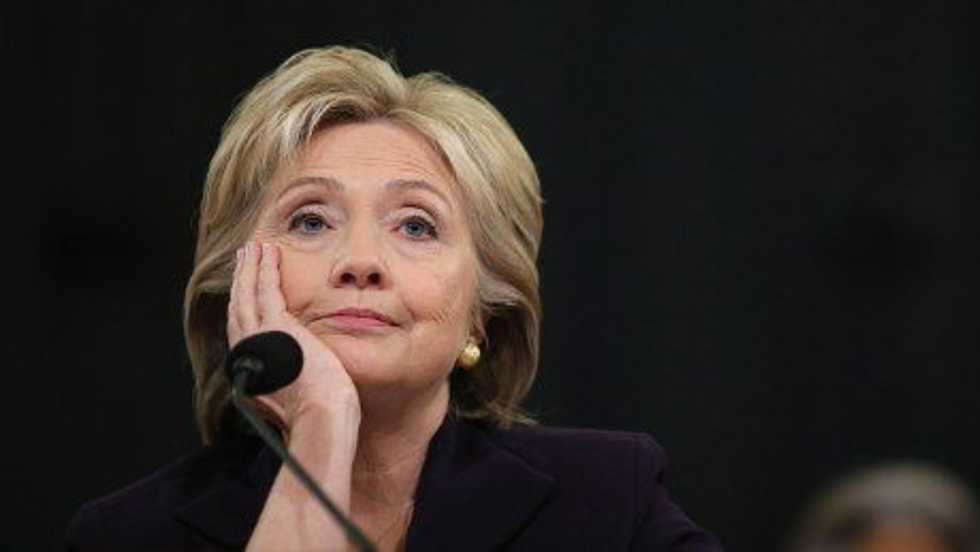
As this season of primary politics reaches its solstice, campaign rhetoric has evolved past pandering, solidifying into narrative. For the Democratic Primary, Hillary Clinton and Bernie Sanders have both escalated their rhetoric, grasping for a slam dunk to change the race entirely. Sanders has won six straight primary battles, but still needs a substantial number of the remaining delegates to capture the nomination. Clinton, on the other hand, is trying to capture a strong victory in New York and the remaining states, putting the race out of reach before the end of April.
Notably, Sanders has recently asserted what many of his supporters have voiced: that Hillary Clinton is not qualified to be President. This is a somewhat extreme attack directed at a former Secretary of State, but it seems to be the culmination of rhetoric and sentiment that's festered ever since Sanders became the clear alternative for the Democratic nomination at the Iowa Caucus.
Clinton's knowledge of foreign policy has in the past dwarfed Sanders on the debate stage, and to counter this Sanders has asserted that having experience and demonstrating proper judgment in foreign policy matters are two different attributes. That being said, there's a difference between disagreements in judgment, which is basically a policy disagreement, and asserting one's opponent isn't qualified for the presidency over that disagreement. This is the sort of banter one would expect between Republicans and Democrats, across partisan lines, not in the midst of a primary between two long-tenured politicians
It would seem that Sanders is attempting to cultivate votes through anti-Clinton and anti-establishment sentiment. We have all heard, after all, that Clinton has strong ties to Wall Street, that she's something of a "War Hawk" in voting for the Iraq War, and she has Political Action Committees ("super PACs") that fundraise millions of dollars for her candidacy. Her husband, Bill Clinton, as President in the 1990s passed bills that paved the way for mass incarceration and gutted welfare. All of these facts, well known by Sanders's strong supporters, tied together suggest that Hillary Clinton is not qualified to be President. In this sense she isn't a progressive, she's bought by Wall Street and the 1 percent, she's going to cut funding for social programs, bomb other countries on a whim, and if elected president she'll turn into a wolf in sheep's clothes just like her husband.
This narrative, though not outright announced by the Sanders campaign, is a strong sentiment held by those on the left who oppose Clinton. Unfortunately, this narrative applies a standard toward Clinton that no other Democratic candidate for president has ever had to live up to. This created standard is based upon a naive understanding of how the American political structure has ever functioned and ignores how it currently functions.
The Federal Government Is Not Designed For Revolution
One of the attacks directed towards Sanders and his supporters is that they are unrealistic and too idealistic. Though they may hear this attack as saying "it's futile to pursue policies that alleviate poverty, proliferate healthcare coverage, etc so we should not pursue these things," that is not the point. At the foundation of the Sanders platform, and transitively the logic of his supporters, is a misunderstanding of how political change is made in the United States.
Namely, popularity is not what gets laws passed. Saying a candidate has a class of people's best interest in mind does not mean they'll vote for that candidate or support his or her agenda. The legislative branch of the federal government is shaped in such a way that only laws of consensus and coalition pass. In this sense, electing a revolution is nonsensical. Revolutions by their very nature are radical and rapid, causing change overnight through a strong consensus of numbers supporting those changes. Though Sanders may see great numbers supporting him on the campaign trail, he does not have the majority of the Democratic Party supporting him, whether that be among voters or members of congress. Further, one doesn't see an army of Sanders's Democratic Socialists running for congress this cycle, let alone many with a chance of winning and establishing hegemony.
Clinton is often criticized for not championing the same progressive policies as Sanders, namely single-payer healthcare and universal public college education. What's lost on Sanders supporters is that Clinton has said on multiple occasions that she supports the principles of universal coverage, among other things. Her pragmatic philosophy of political change isn't a principle in itself, so much as it is a reaction to a Republican controlled congress that has blocked every progressive reform it could since even Bill Clinton was president. Clinton has learned the hard way that politics is a game of compromise and being hyper-ideological does not accomplish that.
The Democratic Coalition
The Democratic Party has never been a party in which a single ideology dominates. The party's main constituency today comprises of college educated women, people of color and ideological progressives, to name just three. Though there is overlap between these factions, to project Sanders's "wing" of the party (it's worth noting that he actually isn't a part of the party) as the ideological standard is to ignore the entire structure and history of the party.
In this sense, the Democratic Coalition exists not to establish an ideology, but to pass certain policies through congress, whether they be for new social programs, protections for minorities, protection of women's rights, environmental regulations and so on. Democratic voters as a group in this way have historically voted for a platform of issues and not an ideology.
The Republican Party, in contrast, has been an increasingly ideological party. Factions such as the religious right, neoconservatives, and fiscal conservatives have in the past thirty years or so supplanted themselves as the ideological litmus test for the party. To be considered a Republican and not a RINO (Republican In Name Only) a republican running for office has had to appeal to the principles of religious conservatives, the free market, and of military strength.
It would seem that Sanders is attempting to create a culture of ideology in the Democratic Party much like that of the Republican party, in which one has to give lip service to progressive policies to be considered a legitimate party member or progressive. Regardless of whether or not this is a good strategy, it's definitely an unprecedented one.
The Democratic Coalition's Historical Shortcomings
Though people of color are today a strong faction of the Democratic Coalition, it wasn't always that way. Notoriously, the coalition in the not-so-distant past comprised of white southerners who supported progressive programs so long as they didn't help people of color. These "Dixiecrats," racist as they were, helped implement Franklin Roosevelt's New Deal and Lyndon Johnson's War on Poverty. They slowly left the party after Lyndon Johnson passed the Civil Rights Act and upon the Republican Party adopting dog whistle talking points.
In 1992, at the twilight of the Dixiecrat's influence on the party, a young Democratic governor from Arkansas named Bill Clinton was elected President of the United States. Though Clinton himself could not be called a Dixiecrat in his own right, he and the Democratic Party in the 1990s certainly benefited from the Dixiecrats' long-time political loyalty to the Party, winning six of the former confederate states in both 1992 and 1996. To put things in perspective, since 2000, the Democrats have only won five states from the former Confederacy in all four elections combined.
As President, Bill Clinton faced difficulties governing. Clinton had to maneuver difficult political circumstances, including a Republican dominated congress. The end result was non-progressive legislation, including a now-controversial crime bill, welfare reform, and the Defense Against Marriage Act, among others. These compromises, often referred to as "triangulation" was a mechanism for Clinton to be re-elected in 1996. It's important to note that Clinton didn't receive 50 percent of the popular vote in either election, benefiting from Independent Ross Perot both times taking at least 8 percent of the vote.
Though Bill Clinton's policies are open for criticism, it's clear that his administration was strongly influenced by political circumstances. From the Republicans he faced a strong cultural hegemony of conservatism due to the fresh legacy of Ronald Reagan's presidency, and from his own party he had a shrinking yet still relevant faction of white racists to keep content. Say what one wishes about Bill Clinton's principles and motivations, but it's clear that the political circumstances he governed under were much different from that of today. White southerners outside of North Carolina, Virginia and Florida are not a demographic the Democratic Party cares about today. It's easy for progressives and Democrats to look back at the failures of Clinton with contempt, and there's much to be contemptuous for, but holding him to the modern standards of the party is not a fair criticism, given the alternatives of the time were much worse.
Hillary's Problem
What's even less fair is to hold Hillary Clinton responsible for the political decisions of her husband or to invalidate her qualifications based upon the principles of one faction of the party. To be clear, there is much to be critical of Hillary Clinton for if you're a liberal or a Democrat, from her support of the death penalty to her position on Syria as Secretary of State to her vote for the Iraq War as a Senator.
What isn't a valid criticism is her close ties to big business and use of Political Action Committees. Though it fits perfectly in the narrative of Sanders and Progressive Purists to say she's bought and sold by the 1 percent, what they neglect to mention is that every successful Democratic presidential candidate (ever) has had to collude and make compromises with big business in order to be elected, Barack Obama included.
It's refreshing to see criticism of the influence of corporate power on politics become part of the mainstream political discourse. Though the connection between big business and politics may be problematic, it's not fair to say that it's a problem exclusively embodied by Clinton. She should not be condemned for lacking what makes Sanders unique as a candidate. At base, these criticisms of Clinton is that she isn't Bernie Sanders.
It's even less fair to assert that, due to Bill Clinton's triangulations in the 1990s, we can expect the same thing from Hillary Clinton. After all, Hillary Clinton is a different person from Bill Clinton, and the political climate she would inherent as President is much different. It may be a valid criticism that she has not led on issues pertaining to LGTBQ+ rights or racial justice until it was politically convenient, but it isn't valid to say that she'll flip flop from these stances once elected.
Bill Clinton did not run on a platform of racial justice or LGBTQ+ rights, nor was racial justice a solidified part of the platform as it undoubtedly will be in 2016. Technically, he didn't flip flop on his core principles so much as he found common ground to get re-elected, as all politicians do. There's a difference between a politician running for office on one issue and changing a position after being elected and changing a position in order to be elected. For the latter, it's political suicide to flip flop after making that political decision. These are the decisions we're seeing Clinton make right now. At the end of the day, does it really matter if Clinton is being politically opportunistic so long as she sticks to the principles she's running on while in office? To say she is definitely going to flip flop after being elected is an assertion that can't be falsified. We can say that of every politician, but for some reason people "especially" believe it of Hillary Clinton.
At the end of the day, Hillary Clinton's success as a candidate lies in being an experienced Secretary of State and eight-year Senator from New York. Her failures lie in being a politician, being married to Bill Clinton, having similar ties to Wall Street as other Democratic politicians, and being a candidate fitting the historical mold of the leader of the Democratic Coalition. At base, she's the strongest candidate the Democratic Coalition could offer at a time in which political institutions are not popular. Though both her critics and her supporters will create a standard to validate or invalidate her candidacy, not all standards or criticisms are valid. Clinton is not perfect, but she isn't the boogeyman either.