


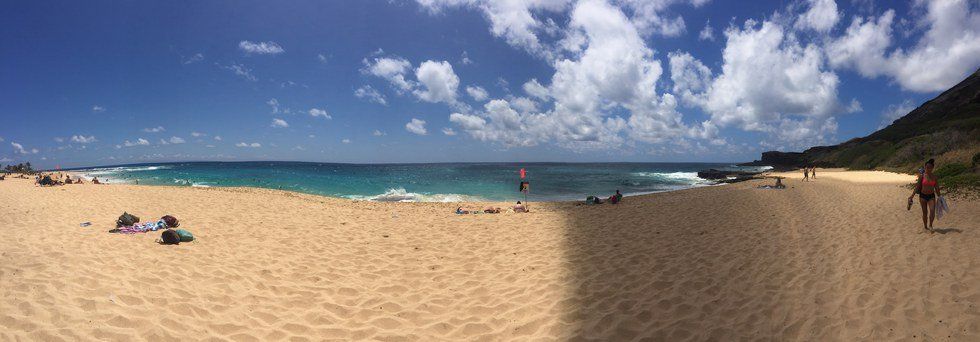
Let's start off by saying this: I am from Hawai'i, but I am not Hawaiian.
No, it is not the same as being a Californian. Hawaiian is an actual ethnicity, unlike The Californians sketch from Saturday Night Live. It's a silly sketch that has me laughing every time and depicts the stereotypical life of a California-native. But what most people don't understand is that the Hawaiian culture is quite rich in its history, and I wouldn't claim it as my own ethnicity.
I am a mixed-plate — someone who has multiple ethnicities. However, I am not exactly 100 percent sure the specifics due to the disagreements my relatives have with where our ancestry lies. I do know I am Filipino, have Spanish blood, have European ties (English and Irish), and am perhaps Chinese or Japanese — some of the family says one thing, some say otherwise.
Even though I am all of those ethnicities, I didn't exactly grow up in all of those cultures. Filipino culture? Absolutely. American? Well, duh. Spanish, English and Irish? Not so much. And of course, living in a state where diversity is present from the moment you step off the plane and into the airport, has exposed me to both Chinese and Japanese culture. Of course, knowing a lot about Hawaiian culture is a given as well.
It was very common for me to celebrate Chinese New Year and Japanese Girl's Day, eat Portuguese sausage and malasadas, do various styles of Polynesian dance and also listen to reggae-influenced music. The list can definitely go on, and I am proud to say that I grew up knowing about these different practices of culture.
That multiculturalism also includes the religion I practiced (Catholicism) and the military lifestyle my dad raised me on. These two helped shaped certain morals and beliefs and helped me live off a 24-clock as opposed to the typical 12-hour one. All influences I've had makes me who I am, and I can't imagine what it must be like to only be used to one culture.
I am a local girl, born and raised on the island of Oahu, where it's more surprising to just be of one ethnic background than it is to not have enough fingers to count them all.
It's not just about eating at a Japanese restaurant and enjoying various Americanized versions of sushi--it's knowing that slurping your soup isn't disrespectful. It means you are enjoying your meal.
It's taking your shoes off when you enter someone's home, and leaving them at the door. It's meeting an elderly Filipino grandmother, taking her hand, giving her a blessing by touching her hand to your forehead, and saying "mano po."
It even means that you are automatically expected to refer to your friend's parents as "Aunty" and "Uncle," none of that Mr., Mrs., or first name BS. Oh, and if they offer you food, you sure as hell better take it; It's disrespectful not to.
Also, putting pineapple on your pizza does not automatically make you "cultured." Sure, your pizza is a little more tropical, but it doesn't mean it's Hawaiian food. Try kalua pig some time if you want to be a little more authentic.
You see, growing up multiculturally means that I learned a lot about other ethnicities and their particular practices within their culture. I was fortunate to be able to partake in these things in my daily life without even thinking twice about it. It's second nature to slip into a relaxed speech with my roommate, specifically the Hawaiian Pidgin English language, which is now officially recognized as one.
Though I may not be Hawaiian, Samoan, Portuguese, Korean, or other ethnicities prominent in Hawai'i besides the few that I am by blood, culturally, I am all of these. There is a difference, and unfortunately people in my lifetime have had a hard time understanding this.
Hopefully, now, you can also better understand growing up in a very culturally diverse, but beautifully melted-together environment. It's a blessing, and I can't imagine life not knowing all I do.
*Bettah respect dat, bumbai you going get lickins from braddah ova dea.
*Use the Hawaiian Pidgin dictionary to translate.

















