
Recently, the conversation about a citizen's right to privacy and the governments demand for information has been ignited. This has been a topic discussed on and off since digital information became more prominent. Cases such as the one involving Edward Snowden have been pivotal in the national conversation. This time, the conversation is between Apple, a reliable company that most of us trust with our information since you are probably reading this on your iPhone, and the FBI, who we all trust to protect us.
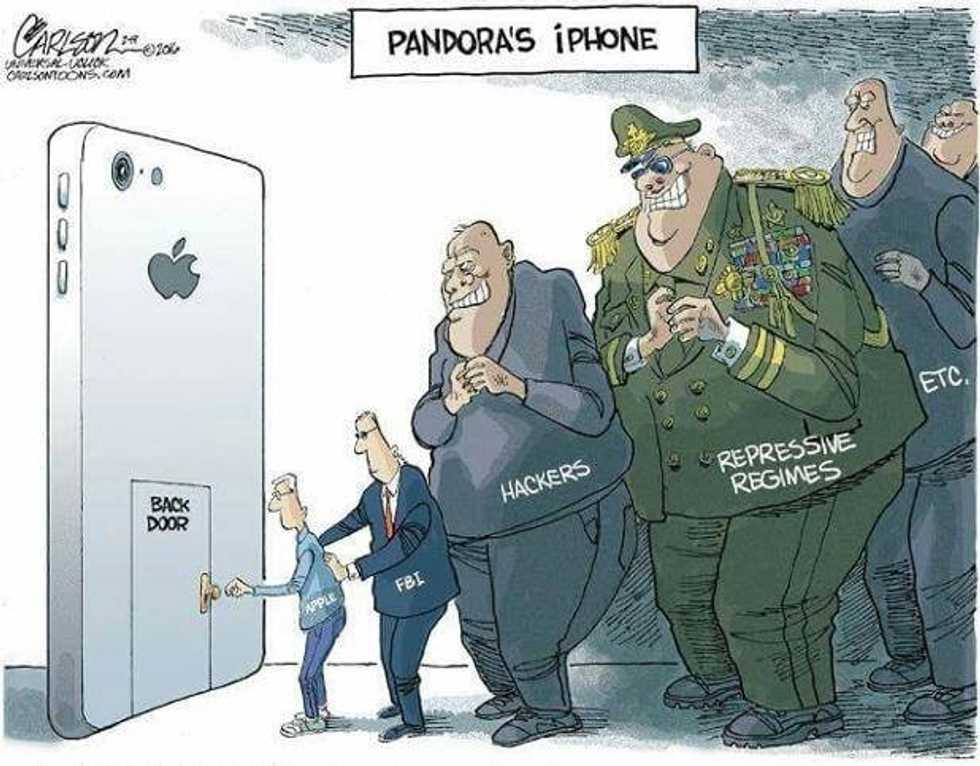
The Federal Bureau of Investigation has requested that Apple create a "backdoor" to the iPhone. The United States government has requested this because they need to circumvent the encryption of an iPhone recovered from the San Bernardino case. A letter written by Apple's CEO, Tim Cook, explains why they are refusing this court order to create this backdoor.
Before I explain what Cook says in his letter, I want to clear things up. Apple is not refusing to give information to the FBI. Apple has been helping the FBI with everything they have asked for up to this point. Apple has given them all the data they have on the phone, including a backup of the iPhone in question. They still offer suggestions of how to get information from the iPhone. Apple has extracted data under a court order, but only for operating systems before iOS8 (iOS9 is the iOS on the iPhone in question).
Tim Cook explains in his letter what the court order really asks. The FBI is demanding data from an iPhone that is tied to one of the terrorists in the San Bernardino attack. However, they are wanting this data by demanding Apple creates a 'backdoor.' This would allow authorities to circumvent the encryption that makes it so difficult to get information from an iPhone.
If Apple did comply, this kind of software can't be created by simply tweaking the current iOS. They would need to start from scratch. In order to actually create this "GovtOS" as Apple refers to it, roughly six to ten Apple engineers would need about four weeks to do so. This would require numerous requirements such as writing and testing a new code, preparing proper documents and security testing.
Some have asked if Apple could just create this new system and apply to the single iPhone. Cook explains that when you create something in the digital realm, it can never be fully removed. Once the technique is created, it can be applied to any number of devices, any number of times. This would then allow any individual with the capabilities of advanced hacking to easily hack into not only the iPhone in question, but the iPhone you are reading this on and grabbing all of your information on it. This "GovtOS," if created, would be like a master key that could unlock banks, restaurants, homes, and stores. Anyone with this kind of access will abuse it.
Many argue that we, as citizens of the United States, have a right to privacy, and the government should be hands-off in requiring data. However, I would like to say that it is not necessarily a right, as so much a privilege of privacy. The data on the iPhone in question could help the FBI in determining many unanswered questions about the San Bernardino attack, but they shouldn't punish the American people by forcing Apple to create a backdoor so they can access anything at any time.

















