


The title of this article may be slightly misleading as it would probably be very unlikely that the male population would just cease to exist. However, I do think it could provide a very interesting change of perspective on the idea of "male necessity" within a species. So.... what does that even mean?
Well, to start, the two sexes that we all know about are the "male" and the "female". Seems fairly simple, right? What’s easy to notice is that the 'male' stays constant in both of the titles. Because it is consistent in both of these names, one would think that the male sex would have to be the default of the two. As I would like to demonstrate in this post, this could not be farther from the truth. In fact, there are certain species that remain alive today that are exclusively populations of females.
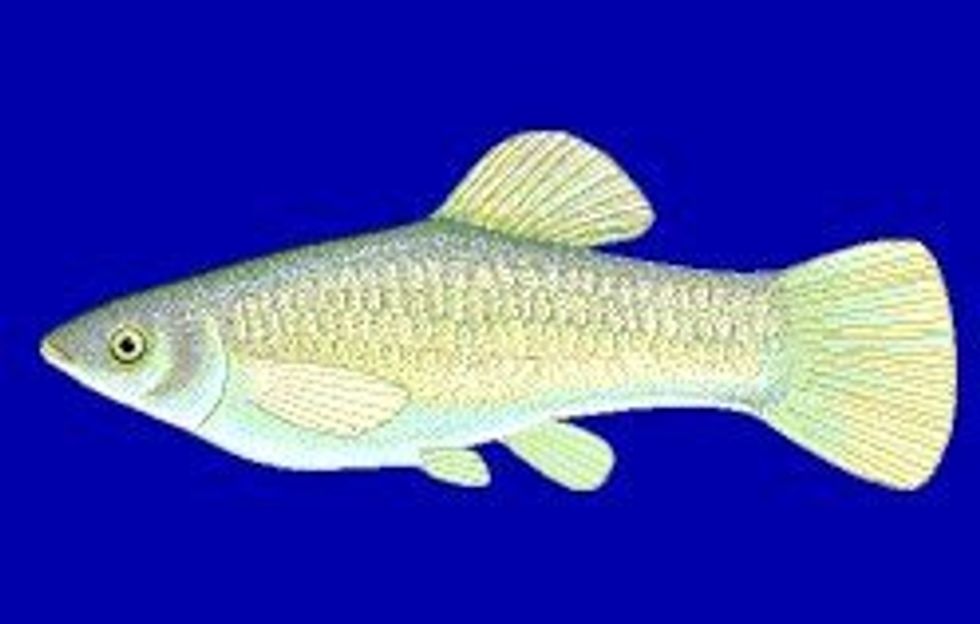
One of these species, Poecilia formosa, is not what you may think it is. It isn't a protist, fungus, or plant of any kind. Surprisingly enough, there are animals, chordates nonetheless, that are able to reproduce as clones. To clarify, a chordate is an animal that belongs to the phylum chordata and is characterized by its having of a notochord along its dorsal side during embryonic development. This will most often be replaced by a vertebral column as the organism matures (we humans are chordates). The Poecilia formosa or "Amazon molly" is actually an ancient species of fish that is native to northeastern Mexico and the southern United States near the Rio Grande. So how is it that this species is able to reproduce, and how has it had such reproductive success for so long?
The Amazon molly reproduces through a technique known as gynogenesis. Gynogenesis, or "bastardation" (as I like to think of it), is clonal reproduction that is stimulated by the sperm of another, closely related species. This form of reproduction differs from typical parthenogenesis in that sperm is necessary for fertilization, but it plays absolutely no role in gene influence of the offspring as the Molly's egg is already a diploid cell (2n). This leaves her with all the genetic material that she needs. Sadly enough, this biological phenomenon leaves the cloned offspring fatherless.
It's okay though; I have a feeling this fish doesn't feel too bad about it.
In nature, this species will typically abuse the reproductive potential of one of four different local species. These include the P. latipinna, P. mexicana, P. latipunctata, and occasionally P. sphenops. The sperm of each of these species is just closely related enough that it is able to stimulate the diploid egg of the Amazon molly. Given that the idea of reproduction is to make sure one's genes are successfully passed along to the next generation, these other species are almost betraying their own kind by taking a liking to the Molly. I think that the most interesting thing about this species is that is was ultimately more beneficial to their survival by getting rid of their male population.
What a good idea it was! The Amazon molly reaches sexual maturity anywhere from 1-6 months after birth and typically has a brood (batch of young) with somewhere between 60-100 fry (young) being delivered every 30-40 days. This lends itself towards a large potential for population growth as long as the host is present. This endows the community with variability in maturity. They become even better at reproducing in warmer temperatures (about 80 degrees F) as this usually correlates with larger food availability. Aside from the apparent fragility, is this the best method of reproduction chordates have ever had?
If human females are able to harness the magical power of parthenogenesis, will our species rise to new heights? Or would we die out? Well, I would argue that this, as seen in nature, is a very rare successful case. It is most likely that any species that evolved in a similar way would not be very successful.
One could think that the Amazon molly is consistently "walking on thin ice" because its survival is dependent open the survival of its sister species in the area. If all the males of the sperm-donating species were to be wiped out, this fish would not be able to produce offspring. Additionally, the biggest downside to asexual reproduction is the fact that there is no genetic variability in the population. There are no "better fit" individuals to rise up and fix the weak gene pool. Also, there is a problem that is known as "Muller's Ratchet". This so-called "Ratchet" states that within an asexually reproducing population, harmful or "deleterious" mutations are inevitably going to strike the population. Since there is no chance of this harmful mutation NOT being passed down because of their cloned offspring, this will eventually destroy the entire species. Nonetheless, they may be the subtle evil geniuses that have been able to pull off the biggest reproduction scheme in the history of eukaryotic life on earth and may soon take over all of creation!
That last sentence may have been a slight exaggeration. But anyway, how would a species like this even come about?
The Amazon molly is assumed to be a hybrid species of two of its closely related hosts. However, this theory lacks the specific evidence as to why this particular hybrid species has no male population. Another possible explanation is that this fish is actually a multi-generational hybrid between a variety of closely related species. As we know with hybrids, most of their F1 generations are infertile (For example, Mules are an infertile species). Because of this infertility, it would be very difficult for an F2 generation to be produced from the existing offspring. However, there is a rare phenomenon whereby only the females of the hybrid species are infertile, leaving the males perfectly capable of passing on their genes to the following generations. Because the male could contribute genetically, this led to a bigger diversity in the F2 generation. Because of this initial genetic diversity, the Amazon molly was more easily able to escape Muller's Ratchet. This theory goes on to state that the strongest of the offspring went on to eventually become the Amazon molly as evolution did the rest. Neither of these theories are perfectly sound, as I am still trying to grasp the concept of this crazy process.

















