


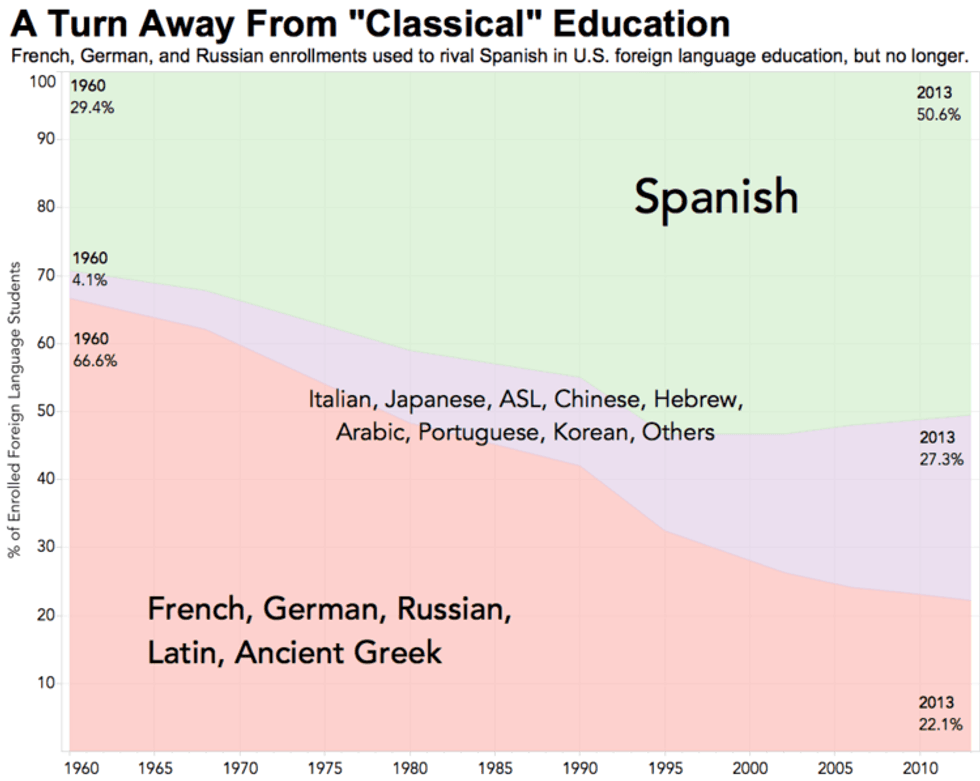
One day during the summer while I was cashiering, I noticed a man that donned a shirt with the flag of Québec on it. I greeted him as I did with all customers, asking if he found everything alright and how he was doing, and he told me that he was well. He put his items on the conveyor belt, and as I was bagging, I had a curious idea. I continued to bag his groceries but kept my idea to myself until it was time for payment. As he reached to get his debit card out of his wallet, I asked him, "Parlez-vous français ?" He was initially a bit surprised and taken aback. Most Americans, if they have an opportunity to take a foreign language, will pass up French in favor of Spanish. During the 1960s, Spanish is the "practical" choice of the two (since Spanish dominates the Western hemisphere), and some feel that it is the easier choice of the two languages (due to French's unique pronunciation and Spanish's simpler grammar).
The man and I connected instantly, and we started to speak in rapid-fire French. We talked all about Canada, where he lived in Québec, and my own visits to the province. He asked me where I would be going to college, and he was very attentive, even though my French was imperfect. He thanked me for being a wonderful cashier, although we only ended up talking for a few minutes. After he left, I reflected upon what had just happened. I had treated him no differently from my other customers. The only difference between this interaction and others was the connection that we made through language.

This is just one story of how powerful a connection through language can be. A common language serves as something much more powerful than a means of communication. A common language indicates a common identity, a common understanding of ideas, and as a result, a sense of mutual respect. Language is just one facet of culture, which is but a small part of social interactions. Even though it is still a small part of a larger whole, language serves as a vehicle that enables further cultural understanding. It broadens and matures one's mind, empowering individuals to find new means of self-expression. It provides this mature mind with new perceptions, ideas, and ways of thinking beyond the grasp of one's native culture. For according to a Czech proverb, "Those who know many languages live as many lives as the languages they know."
Unfortunately, language education in the United States is dwindling. Even though 93% of high schools offer foreign language courses, only 1% of American adults achieve proficiency in a foreign language that they studied. College enrollment in modern languages was down by more than 111,000 spots between 2009 and 2013, meaning only 7% of American college students are enrolled in a language course. There are efforts to revive this, of course, but language education seems to me like an afterthought in the American education system. Foreign language study often does not start until middle school or high school in the United States, compared to elementary school in most European countries.

Some feel that this is troubling because of how increasingly globalized society has become. Thanks to the technological gifts of the digital age, the workplace is far more interconnected and integrated now than it was during the 1900s. People from different cultures began to interact more often, which caused a changing dynamic in language interactions. Some languages rose to prominence, while others began to dwindle in popularity.
Globalization was certainly kinder to some languages than others. English rose to prominence as the "lingua franca" of business, and its influence began to disseminate around the world. Classrooms abroad took measures to integrate English education into the curriculum, resulting in the widespread knowledge of the language today. Some Americans feel no need to learn foreign languages before traveling abroad, as they feel that "everyone knows English." While the idea that "everyone knows English" isn't entirely true, this lack of pressure to learn foreign languages for Americans indicates just how prominent English has become.
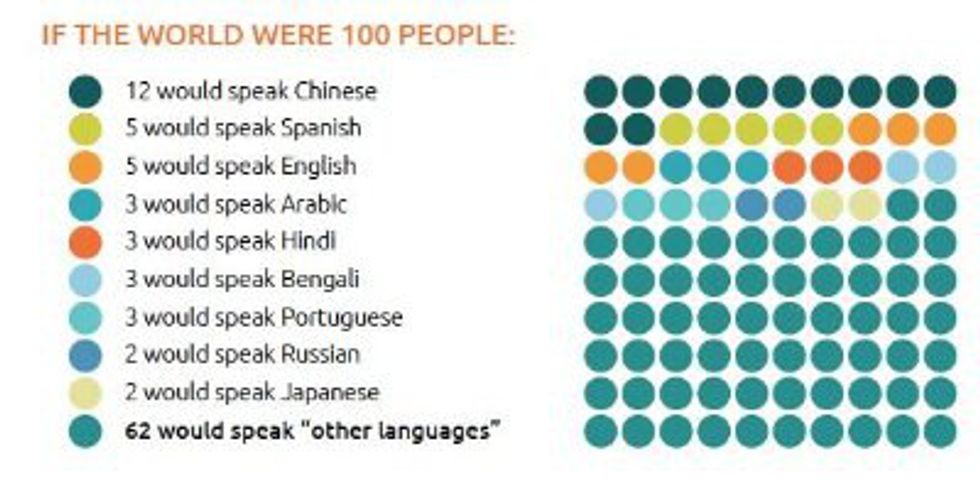
Despite English's popularity, the case still stands that foreign languages can expedite international business, communication, and affairs by removing cultural and communication barriers that would otherwise play into negotiations. Languages provide a cultural background and an atmosphere of mutual understanding before negotiations even begin. One can even make a case for reciprocity; since foreigners are learning English, it would only be fair for English speakers to learn a foreign language.
On the other hand, it is important to recognize the validity of the opposing viewpoint, that Americans do not need to as readily know foreign languages as Europeans or other cultures do. In Europe, countries are about the size of American states, and this proximity makes language learning even more imperative. Meanwhile, the United States is separated from economic powerhouses such as the European Union, China, and India due to the Atlantic and the Pacific Ocean. On a daily basis, most Americans will not need to know a language other than English. As such, many are not willing to invest the time and effort into learning or retaining a foreign language that may only be of occasional use to them.
Ultimately, learning foreign languages is an individual decision. It is up to each individual to determine whether learning a new language is worth the time and effort investment. Though I cannot make anyone's mind up for them, I urge everyone reading this to evaluate the importance of foreign languages in your career. I urge you to think of the opportunities that learning a foreign language brings, and whether the time investment that a language requires is worth attaining such a long-term enrichment in your life. If so, don't be afraid to surround yourself with that language and culture. Travel! Study abroad! Try a new food from that culture! Meet native speakers and don't be afraid to make mistakes! I wish you all very happy language-learning ventures, and until next time, ciao!