



Almost two years ago, Goodwill Ambassador Emma Watson gave a speech on gender equality for her HeForShe campaign.
“To date, I’ve seen my father’s role as a parent being valued less by society, despite my need of his presence as a child, as much as my mother’s. I’ve seen young men suffering from mental illness, unable to ask for help for fear it would make them less of a man… I’ve seen men made fragile and insecure by a distorted sense of what constitutes male success. Men don’t have the benefits of equality either.”
The team behind the 2011 documentary “Miss Representation” released the film “The Mask You Live In” in 2015. This April, the documentary was added to Netflix. “The Mask You Live In” discusses the struggles boys and men face fitting into America’s narrow definition of what it means to be a man.
The stigma most thoroughly discussed in the film deals with the correlation between emotion and weakness. Men are less likely to show empathy because they’ve been socialized not to by their friends, parents, and the media. Feelings have become negatively associated with weak and feminine qualities. Boys are taught that to “be a man” means to dominate, to control, to show no emotion, to use violence, to be a womanizer, to reject “feminine” qualities, to be athletic, to be economically successful, and to show no intimacy towards other men.
At this point, you might be thinking, “What do men's emotions have to do with feminism?” A feminist, to quote Chimamanda Ngozi Adichie, is “a person who believes in the social, political, and economic equality of the sexes.” In contrast, feminism is often associated with strictly benefitting the quality of life for women, without regarding how this will affect men.
Social gender stereotypes have placed men and women on oversimplified ends of a diverse spectrum that claims men must be aggressive and in control, while women must be emotional and submissive. Until feminine and masculine characteristics can be seen on a spectrum rather than two extreme contrasts, men and women alike will never be free. This is the true feminist movement: freedom from gender bias, and an embrace of the individual.
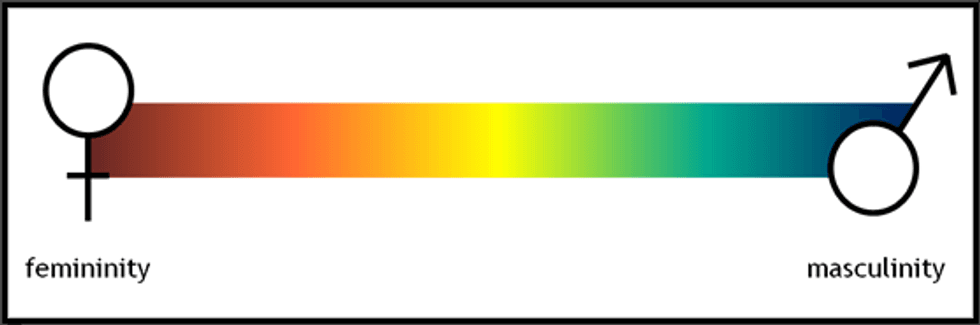
Dr. Lise Eliot and Dr. Michael Thompson from “The Mask You Live In” explain gender as a “social construct” that does not correlate with a human’s sex. The statistics presented in the film support the claim that “boys and girls are far more similar than different.” Masculinity and femininity are part of a spectrum that overlaps.
Despite the assumption that sex differences in the brain are hardwired, the brain has been proven to change based on experience. The hyper-masculinity and hyper-femininity that boys and girls are introduced to from day one help shape the feminine and masculine characteristics they adapt to. From the clothes they are dressed in, to the toys they are given, boys and girls quickly become aware of the construct they are being asked to fit into in society.
While there is still a lot of work to be done to create a level playing field amongst the gender spectrum, the fact that a film like “The Mask You Live In” shows a diverse range of men and women acknowledging that there is a problem shows progress. However, the progress will only continue if everyone agrees to be a part of the discussion. How many more generations of children will be oppressed before you decide to change the pattern?















