In the year 2010, Kanye Omari West was in a self-imposed exile. Alone on a Hawaiian island, he was mentally consumed by the image of himself imposed by the media and the depressive lows and manic highs he acquired from his celebrity status. Likewise, he was afflicted by his acute awareness of racial injustices that were quietly prevalent in his society. He was exasperated with his desires, his public image, systematic racism and himself. The maddeningly introspective phase West experienced while in self-inflicted exile caused him to create his fourth and most critically acclaimed album, "My Beautiful Dark Twisted Fantasy," which expanded the genre of hip-hop and music itself. Kanye West’s short film, dubbed “Runaway,” which accompanies his album, provides an effective visual of his purposes in creating "My Beautiful Dark Twisted Fantasy" by artistically revealing a glimpse into his disarrayed unrealistic desires, his dissatisfaction with his public persona, and his manic frustration towards society and its systematic racism.
“Runaway” was directed by West himself and written by his usual screenplay writer Hype Williams. It is an approximately thirty-minute-long short film that is accompanied by the majority of the album, "My Beautiful Dark Twisted Fantasy." The visual tells a strange, seemingly unrelated narrative of West and a celestial phoenix woman he rescues from the ashes of a comet. His relationship with the woman he rescues, the utopian society of the setting, and the overall visual aesthetic itself successfully highlight the outrageous desires and fantasies West has acquired after receiving virtually all this world has to offer through acquiring fame.
Additionally, the story of the celestial woman and her adjustment to her new world effectively parallel the experience of West as a new celebrity. Both are submersed in an unfamiliar, nearly alien, environment, and in this environment they are defined by their mistakes and differentiations from the norm. When asked about the film in a red carpet interview, Selita Ebanks, the actress who stars as the phoenix, stated that the general moral of the narrative is that the world typically rejects or attempts to adjust what is different in individuals rather than working to respect and embrace other’s discrepancies. Included in West’s anger towards society’s judgmental tendencies is an infuriation towards its statutes of systematic racism. West argues effectively, by using his film, that society should embrace incongruities in people to create a more diverse society with a variety of thought and experience.
The film opens with a chorus of angelic voices accompanied by violins as West frantically sprints down a road at twilight. The screen flashes black, and in fuchsia “RUNAWAY” appears in all capital letters. Then a comet is shown on screen, accompanied by Nicki Minaj’s voice as West’s “Dark Fantasy” begins to play. The comet hurtles down towards a forest of black trees through a sky full of a wide array of pinks. Meanwhile, towards the forest an MTX Tatra V8 speeds. Inside the car is West himself. As “Dark Fantasy” continues to play, the screen switches from views of West in the Tatra to footage of a young doe wandering throughout the trees observing the comet hurtling towards the earth with indifference. The opening scene effectively sets up a signature and tangible aesthetic that is followed throughout the whole film. The comet then smashes to the ground, speckling the forest with orange fire. West then parks the Tatra and approaches the wreckage of the impact, examining the unconscious body of a woman phoenix on the ground. He then picks her up and walks away from the forest as “Dark Fantasy” ends and the Tatra explodes in the distance.
The screen goes black and a newscaster’s voice is heard. The phoenix rustles as she wakes up inside a house on a couch. As she wakes, she confusedly approaches the television and simultaneously the newscaster begins to speak in a different language the viewer cannot understand. This first encounter with the unfamiliar, and the choice West made in showing a news segment, is a tool he uses effectively and deliberately to connect the phoenix’s experience with his own. The phoenix cannot understand the newscaster and does not comprehend what she or the television are. This clearly mirrors West’s early relationship with the media as a whole, full of misunderstanding and underestimating influence. For instance, during the 2009 MTV Music Video awards West interrupted pop star Taylor Swift’s acceptance speech for “Best Female Music Video.” The media took this outburst and ran with it, exaggerating the concept that West was inconsiderate and egotistical. After his outburst, West apologized profusely, but he was recurrently asked about the incident in interviews. Despite his best efforts, he would get visibly infuriated once more with the concept of Swift winning over his label colleague Beyoncé, causing more madness in the press. West realized, and continually realizes, through public blunders that he has to be watchful about what he says in the presence of the media. He parallels his experience with the media and the phoenix’s encounter with the television by explaining in a symbolic way that the media presses celebrities from all sides in order to create scandals and what the consumer observes from the outside is not always the truth.
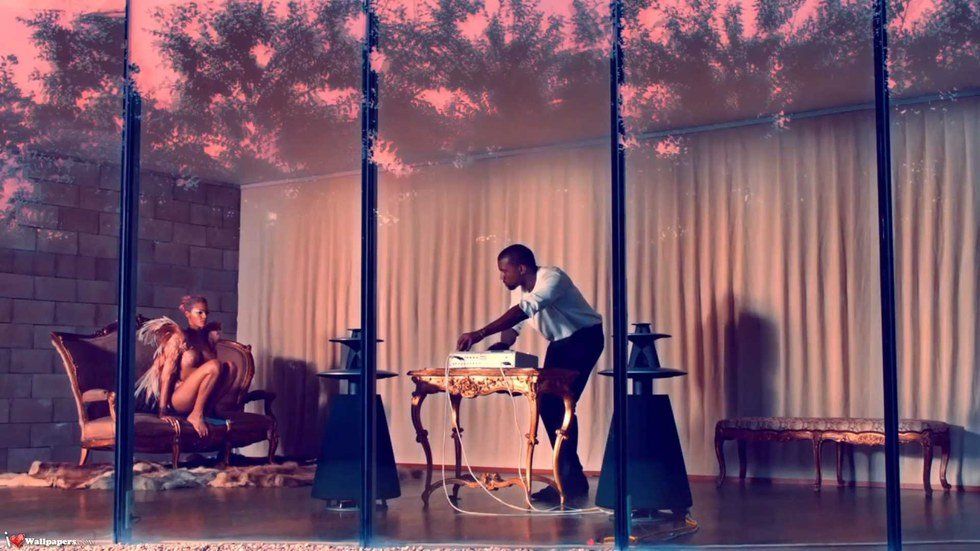
The video switches to footage of an explosion as West’s “Gorgeous” begins to play. The phoenix is then shown sitting in a small Garden-of-Eden-like courtyard as she examines the world she has landed in. West watches from a window in the house as the phoenix approaches the animals and plants in the courtyard with wonder. This is effectively symbolic of West’s first encounters with fame, exposing him to a stunning and seemingly perfect world which he had never seen or imagined before.
The next scene shows West playing a live alternate rendition of “POWER” on an MPC 2000XL sampler that he uses to produce the majority of his music. As he creates the song, the phoenix dances a strange looking bird-like dance. The scene changes quickly as “POWER” turns into West’s “All of The Lights.” The video then transitions to images of fireworks and an eccentric parade that West is orchestrating for the Phoenix’s enjoyment. West holds the phoenix’s hand as they watch the congregation of strangely dressed marchers and lavishly ornate elements.The beginning of the strange pair’s relationship and the elaborately unconventional parade effectively hyperbolize the outrageous desires and fantasies West has developed as he achieved fame and became numb to the everyday extravagant.
Included in the parade scene are undertones of racial subjects. Every member of the parade, musicians and dancers alike, is Caucasian. Additionally, included marching in the parade is a group of men dressed in crimson Klu Klux Klan attire. A young African American boy, who was earlier shown running unmasked with a beacon, is now filmed in a similar robe. The inclusion of these elements effectively communicate West’s continual infuriation with celebrated and inherit racism that is accepted as common in the white, and likewise to an extent, the black communities. These artistic choices by West unmistakably symbolize the effect of embedded racism in culture that causes young African Americans to inherently be ashamed of their blackness. Inclusion of these elements is an encouragement to the young black community to embrace their African American culture with pride, and to be aware of the embedded systematic Caucasian privilege that surrounds them.
West’s “Devil in A New Dress” begins to play as the scene switches to an enormous dining hall. Files of attractive African Americans dressed in white approach a white tableclothed banqueting table as six Caucasian servants line the opposite walls holding pitchers of water. The servants placed along the walls are effectively reminiscent of wealthy plantation homes in the early southern U.S. and the African Americans that would be standing similarly at every meal their masters ate. The deliberately chosen detail of the servants switches the role of black and white, and transparently displays West’s desire for an authoritative and intelligent African elite that overcomes societal norms of imbedded Caucasian power.
West arrives in the dining hall in a white jacket tuxedo, leading the phoenix by the hand. The other partakers of the meal whisper and stare at the strange couple, confused on what she is and why she is included in the elite group invited to the meal. The reaction of those at the table is effectively used as a symbol of the black community’s criticism of West’s relationship with his art. West is not typical as an African American artist, and frequently his music and image are not respected or understood by sections of his own community as much as he would wish.
Before the meal even begins, West then pushes his chair back from the table and approaches a straight back piano in the dining hall. He presses a key and plays an isolated sparse repetition of it, roughly the tempo of a heartbeat. As he plays the note over and over, the quick tapping of approaching footsteps starts. A swarm of Caucasian ballerinas in black tutus file into the room and into the open space on the opposite side of the dining table. Meanwhile, those at the table ignore West, besides the Phoenix, who is now turned in her chair observing the scene. This is further effective support that those at the table represent the sections of the black community that do not respect or understand West’s art. Additionally, it effectively adds a message that those who enjoy and respect West’s art are eccentrics themselves in order to understand it.
The sparse notes turn into the iconic opening of West’s title song “Runaway.” West deliberately chooses to play only this song to completion because it articulates his anger towards nearly everyone and everything in his life. As the song plays, the ballerinas begin to dance and those at the table continue to ignore as they eat, some even whispering to one another or plugging their ears. The only time the attendants of the dinner react to his performance is to raise their glasses as the song repeats for the second time, “Let’s have a toast to the douche bags/Let’s have a toast to the assholes/Let’s have a toast to the scum bags/Everyone of them that I know.” The song continues to completion then the ballerinas rush out of the room quickly, followed by the politely unimpressed clapping of those sitting at the dining table. The toasting of the feast party to the lyrics chosen effectively articulates West’s dissatisfaction with his peers, and additionally his frustration with trying to please his own community. He fervently desires to be a leader among African Americans; however, because of his discrepancies from the typical and public outbursts, he is often rejected by them.
West returns to the table and sits in his chair as the Caucasian servants bring out the main course of food. The phoenix is absentmindedly picking up berries from her plate when a large serving dish with a strange-looking cooked bird is set in front of her. West’s “Hell of a Life” begins to play as the Phoenix drops the berries and looks at the cooked bird with a horrified expression. Large wings behind her begin to flap and she screams loudly, making a screeching sound and causing all those at the table to plug their ears and hurry away. Meanwhile, an exasperated West puts his head in his hands. This reaction of the phoenix to the dead bird effectively symbolizes the way West himself reacts to those who doubt him. Frequently, he loses control publicly when criticized in interviews or by the media, and nearly always regrets his actions later. The connection is transparently communicated in the film in both aspects, by the contrast of the furiously horrified reaction of the phoenix and the solemn frustration of West himself.
“Hell of a Life” fades out as “The Blame Game” begins to play and the scene switches to an aerial view of the phoenix in the garden again, accompanied by a sheep and a young deer. “The Blame Game” then fades out as the camera view switches. “Can I ask you a question?” the phoenix says to West, as a view of their silhouettes atop a roof during a pink twilight is shown. She asks West where he thinks the statues that exist came from. Without hesitation, he answers that he thinks artists are the ones that make them. She abruptly interrupts him and says “No, they are phoenix turned to stone.” West chuckles at the phoenix’s reply, but she heatedly continues on in her explanation.
She tells West that the thing she hates most about his world is that “anything that’s different you try to change; you try to tear it down.” She continues her description, explaining how his world rips off the wings of the phoenix and turns them into stone. This exchange between West and the phoenix effectively elaborates on his purpose in choosing the plot of his film that accompanies "My Beautiful Dark Twisted Fantasy." West’s choice in storyline deliberately articulates his disturbance towards the tendency of society to reject what is dissimilar. This dialogue included near the narrative’s conclusion draws a direct parallel to the frustration West holds toward society and its continuation as an environment that is hostile to creativity and innovation in art.
The phoenix tells West that in order to not turn into stone herself, she must burn and return to her world.The “burning” of the phoenix signifies the future of rebirth. In the context of West’s film, this notion successfully connects to the public breakdowns and scandals West endured at the time prior to his self imposed exile as a type of “burning” of his original creative self. The symbol successfully represents how West was broken down by his struggles at the time before his creation of "My Beautiful Dark Twisted Fantasy," and was reborn as an artist with the album’s creation and release.
The closing scene begins with a camera scan from an areal view across the garden enclosure to the roof of the house, showing an unconscious West wearing a tieless suit and black velvet loafers. He stirs and sits up, confused and obviously looking for his phoenix. Realizing the situation, he immediately begins sprinting towards the woods, attempting to catch her before she burns and returns to her own realm. The camera switches between views of West frantically running through trees and the phoenix shooting through the air. Despite his racing, West is too late to keep his phoenix from parting. She shoots into the air, burning herself and becoming comet-like as she rockets away and therefore leaves West behind in his world.
The abandonment of West by his phoenix can clearly be extrapolated to once again symbolize the passing of West’s earlier creative self caused by the “burning” of his public image and surplus of criticism from his peers. This “burning” additionally fueled the frustration that allowed him to create the album "My Beautiful Dark Twisted Fantasy," which is the “rebirth” of his creativity and realization of his new self.
Many people do not take Kanye West seriously as an icon or an influential artist of his generation, despite his constant push towards breaking artistic confinements of societal norms. His frustrated rants and reputation as an egotistical maniac are a running joke. However, his insurmountable impact on modern contemporary art (including nearly every genre of music and also other areas of creative work) cannot be ignored. Additionally, he strides constantly to further empower the black community through his work and public pride in his label of blackness. West’s frustration is caused by his arrogance and determination to be appreciated by society and his own people. His infuriation with his environment causes him to have countless character flaws as a role model; however, it makes him into a complex and influential artist who creates ground breaking projects full of effective symbolism and unique beauty that translate into contemporary masterpieces.