
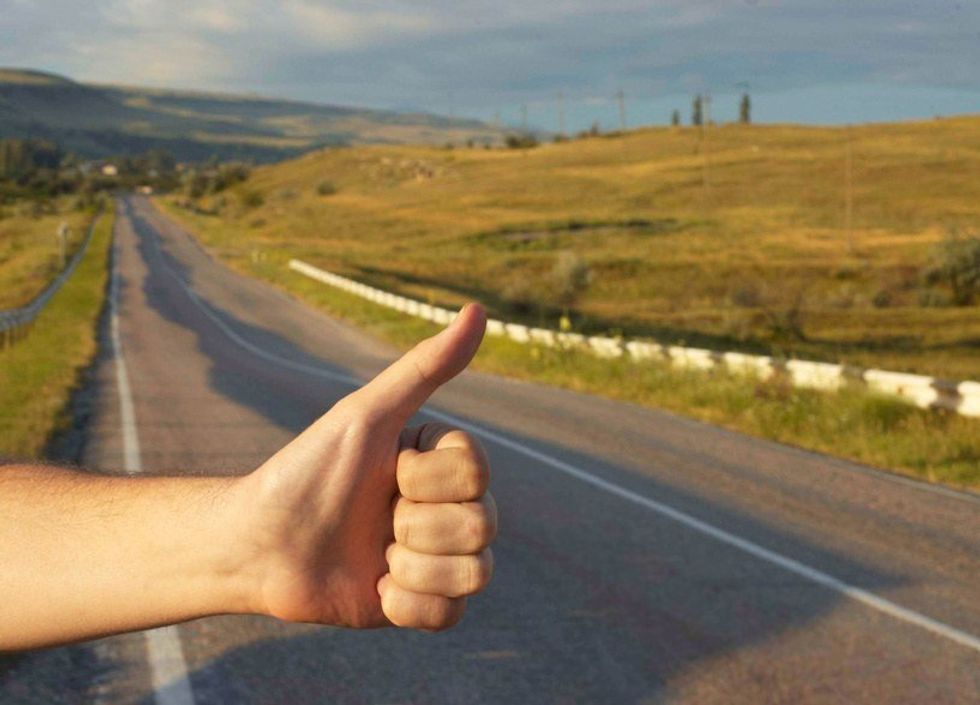
The key to my hypothetical axe murdering career comes, I think, from the fact that, by virtue of my gender, I am— so I've been told— wholly incapable of sustaining such a hobby. That is to say, my lady brain is too innately nurturing and my constitution too delicate and sensitive for such a violent pastime— and certainly my whiteness and cis-ness don't hurt such judgements regarding my capacity—or, rather, lack thereof— for violence. All this, of course, I have learned from relying on the kindness of strangers: after anywhere between five minutes to three hours of thumbing on the highway or interstate on-ramp comes the welcome but turbulent affair of the turn signal flashing from the decelerating vehicle as the window rolls down with variant degrees of tentativeness. The bag at my feet is hoisted up and the hat on my head pushed down firmly and the mind in my head is braced for the variety of responses that inevitably arise in response to the female presenting freeloader loitering by the roadside.
Disregarding the few outliers and individuals existing entirely off the spectrum, the range runs from the concerned, disapproving mother who insisted I must be looking for trouble by hitchhiking in a skirt (and that I would most definitely find it should I not give up the reckless ways so clearly unsuited to my gender), to the enthusiastic and encouraging old hippie couple on their honeymoon in the Appalachians, to the sexually aggressive and decidedly douchey musician who insisted that I was too cute to violently extinguish his life; and further that, if anything, it was I who should be afraid of him. Hysterical. Truly.
And usually, but not always, comes the confession that I was only rescued from the dusty hot highway shoulder due to my gender— specifically, my female gender (what is not ever voiced is the probability that I was also only rescued due to the paleness of my skin and conformity of my gender presentation). However, what womanhood means to these kind strangers (that is, the few times that I have been brave enough to ask such a question), is unclear, and the asking often brings a deal of confusion: the few responses have ranged from quizzical and affronted glances, to allusions of variant crassness to the presence of my female body parts, to the very occasional engaging conversation on the social construction of gender identity. Ultimately, though, the implicit message is clear: whatever the stuff that determines my female identity actually is, it also somehow makes me a safer human. Theoretically.
Of course, I'm not being entirely fair. Gender essentialist notions aside, my gender has assisted me in escaping an identity contingent upon the cultivation of toxic masculinity. And, having experienced varying degrees of sexual assault from a diverse cast of male characters, but never (personally— the hypocrisy of my claiming that women cannot and do not commit sexual assault does not escape me), to my knowledge, from a single woman or nonbinary person, regardless of trans or cis identity, I can empathize deeply with a worldview that sees strange men through an experientially constructed lens of suspicion and fear, particularly when that view is espoused by the women who are so kind as to take me along on the road with them.
I also acknowledge the harm that such a worldview does to male survivors of sexual assault, who already deal with a stark degree of invisibility and marginalization— thanks, of course, to patriarchal assumptions surrounding a male identity. This convergence of oppression is most certainly a "clusterf**k" as it were. And really, how strange it is that my gender, which so often serves to make life more difficult and— in some ways— dangerous (while at the same time affording me a significant level of privilege by virtue of my cis-ness), in this case brings me a degree of situational privilege over those with a male identity, even if this privilege is contingent upon a notion of gender which essentialness my identity and assumes me to be more nurturing and less violent on that basis.
It is in this difficult but not impossible quandary that the central purpose of this particular clusterf**k arises: that the dynamics of hitchhiking, the radical vulnerability which comes as a package deal when one relies on the kindness of strangers for transportation, never fail to reveal with a stark apparency the colloquial assumptions made by others regarding the meaning and nature of various facets of your own identity, as well as how the identities of said others influence how they react to your own identity. That I am white and a cisgender woman means that I find rides with relative ease wherever I go— at least in the United States. And although I have been touched deeply time and time again by the level of kindness and consideration shown to me by perfect strangers, many times— particularly when white Southerners are in the mix— it occurs to me that too often said kindness is contingent upon the relative safety felt by drivers when they see both my whiteness and my gender presentation, which awaken within them biases that assume a lack regarding my ability to care for myself— at least as compared to a baseline of perceived male strength. And although I often say that, contrary to what seems to be popular belief (given the reactions I receive from people when I tell them I hitchhike), most people in the world are not axe murderers, it is this gender-based and disproportionate assumption of my lack of capacity for or inclination toward violence that would make me an excellent axe murderer.





 man running in forestPhoto by