

In my junior year of high school I became a self-proclaimed feminist.
Before you go further into this article, I want to make sure that every person reading has a clear definition of feminism. If you're not sure what feminism is or have heard it associated with things such as "man-hating," here's a link.
I believe that I was unknowingly a feminist from a very early age. I certainly shared and supported feminist ideals but did not realize this until my teen years.
Growing up in a fairly conservative household, this does not come as a surprise to me. I was fairly sheltered which left me to figure out these things on my own.
Incredibly interested in the idea of feminism, I wanted to fully submerge myself in it. My entrance into feminism was like a hurricane of information.
I began researching every thing I could – from important feminist figures, to the poor representation of women in media, to the continuous battle for reproductive rights.
I adored learning about the previous feminist movements and the women involved in them, such as Betty Friedan, Gloria Steinem, Eleanor Roosevelt, Bell Hooks, and Maya Angelou.
After educating myself on the origins of feminism and the first and second waves, I researched modern day feminists and what people were doing in the world today to make a difference.
To my pleasant surprise, I found that feminists were everywhere in the media: Amy Poehler, Ellen Page, Nicki Minaj, Malala Yousafzai and Kate Nash are some of my favorites. Even male celebrities like John Legend and Joseph-Gordon Levitt were proudly claiming the feminist title.

This was incredibly inspiring. It helped me realize that people just like me, fighting for women's liberation, were everywhere. They do not pertain to a certain skin color, gender, social class or religion. Feminism was, is, and will always be open to everyone and affect everyone.
Once I came to this realization, I established myself as an intersectional feminist.
This is when my outlook on society and the world around me took a complete 360.
I began to notice how sexism invaded daily life. It worked it's way into almost every conversation and interaction. From comments like "you throw like a girl" to "stop being so emotional, are you on your period?!" I was dumbfounded. There were countless mini misogynists running around my school!
I was incredibly frightened by people's lack of awareness and respect. Sexism is still a big problem. How did I not notice this before?
When learning about feminism, I struggled with what I could do to make a change in the world. Sure, when I turned eighteen I could vote, and maybe someday I could fund a girl's education in a third world country, but what was I supposed to do in the meantime? The last thing I wanted to be was a lazy feminist.
As a single being, I felt that overcoming the war on women was not a feat for me alone. I think many young feminists share this feeling. I was simply overwhelmed.
Then I realized that I have a tool for fighting the patriarchy any time I need it.
This tool is my voice.
Instead of ignoring sexist remarks or letting misogynistic jokes slide, I use my voice and stand up for not only myself, but all women. Even if it is scary, even if I annoy people, even if I'm labeled as outspoken; I need to use my voice as a weapon in my daily life.
Many people that I have discussed feminism (among other political subjects) with, have claimed that speaking out doesn't make a difference, it just "bothers" people.
But feminism isn't about being comfortable. It's quite the opposite. We want people to question themselves and the patriarchal world surrounding them.
That's the point.
What people seem to not understand is that these "little" things contribute to the greater picture. Those "harmless" sexist comments you hear at your workplace and those objectifying cat calls towards a woman's body as she's walking down the street have a more extensive affect than many would like to believe.
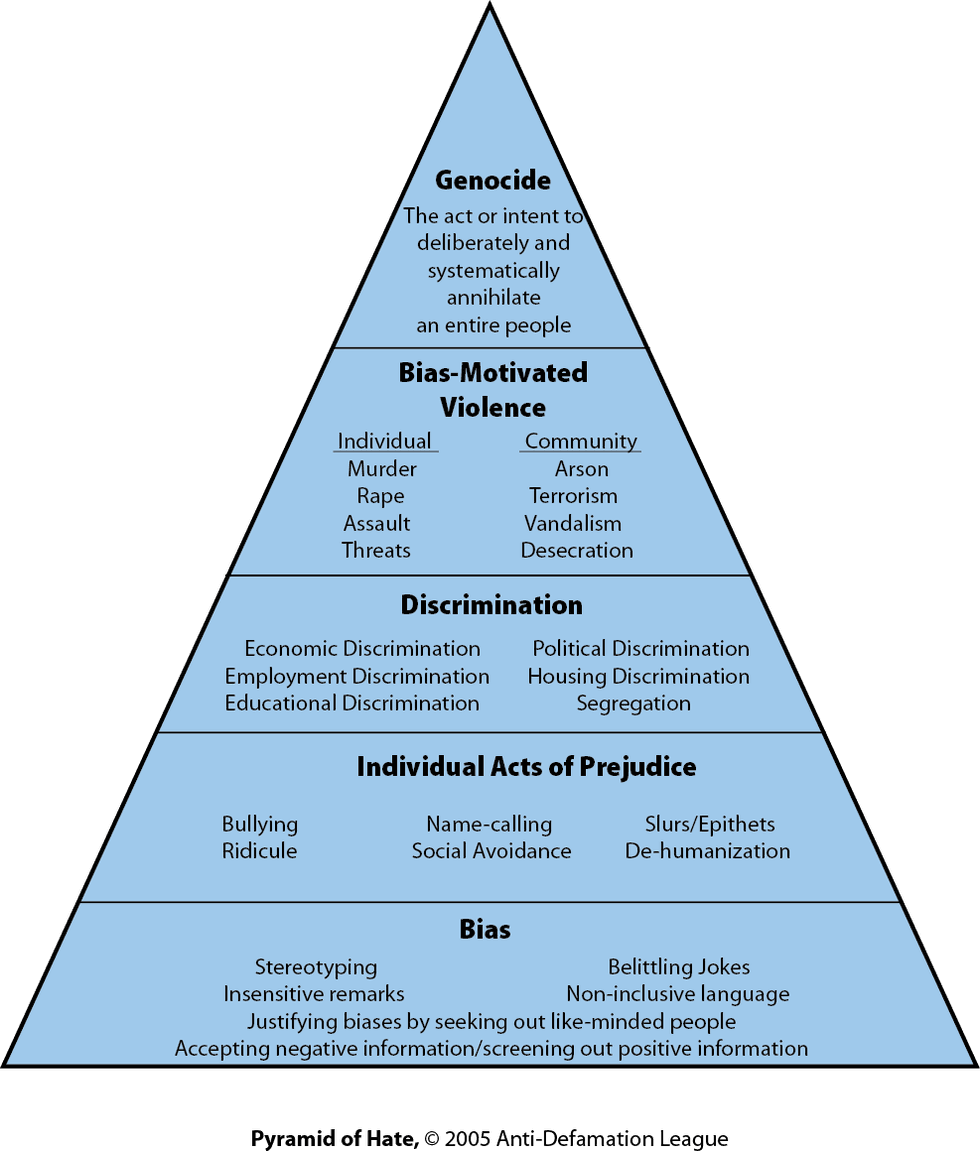
Featured above is the Pyramid of Hate, where stereotyping, belittling jokes, and insensitive remarks fall under the category of 'bias' at the bottom. Following the pyramid upwards, it is clear that these "minor" comments do make a big difference. They lead to discrimination and violence (which we already see among women in the U.S.) and end in genocide.
Sexism and misogyny begin with those biases, and they will not end until those biases are recognized and changed.
This is why it is so inherently necessary for myself and other like-minded feminists to stand up and speak out. This job isn't insignificant, it is vital to our survival.
To those people who doubted me, I have proved you wrong: I am living proof that speaking out makes a difference.
I have seen friends and family, not to mention people I barely know, make a change in their attitude and behavior because I stood up and said something like, "Hey, that's not okay." Some of them are even proud feminists now.
My fellow feminists are also living proof that speaking out makes a difference.
They are the reason I questioned beauty standards and the importance society places on beauty itself. They are the reason I will not allow men to decide my value. They are the reason I no longer slut shame. They are the reason I appreciate and support other women. They are the reason I respect and use people's preferred pronouns.
They are the reason I feel hope when I see strong women standing up for themselves.
We can never predict what people's reaction will be. It may be negative, but it also may allow someone to take on a new perspective, causing them to think more before they speak or behave like that again.
Wouldn't you find worth in it, if only to change just one person's mind?
Fighting the patriarchy means change. Change begins with one voice.
















