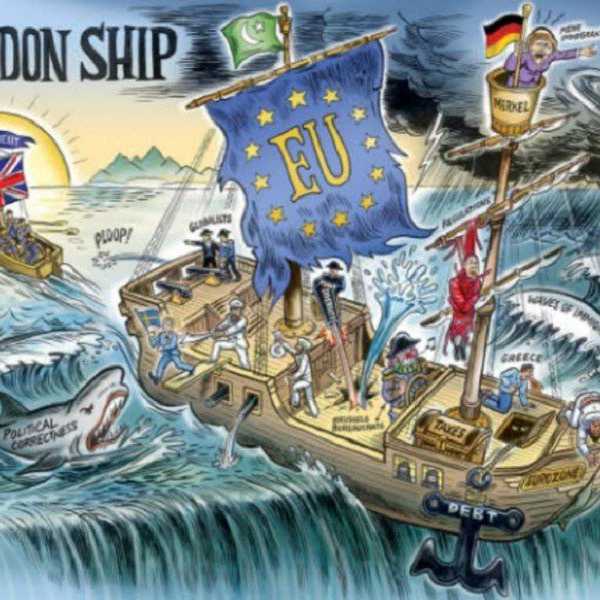
The European Union is facing an identity crisis. With the rise—and steep decline thereafter—of secessional mood swings stemming from threats of a Brexit or Grexit, a foreboding shadow teases the rise of a sequel to such rhetoric: The E(u)xit—the European Union exit. Since the 2014 elections, an influx of dichotomous parties and countries are fighting for control of the conversation raging in the heart of the union—its democracy—by skewing it into a series of ultimatums revolving around democracy and its political, economic, and social implications. This lack of cohesion sets a precedent that forecasts the inevitable ending of the EU through exacerbation of regional rifts coupled with blatant disregard of democracy.
While a union by name, the EU has clearly distinguished economically warring factions: the ‘core’ and ‘periphery.’ Core nations—Germany and France—are notorious for dictating policy objectives to their counterparts while observing blatantly contradictory policies in their own nations. While widely undemocratic in nature, the core is given the benefit of tyranny of the majority because of impartiality inherent within the EU’s voting system. Similar to the US House of Representatives, voting on implementation of policy is correlated to size of country—as such the grievances of ‘minority’ (periphery) countries are repressed. The EU has attempted to readjust this power imbalance through also creating a system of equal representation as seen within the US Senate. However, reputation has empowered core nations to bully their counterparts into overriding decisions in their favor, undermining the process of democracy while instead upholding a facade of voice.
This problem is being aggregated by a decisive split in the EU’s economic interests: core countries value exports while peripheries value imports. Consequently, core interests uphold a pressure to pass unionwide policies tailored to their economic strengths. A divergence in economic interests through policy often leads to key splits in economic identity. Take, for example, another union: the United States of America. In 1857, Congress was met at a crossroads between keeping economic stability through the unity of ‘The American System’ or independence through observing state rights. Northern and Southern factors threw around the contentious issue of a tariff as implementation would build one economy while destroying another. This is very similar to the crossroads Europe is facing; any decisive economic policy is bound to favor interests of either the core or periphery while crippling another. Yet, Europe needs to learn from its detractor: The US created policy based on compromise through incorporation of both interests. Europe, especially given the rise of extremist interests, needs to learn to balance compromise in the face of binary economies rather than granting concessions to a given party or country.
Unfortunately, it becomes apparent that the EU has morphed into a political bloc of democratic extremities—what created the EU may mark its downfall. Europe downplays its identity; created to fight the nationalistic identities that continually plagued the political atmosphere after WWII, states of varying political and economic backgrounds were thrown together in hopes of achieving a unified identity as to mitigate regional conflict. This formation is strikingly similar to that of the foundation of the US, where states like Georgia and Massachusetts unified not due to commonality but rather common enemy. Yet, the fates of these rivaling unions diverge when it comes to evaluating cohesion. The US, through the Articles of Confederation, understood that too much power concentrated at the state level led to instability. the EU has yet to observe the power of a strong central government, allowing for the politics of individual states to undermine the political success of the continental union. To seek political stability is to see an EU with a evolving but unifying political doctrine. Countries with more political clout shouldn’t crowd out their counterparts from voicing legitimate grievances as extremist factions are formed from consequence to garner attention.
Democracy is like a machine. While comprised of varying sized cogs and gears, all parts
must function for it to thrive. Unfortunately for the EU, a majority of its machine is disregarded
due to a lack of size; countries with less political clout are overshadowed for the monotony of
political giants like Germany or France. To uphold the EU is to uphold democracy: periphery
countries must speak out against their prejudiced injustice to bargain for oil for their parts to a
compromiseready core in hopes of political cohesion. However, if all members neglect to listen
and observe democracy in the context of their neighbors, an exit is eminent—the EU must
observe democracy or face dissolvement.