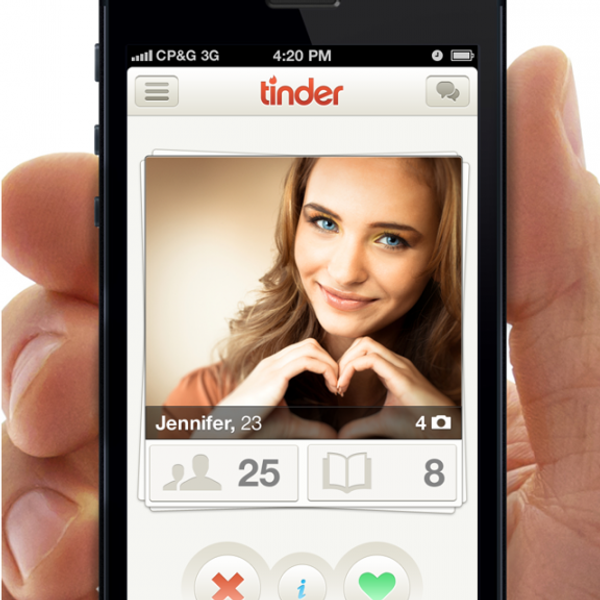
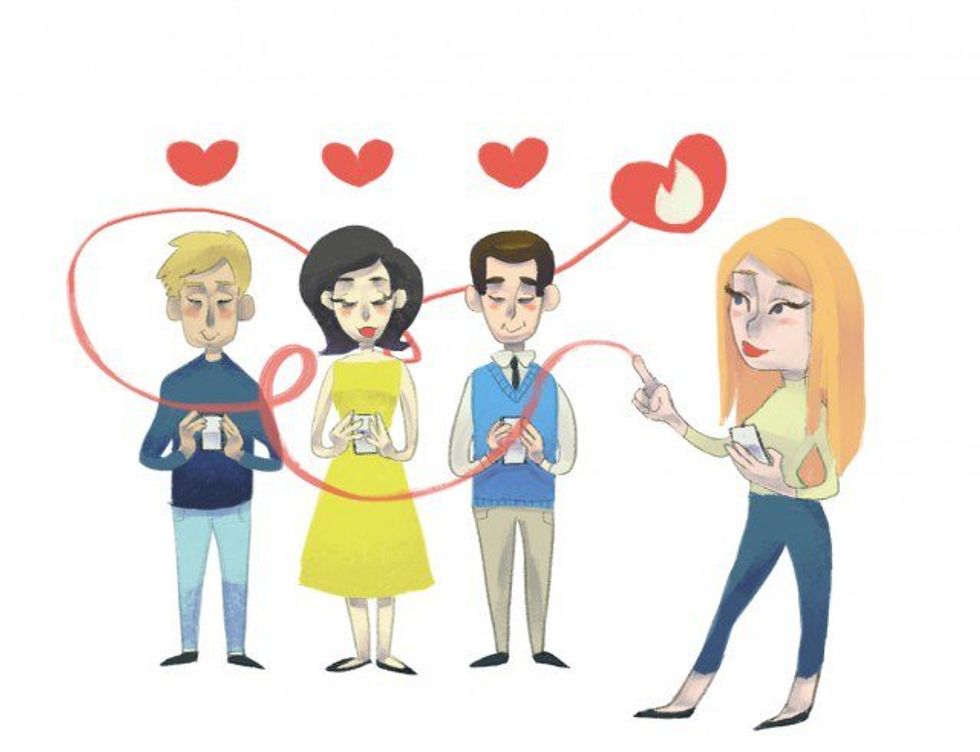
This year, I made the courageous and difficult decision to convert to Bumble from Tinder. God, I make my parents so proud. For those of you who live under rocks, Bumble is an app whose concept is very similar to that of Tinder. You swipe right for “hey” and left for “nay," but in Bumble’s case, women hold the key to major success. With each match, the female counterpart has 24 hours to make a move and send a message, while the men are forced to wait patiently. Two things about Bumble really drew me in. First, that Bumble is lesser known, and I wouldn’t have to worry about the entire student body voting on my “hot-or-not”-ness. Second, that I don’t have to commit to anything.
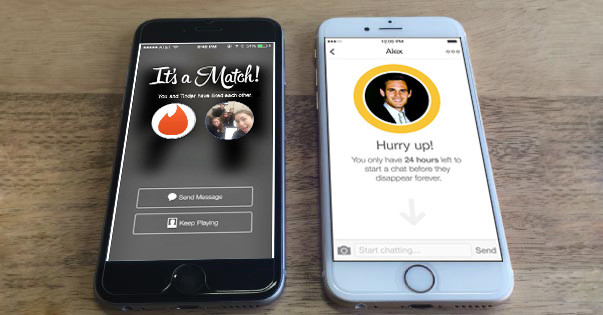
Swiping right is a lot of pressure. When I play around with Tinder, every profile is a set of calculations: what year is he? How many photos does he have? Is his caption witty? Who are our mutual friends? The list is endless, but necessary, because I know that in the event of a match, I’m fair game to receive absurd “what are you wearing” and “you dtf” messages. Gag.

Matching with people on Bumble comes with infinitely less pressure, because I can just wait it out another day and bye, Felicia. This got me to thinking: what is our generation’s problem with commitment? Why do we have to add ‘maybe’ to every equation? We get free samples at Costco without feeling the social pressure to buy anything. We get 30 day free trials to experience the thrill of programs without having to empty out our bank accounts. In college relationships, the number of one-night-stands-leads-to-accidental-feelings far outweighs the number of four-dates-later-a-first-kiss-occurreds.
For some bizarre reason, we feel self-entitled to know everything about a person or a product before we’re allowed to let ourselves go hard or go home. Is this phenomenon ruining our youth and our ability to decide for ourselves? Or is it simply allowing us to weigh all the options to opening new doors? Don’t fret, you can always takesies-backsies.