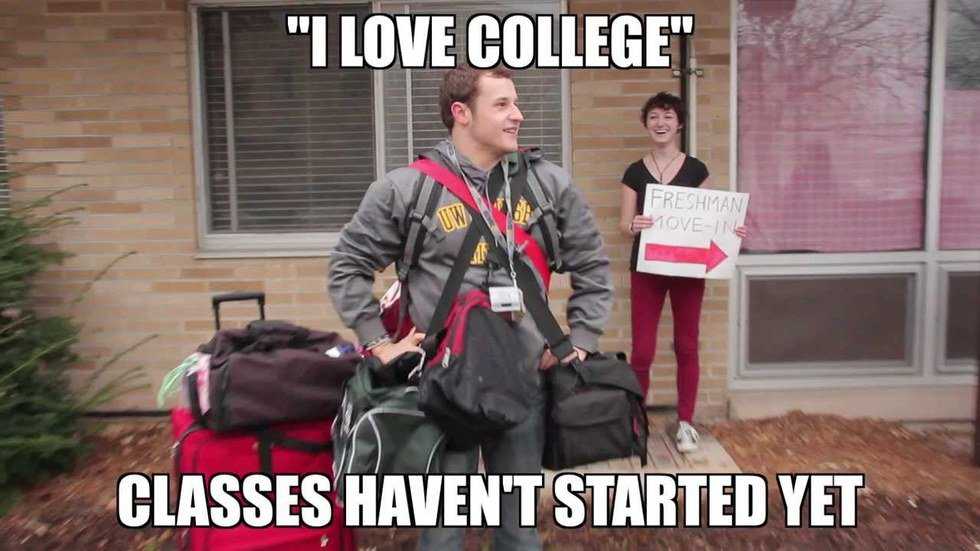
They say that college is the best four years of your life. I say it’s what you make of it. If you major in something that you are passionate about, join a few clubs and meet new friends, then yes, your college experience can become something worth cherishing. But if the rumors your high school teachers and friends told you cause you to become afraid to venture out and try new things, then college may turn out to be a bummer for you. Here are eight things that I was told about college before I started and what actually happened when I got there. (Cue the "Mythbusters" theme song).
1. High school prepares you for college.
I disagree with this statement. In high school, I followed a strict schedule of waking up at 6 a.m., had eight back-to-back classes each day, went to an after-school club or activity, then came home late and did homework. This schedule was followed Monday through Friday and I had no say-so in the matter. I quickly learned that college differs completely, from the classes to the general atmosphere. I can pick which classes fit my schedule best—since I’m not a morning person, I do my best to avoid the 8 a.m. classes. Or if I don’t want classes on Mondays or Fridays, I don’t have to register for those days. Hell, I don’t even have to show up to class at all if I don’t want to. (But I do.) As for the atmosphere, there’s little to no judgment on what I say and do, unlike high school. For example, if I wanted to show up to a class wearing a giraffe onesie and eat an Italian sub sandwich during the lecture, I can do that and nobody would question it. If I did that in high school I would be sent home for a dress code violation and get reprimanded for eating in class.
2. The workload is 10 times heavier in college than high school.
I somewhat agree with this statement. I won’t lie to you—college is more work. It requires more responsibility, time management and studying. At the same time, however, it isn’t high school. I'd have over six assignments in one night that were due the next day. Since my college class schedule is less time consuming than my high school schedule, I have more than enough time to get my assignments done. My advice is to set aside a little time each day to study so you don’t burn out. Feeling overwhelmed with assignments? That will happen from time to time. What I normally do is make a checklist. Then I do the smaller assignments first and cross them off as I go along. It tricks my brain into thinking I got a lot of work done—and it helps me feel better!
3. Professors couldn’t care less about you—they’re only there for a paycheck.
Not entirely true. High school teachers like to drill that thought into your brains to scare you. Don’t get me wrong—some professors are like that and you’re bound to come across one or two over the course of your college career. I know I’ve had my fair share of them. My advice for those classes is to keep a low profile, get your work done and try your best. You only see that professor twice a week. Luckily for me, I’ve had some really great professors that genuinely care about their students and love teaching. The next time you have a question or need something clarified, don’t hesitate to raise your hand in class or to shoot the professor an email. That’s what they’re there for.
4. The food is delicious.
This is a lie. The food isn’t inedible, but it’s not exactly fine dining either. I suggest avoiding the dining hall if you don’t want a case of food poisoning—I’ve had a few friends complain about having to rush to the bathroom after a meal. Luckily, there’s another option—the food court. But the food court at my school consists of unhealthy fast food and deli options and the limited choices become redundant after a while. My advice to you is, if you commute, to bring your own food from home like I do on occasion. You’ll save money and it will taste better. But if you live in a dorm, invest in a Rapid Ramen cooker and follow the typical college kid diet of ramen noodles and Cheetos—which will also save you money.
5. If you don’t live on campus, you don’t get the full college experience.
That’s false. I chose to commute and I still met some amazing people. I’ve also joined a few clubs, where I’ve made many good friends. We go out to eat, to the movies and to parties like normal college kids. I won’t lie, commuting does have a few drawbacks, like not being able to go to your dorm for a nap in between classes or being able to pop over to your friend’s room whenever you feel like it—but that doesn’t mean you won’t meet new friends or find things to do. The only time you won’t get the so-called full college experience is if you’re one of those boring students that hibernate in your dorm for the entire semester and only leave to go to class.
6. Every time you turn around, you’re going to find a party.
College has gotten a bad rep for having parties every night in every building. (Thanks, Hollywood.) But that’s not true in the least. The parties are mostly on the weekends. Even then, you really have to look around and get information from other people if you want to find a party. And unless you go to a frat house, the parties are nothing like the movies where there are drugs everywhere and people are doing keg stands. They’re normally low-key, with people drinking socially and talking with their friends.
7. Campus police are only there for drug and party busts.
Yes, they are there for drug and party busts, but that’s not all that they’re there for. The campus police are actually really helpful when it comes to you and your personal safety. They helped a friend of mine out immensely when she was facing a stalking incident. The chief of police issued a restraining order on her stalker and called her periodically to make sure she was OK. So if you ever find yourself in an uncomfortable situation to the point where you feel like you need to take legal action, don’t be afraid to contact the campus police.
8. You’re most likely going to switch majors within your first two years of college.
I can vouch for that. I started out as a psychology major but quickly learned that science wasn’t my forte and switched to communications. And this is okay. College is all about discovering what you like and what you don’t like, and “finding yourself.” So don’t stress if you enter college as a pre-med major but end up graduating with a degree in something totally unrelated, like theater or literature. There’s also nothing wrong with not declaring a major right away—you have plenty of time to figure out what you want to study. My advice is to join different clubs and make sure that your class schedule is a variety of different subjects like art, biology, etc. This will help in ensuring that you find something you enjoy.