


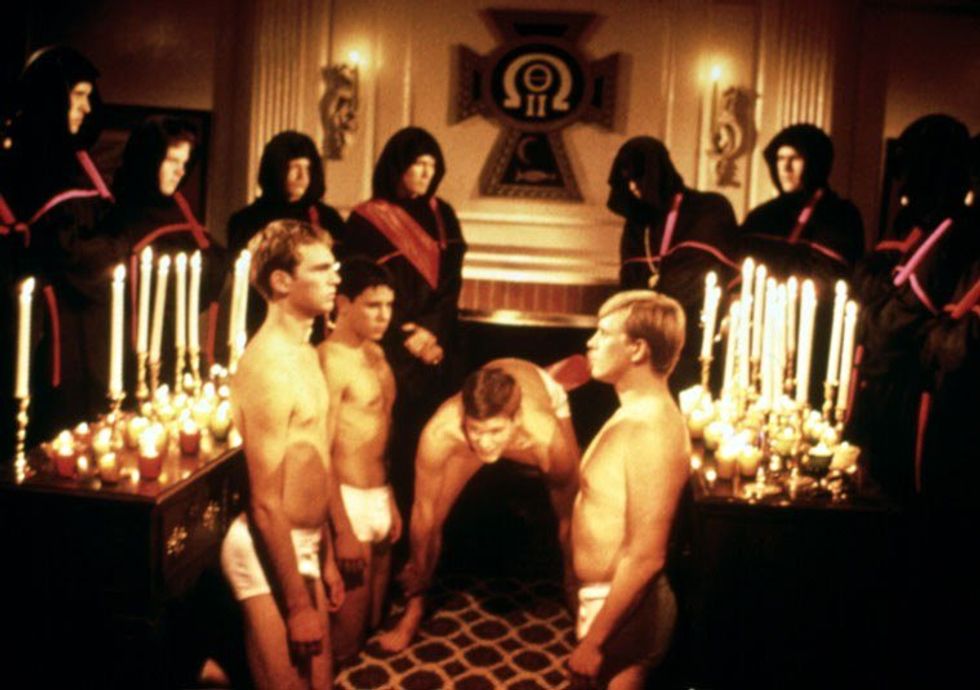
Several weeks ago, a video was posted on the popular content creation site Vimo, which was simply entitled "Recruitment 2016." The segment featured a professionally produced and edited sorority recruitment video from an undisclosed campus. It also showed superimposed over stock film footage of a government style PSA about recognizing the existence and recruiting tactics of dangerous and fanatical organizations, which in the process makes a direct comparison to the social behaviors of sororities as well as all other fraternal organizations as a whole, to that of a cult. The stock film was apparently taken from an equally ambiguous source and is entitled, "Communal Living, Cults, Religion, and Mind Control." As of the publication of this article, this short film has yet to be properly identified as belonging to a credible source.
The one thing however that has come to light in the fallout surrounding the Recruitment 2016 video is the identity of the person behind it all. The creator of the video is a female student by the name of Victoria Valentine, an art photography major for the School of Visual and Performing Arts at Syracuse University in Washington state. In what she claims was intended to be a work of satire, Valentine edits the footage in such a way as to juxtapose well recognized identifiers of what many consider to be dangerous social and cult like behavior, over a series of interview segments which feature a question and answer style format with individual members of these organizations. The video then begins jumping back and forth between the PSA video and the interviews with the girls, allowing the answers given in the segments to be taken completely out of context.
For example, the narrator for the PSA video starts by asking the viewer, “Don’t you want devoted followers who will leave their families for you, give their money to you, give their bodies to you, and give up their lives for you?” The entire time this is being spoken, the video is cycling through carefully selected clips of large groups of girls all dressed in their letters, posing for group photos in front of their respective chapter houses. “Here’s how…” the narrator continues as a crudely made slide presentation is shown, all while an oddly off key and soothing soundtrack plays in the background. The subjects featured in the PSA all speak in unison and with a monotone voice while wearing light blue T-shirts which feature the title “CULT MEMBER” in large block lettering on their front.
“Establish front groups,” he says as the video jumps from clip to clip, featuring a number of young women saying the word “philanthropy” in repeated and rapid succession. The segments were taken from clips which featured the group members discussing the various charitable contributions and philanthropic efforts of their organizations. In making this comparison, the video not only accuses Greek organizations of committing the act of theft by deception or conspiracy to commit theft, but in the same breath also inadvertently discredits and tarnishes the reputation of the charities and philanthropic organizations in which their group chooses to regularly donate. An idea which is only further driven home by the narrator’s next bullet point, “Use deception. Don’t tell them who you really are. Lie…”
The narrator speaks again, only this time the participants in the PSA video speak as well, giving responses such as, “We’re a world peace organization…” which is then promptly followed by a clip from the actual recruitment video of a young woman in a blue dress stating, “We inspire the highest type of womanhood.” The following slide suggests to the audience that they must promise to fulfill the hopes and dreams of potential members in order to gain their trust as a means of manipulating and controlling them. “Don’t you want a world of unconditional love and brotherhood? We hold the secrets to self-improvement,” two more actors from the PSA respond. The video cuts yet again to a group of girls who are responding to an unspecified question in which they reply that joining their organization offers what they feel is “an immediate connection that you have with sixty other girls” and is followed by a separate group in another clip who respond with, “I think my little sisters made me feel like I had a purpose or that I was a part of something greater.” There are a number of other scathing examples which are shown, but I fear disclosing them at any greater length would only appear tedious and redundant.
The video of course was quickly taken down under a bombardment of copyright infringement claims by the respective organizations of Gamma Phi Beta and Kappa Delta, who were primarily featured in the video, citing that none of the individuals featured in the film gave their permission for the footage to be used in such a way, and that despite the counter claims of the project being a piece of satire and under the protection of fair use, the video is in blatant violation of copyright under the terms of Label Law, which allows a brand to protect itself from a malicious third party portraying a company or organization’s image in a negative or otherwise damaging way. The takedowns of the video were a response to the organizations attempting to protect their public image from slander. However, with the Internet being what it is these days, the cyber community responded in full support of the content creator, speaking out against what they considered to be damning evidence of the authenticity and validity of the claims made in the video and that the takedowns of the video were fraudulent and were a violation of the creator’s right to free speech. White Knight keyboard warriors and Reddit users ripped the video from YouTube and reuploaded it on various media sites across the web, which eventually culminated in a torrent file being created for the video on the popular file sharing site “The Pirates Bay.”
In as little as a week, the whole thing spiraled out of control thanks to the misinformed media machine that is the Internet, as documented by numerous threads on Reddit, which only served to stoke the fires of controversy surrounding the video. This is because in the last decade or so, the current trend of social behavior has spawned an entire culture of people who respond in complete outrage at being denied any right whatsoever to view what they want, when they want to. One user even went so far as to say, “They took the video down because they don’t want to look bad. Too bad we don’t care…” This statement was followed by scores of other comments crying about issues of censorship and how stricter policies are needed to deter copyright holders from making what they consider to be frivolous copyright claims against content creators who are operating within the parameters of fair use.
To gain some insight on the matter, I reached out to a few acquaintances who practice trial and copyright law for a living and according to these sources, the devil would be in the details of the individual cases being made, but for the most part what the content creator did in making her video was not what many legal advisers would consider a valid use of free speech or for that matter, an act of fair use. While she has the right to hold and make her own opinions, the situation became criminal the moment she decided to take content from licensed and copyrighted organizations and use it to express her own opinions through the words and actions of those individuals without their consent. In doing so, the content creator completely misrepresents the character and values of the individuals featured, while prescribing a potentially negative and damaging social status onto those who are shown in the video, which could potentially result in the presence of a lasting future stigma which could affect both the private and professional lives of everyone involved.
What many don’t realize is that one of the many things that members of fraternities and sororities pay for with their dues is the equivalent of a licensing fee, which not only offers members of the respective chapters some form of protection in exercising their right to exist and operate, but also gives their home office an internal structure of authority which holds some measure of control over the groups in question and grants them the ability to internally govern and promote a disciplinary system which is aimed at administering punishment while still protecting the best interests of the accused. This also gives a home office the authority to revoke a chapter’s status and bar them from legally representing their organization in the future, should that chapter or the individuals who populate it, violate their rules and terms of service. That’s why almost any lettered organization in the United States as well as other forms of fraternal orders are registered as either a CO. or INC. as an official designation when answering to the federal government. Greek lettered organizations are in many ways, a business franchise that provides a service in the form of exclusive membership in the ranks of a private club or social institution and in return, they are afforded the same measure of resources which come with membership in the franchise, including legal protection from acts of slander and defamation which aim to deface or otherwise misrepresent the brand in a negative way.
This is what lies at the heart of this entire debate. The respective organizations were not attempting to stifle Valentine’s right to compare the behaviors of fraternal organizations to that of ritualistic cults, nor were they attempting to cover anything up in issuing the take down notices for the video. They were simply protecting their members and the overall public image of their brand from what was perceived to be an unprovoked and slanderous act of misrepresentation on the part of the content creator. They were exercising their legal right to protect their brand. In terms of the potential legal ramifications of this incident, not much has been discussed, however, what should ultimately be taken from this incident is that while everyone is free to have and make their own opinions, as well as express those opinions in a number of different ways, attempting to make your point at the expense of others without considering the potential consequences for those involved as well as yourself is not only reckless, but could end up leaving a very permanent and lasting impression on the personal and professional lives of many innocent people.
I can only assume that from the standpoint of an artist, Valentine is attempting to provide relevant commentary on the idea that the presence of these types of groups in a learning environment, only creates division among the student population and instead of promoting individuality and creativity, homogenizes the personalities and identities of those who join. Again, I must emphasize that I can only assume as much, given that I have not heard the content creator’s side of the story. However, this seems to be the most prominent and frequent argument I’ve heard being made by most students as to why they won’t consider joining Greek lettered organizations. Despite Greek organizations differing very little in structure or behavior than any other social group or university sponsored club, Greek organizations appear to have been forced into some form of cruel Catch-22 situation in which practically any allegation can be hurled at an organization and there would really be no appropriate way for the organization to handle it without exacerbating the matter even further. For example, if a fraternity or sorority is accused of hazing no matter how that organization responds, there are very few who would even attempt to give them the benefit of the doubt simply because they have been programed to believe that hazing is the norm in these types of programs and any argument made on the part of a group by their supporters can only expect to be met with harsh criticism and dismissal. The same logic can be aptly applied to Valentine’s video as well.
There was a right way and a wrong way for Valentine to have gone about making her video and unfortunately she happened to choose the wrong way. She could have just as easily accomplished the same end by simply inventing a fictional lettered organization to feature in her project and the message she was trying to covey would not have been any less clear. In fact, this is how many popular films and television shows are allowed to feature Greek lettered organizations in their productions without being in violation of copyright. However, this loophole in the system is largely to blame for the negative views which the majority of society holds against fraternities and sororities in the first place. For decades, we’ve been painted as lawless and fundamentally xenophobic groups of individuals who are encouraged to engage in ritualistic behaviors which have been built on the principles of blind cohesion and the pursuit of hedonistic pleasure. Due to this, a negative feedback loop in social culture has been created in which young men and women join these organizations for the completely wrong reasons and behave in ways which only seem to confirm and strengthen the stigmas being placed on the Greek system as a whole. However, on the opposite end of this spectrum there are those who join these groups looking to enrich and better their overall college experience, only to endure acts of ridicule or hostility aimed specifically towards fraternities and sororities by members of their own student body who buy wholesale into the idea that we are something that doesn’t belong on a college campus and that we are a waste of resources and space.
The reality is that we are literally no different or any less exclusive than any other campus based organization other than the fact that at the end of the day, we do not explicitly answer to the administrative authority of the University in which we attend. This allows us to pursue our own goals and interests completely independent of a third party influence who might have other loyalties or malicious intentions which may disrupt the functioning of the organization as a means to achieving their own end. Yet, there are few who will give audience to such arguments because fraternities and sororities seem to serve a very unique purpose. Greek organizations look great on paper and offer a university free publicity and draw in new students with the promise of a vibrant and entertaining campus life. However, whenever there is a potential social problem such as incidents of alcohol abuse, declining class attendance, or poor academic performance, the Greek system is one of the first groups who shoulder the blame, not only internally, but in the eyes of the public as well. This is because whenever there is an apparent threat to the overall sense of social order on a campus, someone or something must always take the blame and more often than not, the ones lighting the torches and grabbing the pitchforks are the ones who know as little as possible about even the most basic aspects of Greek life. It is a bumper crop of low hanging fruit from which the ambitious seek to gorge themselves and build their careers.
As I have continued to research this topic in the weeks following its initial rise in popularity, not very many people seem to have continued talking about it. It would seem that the Internet is remaining true to form in that its attention span remains as brief as it is fickle. However, in the time since, such influential individuals as Bill Maher explicitly comparing fraternities to ISIS, in his belief that "a cult is a cult" and the countless other articles making passing comparisons between fraternities and cults. I would go so far as to wager that the matter will probably never disappear entirely. So long as the collective hostility towards the Greek community that appears to be an omnipresent theme throughout most of society persists, it's not a matter of if, but rather when the next controversy of the day will catch the attention of the masses and everyone will pile back on the band wagon.