

This upcoming presidential election has most people feeling alienated from the process. They are averted to both candidates. Maybe this is just a one time election that has people feeling excluded from their usual parties, or maybe there is a larger issue at hand - neither the Republican nor the Democratic party really fits the views of a lot of the population.
One study done by Gallup in 2015 found that 60 percent of people felt the need for a third party presence. There is good news. These parties exist right now and a couple have candidates with a following running for president.
Here is a link to the Libertarian party (http://www.lp.org/introduction/what-is-the-libertarian-party). This is probably one that you have already heard about - a very strict constitutional mindset in both economic and social aspects. Free market is combined with civil liberties - like gay marriage and abortion. It may be different from what you have heard before, but according to Trump's recent following that is a good thing.
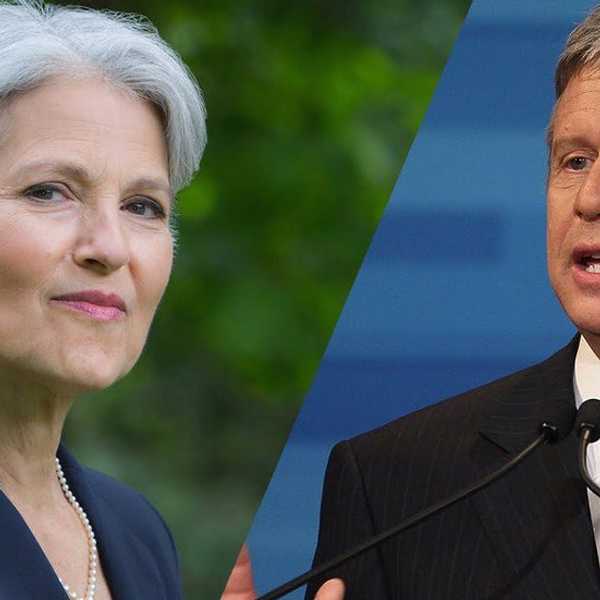
This is Gary Johnson, the Libertarian candidate, and the vice presidential pick, Bill Weld (https://johnsonweld.com/). This former New Mexico governor has the third party campaign with the most support thus far.
Here is a link to the Green Party (http://www.gp.org/platform). The Green Party is a proponent for social and wage equality, and an very strict environmental policies. They have some very leftist views, and a lot of people are attracted to their nonviolence vision.
Jill Stein is the candidate for the Green Party (http://www.jill2016.com/). She is behind Johnson in the polls, but still has some impressive campaign support.
Other third parties include the Constitution Party, the American Reform Party, the Veterans Party, and the Modern Whigs just to name a few.
This is not a call for the abolition of the current parties, as many people do fully support them in their entirety. Rather it is a plea for those not satisfied with them, not to settle for a party and a system that they do not fundamentally agree with.
There are so many issues (Tax Reform, Immigration, Women's Rights, Foreign Policy, etc.) that it will probably always be difficult to find a Party or even a candidate that aligns with every one.
Candidates tend to have their own views, and there are variations of moderates and hard liberals or conservatives; however, they are forced to fit in the ancient skeletons that are the existing platforms of their parties to receive the support they need. Those platforms just aren't agreeable with every voter. If you know you disagree with about half of the key positions that the Party and its candidates stand for then it is time to start thinking about what the other options might be.
So the concern many people have once they think they might support a candidate from another party is "They have no chance of winning." It is disheartening to hear that previous candidates outside of the major parties, like Ross Perot in the 90s, only obtained a little over one percent of the vote. That is still 3 million people, but what if 2016 was the election that could excede all of those attempts? Only a 15 percent average in the polls is necessary to be considered eligible for presidential debates. Polls that are including other candidates besides Hillary Clinton and Donald Trump have shown candidates like Gary Johnson of the Libertarian Party between 4 and 11 percent. It is groundbreaking to say the least. These aren't winning numbers yet, but imagine if half, or even a third, of that 60 percent that wanted a third party, voted for a candidate from one.
For those who say that it is a waste of a vote to support these candidates, is it not more of a waste to vote for someone you fundamentally disagree with, just to oust someone you disagree with a little bit more? This election might not be won by a third party candidate, but in four years one could be. And furthermore, these parties are not just supporting candidates for president, but ones at the state and local levels as well. In fact Libertarians alone hold around 150 positions nation-wide.
Change does not happen overnight, but it doesn't happen at all if no one ever advocates for it. These parties become stuck in a vicious cycle of unrecognition, as the media will not cover them until they have a following, and constituents seem to think they are unimportant until the media covers them. But Grassroots movements, those started by the people, are effective. The media has a hard time justifying reporting on candidates that do not have proven followings, but support for candidates is easier to show now than it ever was before, especially with social media. A higher number of likes, shares and follows for a candidate might be the only proof needed that people want to see more reporting on them.
This election maybe it is time to stop wasting your vote and your voice on candidates in which you have no faith. You can vote for your own values, and if enough people have those same ones the system can change. It is an optimistic opinion, obviously, and one with a long road, but it is not a dead end.

















