

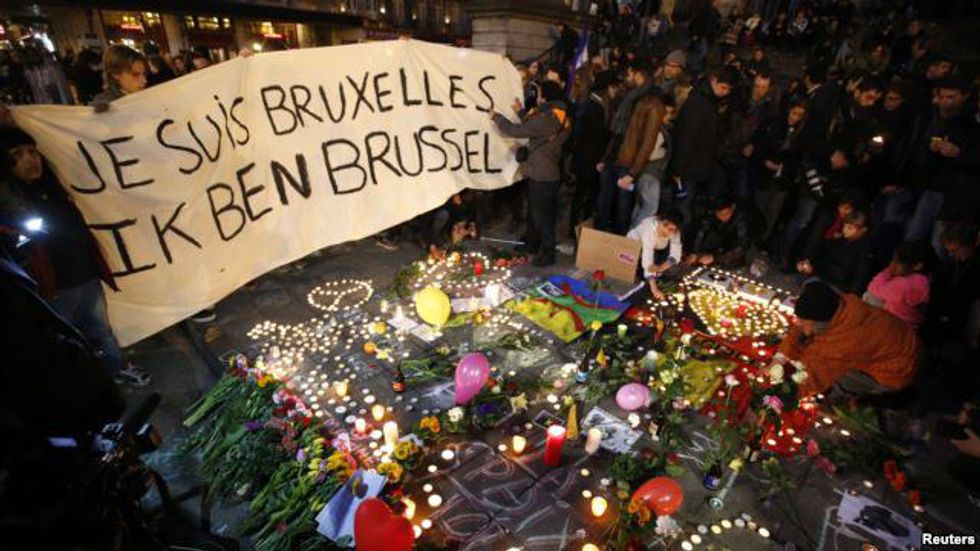
For the past four months, it's felt like terrorist activity is at an all-time high: the attacks in Beirut and Paris in November, the first of four bombings in Turkey, spanning from January to this month, the San Bernardino shooting that took place in December, the recent suicide bombings in Brussels, and the numerous terror attacks that go underreported in the media. With each attack, media coverage skyrockets, and we are bombarded with videos from the destruction, images of victims and mourners, and rally cries from current and aspiring politicians, simultaneously offering consolation and demanding retribution. In this often-berated age of social media, communication across international, political, religious, and social lines has never been easier, for better or for worse. In the wake of the attacks in Brussels, many world leaders took to Twitter both to express their solidarity and to condemn such cowardice and violence. It would seem that in the midst of such tragedy and horror, the world remembers how connected we all really are, vowing to stand and fight together to preserve the rights to safety and freedom that all human beings share.
And yet, it is in these times that we, especially in America, are too quick and too eager to blindly draw the line between "us" and "them."
After the Paris attacks in November, candidate for the Republican presidential nomination Donald Trump said in an interview that America should instate a ban on Muslims entering our country. Fellow candidate for the Republican nomination Ted Cruz said in a statement on Tuesday that America needs to "immediately halt the flow of refugees from countries with a significant al Qaida or ISIS presence." These responses, though natural and understandable, serve more as fuel for the misguided fear and hatred of refugees than as practical, reasonable solutions to the problem. In a recent article, Vox staff writer Brian Resnick shed light on the psychology behind these kinds of anti-refugee responses to terrorist attacks, ultimately finding that the combination of perceived threat and uncertainty both increases hostility for people we classify as different from us, or "other," and strengthens our feelings of connectedness to those we identify with.
Bearing this in mind, it makes sense that many Americans are against allowing refugees into our country. When we feel threatened, our natural response as human beings is to identify the threat as quickly as possible and neutralize it. But it is precisely during this knee-jerk reaction that we should avoid making decisions about how to respond. It's natural and understandable to have hostile feelings toward someone you consider a threat to you, your family, or your country. It's rash and tactless to allow those feelings to inform and direct your actions.
But if refugees aren't the problem, who is? So far, evidence has shown that many of these terror attacks have been committed not by refugees or immigrants, but by citizens. Just days before the bombing in Brussels, Salah Abdeslam was arrested in Belgium for his involvement in the Paris attacks. Both he and his suspected accomplice, Najim Laachraoui, were EU citizens. Stricter immigration laws would neither have kept these men from becoming "foreign fighters" -- Western citizens who travel to the Middle East to train or fight with groups like ISIS -- nor from returning to their home country to carry out acts of terror. The problem is not immigrants or refugees coming in, but citizens becoming radicalized at home and using those new extremist views as a source for their actions.
To be clear, radicalization is not limited to Islamic jihadist, Arabs, immigrants, or any one group of people, and it doesn't always lead to violent actions. Anyone can become radicalized for any extremist cause, whether that be Muslim, Christian, Marxist, or just plain old xenophobic. In fact, a recent study by New America has found that in America, since 9/11, there have been more deaths caused by extremist far right wing attacks than by violent jihadist attacks. It's radicalization that needs to be stopped, not refugees.
Brandon Stanton, the photographer behind the popular blog, Humans of New York, recently did a photo series on Syrian refugees trying to come to America. In it, he shared stories of a number of individuals and their families fleeing from the violence in their home countries in search of safety. For many of these people, the journey to America was a long and painful one, fraught with loss, destruction, fear, and despair. Refugees don't flee from their homes because their lives are simply uncomfortable. They flee because staying means no education, no opportunity, and no safety, and it is their human right to have all of those things. To deny refugees entry into our country, which has long prided itself on being a land of freedom and opportunity, is to decide that there are some injustices we just can't be bothered to fight. And that doesn't sound like the America we were raised to believe in.