


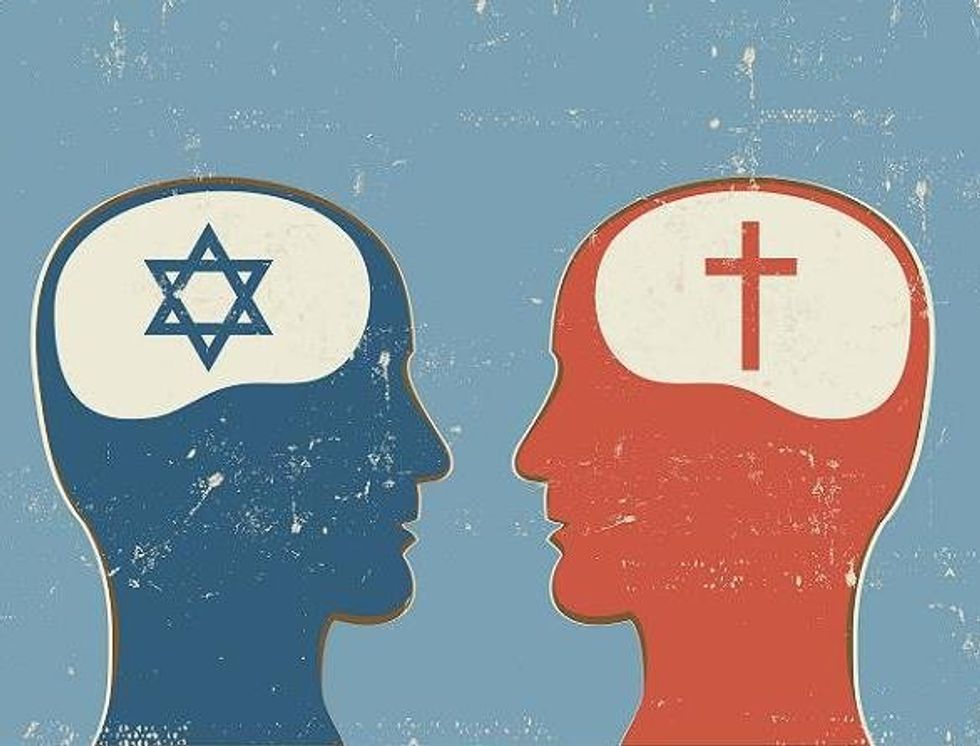
Religion is one of the most ancient practices of human beings, with only necessities such as eating, drinking, and sleeping surpassing it in age. In fact, no one truly knows how old the theory of religion is. The Merriam-Webster dictionary defines a religion as “an interest, a belief, or an activity that is very important to a person or group.” That is a very broad definition which can be applied to many different topics in some way. This is because religion is a very broad topic which can be applied to many different parts of human life and has many different segments to it. There are thousands of variations of religions in the world, all with a variety of denominations inside them. Some of them are very similar to each other, while others could not be more different.
Although religion is a topic which has roots in an ancient age of mankind, it has evolved through time. In fact, religion just might be one of, if not the, most malleable theories of man, because the idea of what a religion is has such a broad scope that it covers. There are so many religions because almost any ideal can be a religion or expand into one. For example, a group of people could believe that anything is a god, and that could be a religion. In fact, any type of philosophy is a religion, because it is a creed which a person can live by. It is arguable that every person has a religion, because everyone has some sort of ideology they live by. The focus of this article is on the relationship between the catholic church and other religious groups and ideals which are present in the world.
"Nostra Aetate" was written over 50 years ago by the Roman Catholic Church that existed at the time. According to the National Public Radio, this is a Latin phrase which translates into English as “In our times.” Before Nostra Aetate, the Roman Catholic Church had difficult relations with other religions, to the point that was enmity going back and forth among them over the span of decades and eras. Take, for example, the Church’s response to the treatment of the Jews during World War II and the holocaust. The church remain neutral about the discrimination, injustices, and genocide which was committed against them by Adolf Hitler and the German government. Pope Pius XII, the leader of the Roman Catholic Church, did speak out against these crimes, but did not do any more than that. In fact, when he was asked by the French Marshal Henri Philippe Petain what the Vatican thought of the malevolence the Jews were suffering, Pope Pius XII stated that the church does not endorse racism, but is not against every law which is against the Jews. Though the Vatican did accept thousand of Jewish refugees in the 1944 after they had become unsettled by the holocaust, it was thought that the indifference of the church toward Jews during the early 1940s was due to antisemitism, because they blamed Jews for the death of Jesus Christ. Any type of aid which the Roman Catholic Church gave to Jews was given due to political reasons and not moral ones (Jewish Virtual Library).
Nostra Aetate, while it addresses other religions, does give much attention to Judaism, and it can be seen as an apology to them for their lack of action during the holocaust. The only other religion which it gives as much emphasis to is Islam. This is likely due to the fact that all three religions come from the same roots. The area which attends to the Jews begins by declaring that the initial followers of their religion were Jews. The text goes on to profess that even though the Jews did not accept Jesus Christ as their lord and savior, God still has a special place in his heart for them. The reason that God does this is that the Jews were his chosen people in ancient times. It goes on the assert that Jews and Christians are spiritual brothers since Christianity is an offspring of Judaism. The text mentions that many Jews wanted Christ to be put to death, however states that all Jews are not responsible for the death of Christ. It then says that if Jews were to come over to Christianity, that they should be welcomed with open doors and brotherhood. Nostra Aetate firmly denounces antisemitism against Jews for any reason, whether it is because of racial or religious reasons. The apology and declaration of kinship with the Jews ends there (Vatican).
Judaism and Catholicism have so many similarities with each other. A lot of their semblance to each other is due to the fact the Catholicism came from Judaism. In fact, the practitioners worship the same God. The difference between the two is that in Judaism, Jesus Christ is not the redeemer of humanity. Thus it is only logical that the two should have good relations with each other, despite their differences on Christ. The God that they both serve states that they must love others, regardless of what they believe (The World’s Wisdom).
In 2013, Pope Francis, the current leader of the Roman Catholic Church, set out to improve the connection between Catholicism and Judaism. According to the general counsel for the World Jewish Congress, Menacham Rosensaft, Francis has been friends with leaders in the Jewish community since his and their early days in each other’s organizations. One of those friends happens to be Rabbi Abraham Skorka, a rector of the Latin American Rabbinical Seminary. Skorka had nothing but good things to say about Francis in his interview. Pope Francis later proclaimed that a Christian cannot preach the gospel and preach antisemitism as well. Also, Francis was set to make a journey to the Jewish community of Jerusalem later that year. The World Jewish Congress continued to speak about how he and the church work to smooth their relationship with them (National Catholic Register).
This is a good move forward when it comes to Jewish and Catholics coexisting as allies. In fact, when you think about it, this could also be thought of as a herculean and maybe even historic event. Through history, religious organizations, at best, have pretended that each other are non-existent, and at worst have sought to destroy each other. There are very rarely public friendships between two religious entities. In fact, one who is well-verse in the history of various religions around the world might be inclined to believe that there has never been ongoing benevolence between any religious fraction unless given research that proves otherwise. This is the best connection between the Vatican and the Jewish community there has ever been. They have an alliance which has managed to overcome countless years of religious aggression on both sides.
The Anti-Defamation League goes into more detail about Jewish and Christian relations, both their history of passive aggression toward each other over the span of many centuries as well as the need for healing and unity between the two parties. The source states that the root of their issues stem from the fact that Jews saw Christianity as a menace to both their belief system and their culture. Christians saw Jews as the ones who were liable for the death of Christ. They then go on to state that both Christians and Jews must not carry animosity for each other. The sources finishes up by going into detail about the improvement of Jewish and Christian relations since the 1960s (Anti Defamation League).
Jews and Catholics have a very rocky history with each other. They seem to always have a reason to be on the opposite site of an idea. Though change is coming. Catholic and Jewish relations have been improving. Hopefully they continue to do so.

















