

In today's day and age, imperialism and the colonization of Africa have been scapegoated as the source of all that is wrong in the middle east and developing Africa. Many on the social justice left and even some in the libertarian circles have decried it as oppressive exploitation of developing countries by the European monarchies of the 19th century. But how true is that? And more importantly can there be some kind of justification that does not venture into the typical racist rhetoric that is all too common in these discussions? I believe there is, in fact I'd say there is a fascinating explanation of the initial occupation of Africa through the lens of the non-aggression principle. So let this article act as a thought experiment for the logical consistency of the NAP.
So firstly, to those not familiar with libertarian philosophy, the Non-aggression Principle is one of the major pillars of many libertarian schools of thought. It is in its simplest explanation the radical idea that you can run a society based solely on the Golden rule, do unto others as you'd have them do unto you. Or in libertarian speak, aggress unto others as you'd have them aggress unto you. If you're still having trouble understanding this it's essentially "don't fuck with other people or their property", this differs from pacifism in that the NAP allows you to act in violent self-defense in response to violent aggression's.
With that out of the way, you may be asking yourself, "Well, Europe colonized Africa in 1870, how is that self defense?" And to that I say there's a lot about this conversation that's been left out of the history we learn about in school. At the same time as the Atlantic Slave trade there was another slave trade going on in the Mediterranean and north Atlantic known as the Barbary slave trade. Unlike the North Atlantic trade which typically bought slaves from the African slave trade (with all the kidnappings done by Portugal and Spain circa 1400-1500 AD on the outer islands and west coast of Africa, I do admit) the Barbary slave trade was characterized by corsairs kidnapping the crews of passing ships, and later raids of coastal cities of Italy, France, Spain, England and Ireland and bringing them back to the Barbary coast made up of Morocco, Algeria and Tunisia. This went on between the years 1600 and 1830 AD.
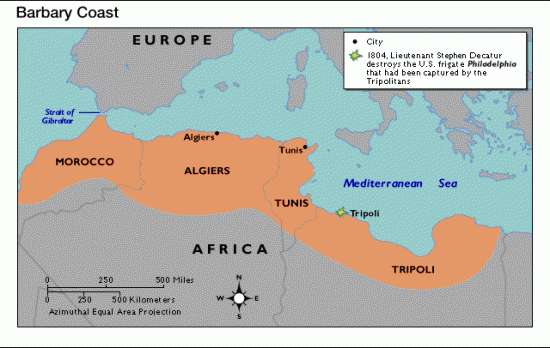
Now it should go without saying that kidnapping is an act of aggression, in this case both against the individual being kidnapped and against the state to which they belonged to. If we can understand why you'd be justified using violent action to take back a piece of your property on an individual level, then why can't so many people comprehend it on a macroscopic level? If someone violently kidnaps your family would you be justified under the NAP to spring them from whatever cage they were thrown in? I know it may sound cold to some of you to compare people to property in this instance but lets be honest, we're not much more than property of whichever state we live under. And when you look at the maps of European colonization in Africa you'll see that many of the countries that had their "property" kidnapped are the ones that took control of the Barbary coast.
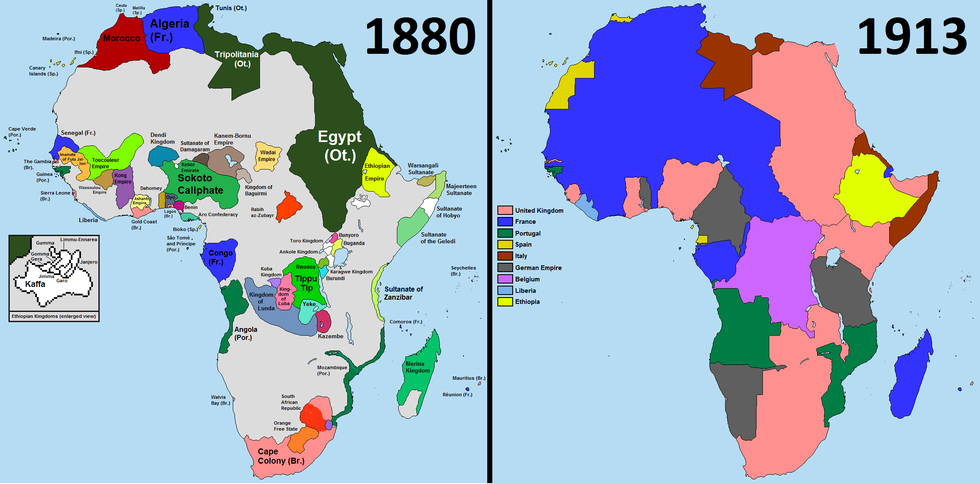
This is at least a partial justification for the initial occupation of said countries. Under the NAP this would be the equivalent of holding a would be kidnapper in a choke hold until they are no longer a threat, of course it would probably be a massive leap of logic to defend the taking of said kidnappers wallet and jewelry in this metaphorical situation whilst he is unconscious under any other circumstance. However, since the NAP is most often used in the context of property rights one could justify the subsequent expansion and exploitation of Africa through this lense. More specifically through the Homestead principle, which states that one gains ownership of an unowned natural resource through putting that resource to use, and marking it as yours, which as we all know Africa is incredibly rich in that. And seeing how the currency pre-colonization were cowry shells instead of mineral coins or something of that sort, it may be safe to assume Africa's resources were largely untouched. Had there already been a market for these resources in Africa then the 40-year colonial period may not have even happened at all.
I want to make it incredibly clear, this is not a moral argument for colonialism. Colonial rule was in many ways unnecessarily brutal and inexcusable in taking away a peoples right to self determination. All I want to prove is that under the non-aggression principle you can justify all manner of non-libertarian concepts and actions, and while it does have its flaws i still believe it is a good guiding principle on how to live your life. I hope this serves to spark discussion on how to further refine the principles of anarcho-capitalism to truly become the peaceful solution i know it can be.