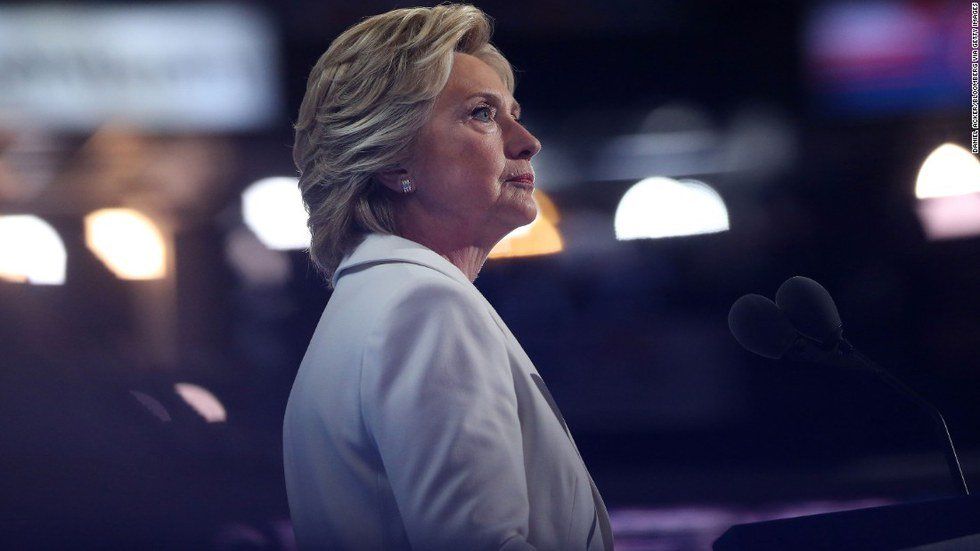
Last week, Hillary Rodham Clinton made history. As the first woman to secure a major party’s nomination for president of the United States, her address to the Democratic National Convention was indeed a milestone for women, both in the US and beyond.
Clinton came to the stage under monumental stress, pressured to deliver "the right speech" after years of dissection and caricature.
But as usual, Clinton’s popularity (or lack thereof) and the reception of her speech have been tainted by criticism of her speaking style. As the Daily Wire put it: “Hillary Accepts Nomination, Immediately Bores Americans Into A Coma Before Startling Them Awake With Her Cackle.”
Ever since she entered the national arena in 1992, media commentators have ripped Clinton’s vocal delivery apart. It has been described as loud, shrill, grating and lecturing. No aspect of her speech is beyond ridicule–her laugh is branded “the Clinton cackle”, and her speech mocked as shouting, screaming and shrieking–inartfully substituting volume for expression.
Many may claim that Clinton isn’t one of history’s greatest orators, but there’s something more insidious going on here.
The criticism that follows her is a classic example of what is called “gender congruence bias”. This theory explains that people expect women to act in certain ways – and that if a woman’s behavior doesn't match with expectations of femininity, people won’t like or accept her. The double bind that female politicians face is augmented by the deep sense that leadership is a male realm and politics in general is a domain of power – power that we are not culturally comfortable to have women wield.
Presidential candidates, like other high-profile leaders, are expected to be male and to have traditionally masculine attributes. Women who aspire to be high-profile leaders are automatically judged and criticized against these male-biased criteria.
Assertive and rational women are condemned for being too masculine–Clinton has been accused of being overly ambitious and calculating. A high-profile woman who displays gender-congruent emotions may be labelled over-emotional and Clinton has been repeatedly portrayed in the media as bitchy and shrill. Female politicians who are calm, controlled and detached are not praised for gender-neutrality but attacked for not being feminine enough–Clinton has been deemed “robotic” (something she has lately riffed on to great effect).
The pattern behind these sexist distortions and misrepresentations has been revealed in a wide spectrum of research, which has found how female politicians are evaluated quite differently from their male counterparts in terms of their speaking style.
One notable difference is the gender expectation that elocution enhances men’s power, but harms women’s. Men are expected to speak and are readily heard, whereas women are traditionally expected to be quiet. When men raise their voices they come off as rousing and assertive, when women raise theirs, they’re said to be hysterical and shrieking.
Clinton is of course not alone among female political figures for being lambasted for supposedly poor oratorical skills.
At the beginning of her career, Margaret Thatcher was also criticized for a shrill voice and received vocal training to change the tone, pitch, and tempo of her voice to achieve a more authoritative speaking style. Later in her career, Thatcher’s speech was praised for its crispness, softness, and firmness of tone–her voice becoming central to her Iron Lady persona.
Angela Merkel, has been ridiculed for her lack of charisma, being described as monotone and dull.
Looking back, recordings of Clinton delivering her famous graduation address at Wellesley College in 1969 reveal she was astute, eloquent, and articulate; not at all the poor orator she’s caricatured as today.
Now with the White House in reach, Clinton has become a threat to the gender expectations of people in power the world over. This sort of subtextual risk is just the sort of fodder that the media loves to dish out for the masses.
It’s past time for this to stop. The public must stop making political decisions based on a woman's vocal style and "charisma"–and the media must stop focusing on voice and judging speech against male-biased criteria.