
Last week, Bloomingdale's released their holiday catalog with an advertisement that countless social media users claim is perpetuating rape culture. The ad pictures a male and female standing near each other and states, "Spike your best friend's eggnog when they're not looking." Within 48 hours, social media voiced their outrage and called out the company for their controversial ad.
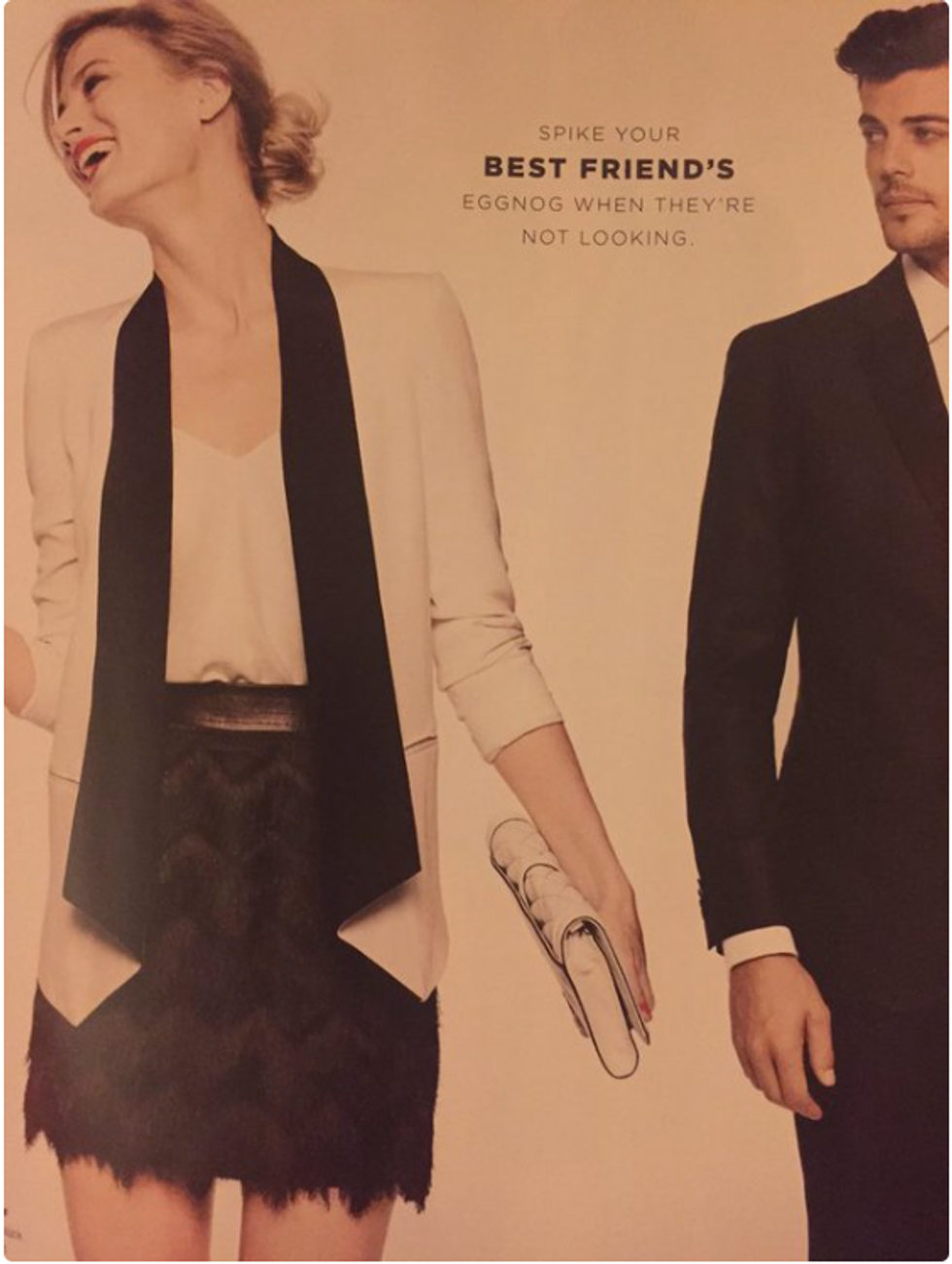
Image via Fortune.
Several users voiced their disgust:
Or don't and quit being a creep... #Bloomingdales -@krisalderson
Rape culture aside, it's not ok to get anyone drunk (or high, for that matter) without their consent. #Bloomingdales -@typicalfeminist
Nice, #Bloomingdales is Bill Cosby writing your ad copy now? -@thomaskeister
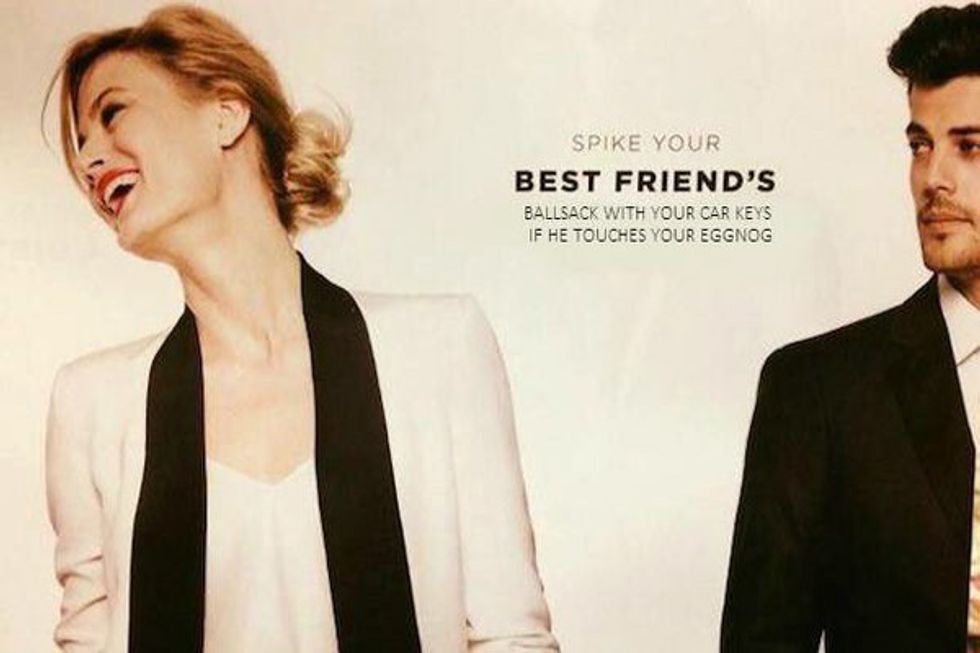
One Twitter user went so far as to make her own advert in response:
If he's trying to spike your eggnog I doubt he's your bestie. Here's my version #Bloomingdales #rape -@ashleystorrie
After several days of accusations and complaints, Bloomingdale's offered up an apology stating, "In reflection of recent feedback, the copy we used in our current catalog was inappropriate and in poor taste. Bloomingdale’s sincerely apologizes for this error in judgment." Unfortunately, in today's media savvy society, apologies aren't enough to fix the problem, nor are they enough to stop the controversy from going viral.
Earlier this year, several other companies, including Anheuser-Busch, were under fire for this exact slip up. Are advertisers being forced to create controversy for the sake of their ad actually grabbing the world's attention? Some people think so, and consequently, aren't buying the apology sent out by Bloomingdale's reps:
Did you see this disturbing ad? #Bloomingdales apologizes for ad seen as promoting date rape #notbuyingit http://buff.ly/1PCzCX5 -@NSVRC
After the Budlight advertisement went viral for promoting rape culture, some blamed the slip-up on a gender imbalance within the company. However, Bloomingdale's is not affected by the same imbalance of gender as nearly half of the company's board members are women. Many people wonder how a company whose target audience is primarily women felt comfortable printing an ad that made so many people uncomfortable.
Sarah Murnen, who teaches psychology at Kenyon College, points out, "Women can be sexist, too. There's a type of sexism called benevolent sexism, and it doesn't seem as bad to people. It's seen as less harmful, but it's more insidious." Benevolent sexism is a subset of ambivalent sexism--a theory that places sexism into two categories: hostile and benevolent.
Benevolent sexism represents evaluations of gender that may appear subjectively positive (subjective to the person who is evaluating), but are actually damaging to people and gender equity more broadly (e.g., the ideas that women need to be protected by men). -Wikipedia
Murnen and many others claim this advert is promoting a type of sexism that may seem innocent and positive on the surface, but could, in fact, be very harmful. Bloomingdale's representative, who issued the apology, has yet to comment on how the advertisement was allowed to be published, nor the intent of the phrase printed within. Regardless of whether or not it was the company's intent to promote date-rape, according to theory's of benevolent sexism, the insinuation is enough to offend the masses and put Bloomingdale's in the hot seat.