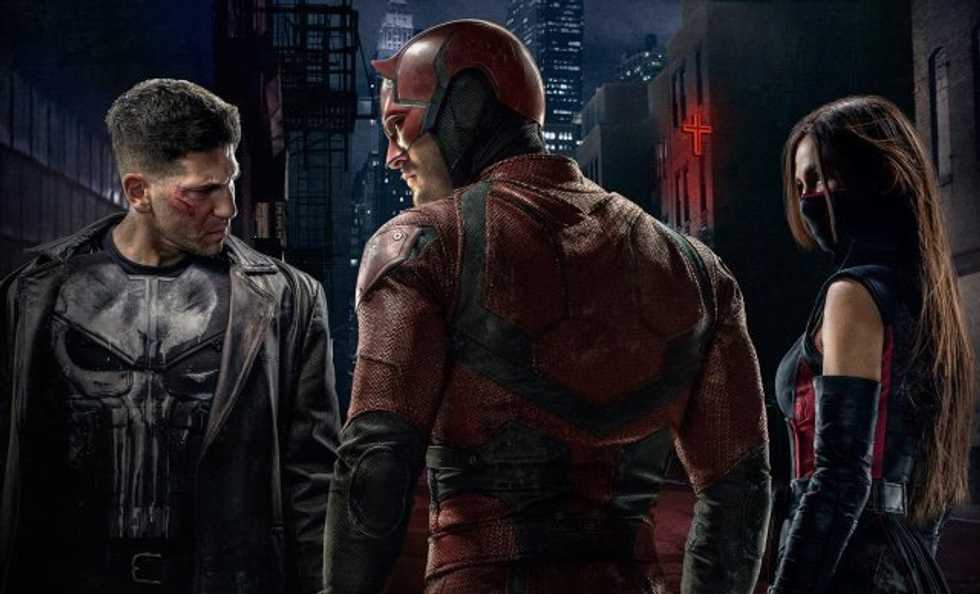
Released on March 18th, Marvel/Netflix's second season of "Daredevil" was a fun watch. I binged it in about twenty-four hours, having started late Friday evening and finished Saturday evening. Going into it, I wasn't quite sure what to expect. We knew that the Punisher (played by Jon Bernthal, who played Shane on "The Walking Dead") would act as one of the season's big antagonists, and we knew Elektra (Élodie Yung) would join the cast as Matt Murdoch's ex-girlfriend from college. We knew there would be a Big Bad, but who that was wasn't quite established.
For this review, I will start with general comments without spoilers, then give a brief warning before launching into a more thorough (somewhat spoilery) review.
I personally am not a comic book reader, and unlike most other shows I watch, I didn't bother reading the official Marvel Wiki entries for the characters in this particular show. Having skimmed them and the regular Wikipedia entries, it looks like Netflix and the MCU decided to make some changes from the comic while bringing Daredevil to the small screen. I can't say whether they worked out better or worse than what was done in the comics, not having read the comics, but I think the original content got us to a satisfying conclusion.
That's getting somewhat at the big thing I want to convey: the season ends really satisfyingly, but getting there is sometimes frustrating. It's somewhat the opposite of last season, where we had a really strong start and then a messy latter half. This season was a bit more balanced, but the beginning relies a lot on vagueness to create suspense. There's some Pronoun Game, but the big annoyance is that characters will often reference backstory that wasn't given to us previously and that isn't explained for far too long to have worthwhile payoff. Luckily, this season does actually answer a lot of questions, but if you hate vagueness, this season will probably grate for you for at least the first several episodes.
For all its unsatisfying tries at creating suspense, this season is satisfying in a lot of ways as well, namely in its use of some of its characters. Jon Bernthal brings us a Punisher who's genuinely sympathetic. Elektra, while initially somewhat annoying in my opinion, has a very good character arc, something Netflix/Marvel seems to have really embraced since the success of Jessica Jones. Matt/Daredevil was underwhelming, but that was more than made up for by the season's shining star in Karen Page, who really brought it and showed that "strong female character" does not mean a woman has to throw punches and spit out teeth to be strong. Karen's a badass this season, and her scenes with Frank Castle, the Punisher, really make this season worth watching and thoroughly steal the show from the title character.
And now for a more detailed review. Spoilers follow.
Not super-serious spoilers about the end, but if you prefer to go into the season not knowing the specifics of things beyond what's in the trailer, take a walk, and we'll call you back in for the closing comments.

Matt Murdoch is probably the least memorable character this time around, and I say "this time around" because I'm assuming, optimistically, that I just forgot any less memorable characters from last season. I like Charlie Cox in this role for his small mannerisms, especially the ones that highlight the fact that Matt Murdoch is a bit of a pretty boy and an incorrigible flirt, but he just doesn't seem to have found what makes his Daredevil special and interesting. We watch Matt struggle a lot this season to balance his law career, his friendship with Foggy, his role as Daredevil, his relationship with Karen, his baggage with Elektra, and so much more, but it felt a lot like we never really got close enough to him to see what was going on internally. With a title character, you expect to have some internal access, but this season, Matt felt incredibly distant. Charlie Cox is a young actor and not exactly a big one, but the plot seems to call for a bit more gravitas than he brings to the role. And when "Daredevil" is up there beside "Jessica Jones" and Netflix's other shows that feature young actors in emotionally heavy conflicts, the title character really needs to bring it, and Charlie Cox just hasn't really done that yet.
On a more positive note, the plotline where Matt was particularly alright this season was the plotline that placed Matt and Foggy at odds. Foggy still does not like that Matt is constantly putting his life on the line, but this conflict really gets into gear about halfway into the season, after Matt jeopardizes their case by showing up too late to deliver the opening statement at the Punisher's trial, in which Nelson & Murdoch are representing Frank Castle against a district attorney who seems to have a vendetta against every one of the good guys on the show. Matt increasingly prioritizes his night job of vigilantism over his day job as a lawyer and a partner in the law firm he shares with his best friend. Foggy is forced to pick up his slack, and this creates a divide where both characters need to decide what's truly important to them and whether N&M is really going to work out.
Unfortunately, it ends up being Foggy who is the more interesting and likable one in this dynamic. Foggy grows as a character through all of this and is truly sympathetic, whereas I personally spent a lot of these scenes thinking Matt was sort of a huge jackass to have as a friend. And that made Foggy's realization that he's a damn good lawyer, even when his best friend and partner totally bails on him, incredibly satisfying. But when the cost of that is the title character's likability and the viewer's sense of empathy with that title character, that's not exactly complementary.
Jon Bernthal's Punisher/Frank Castle, was great. The Punisher is a character who so critically needs to be convincing. His purpose in this story is to introduce the question: Is it more morally correct—not right, but correct, and the show wisely makes the distinction—to save people's lives, or to prevent lives from needing to be saved at all? With the latter argument, when it's embodied in a character who's supposed to be an effective antagonist, needs to come empathy and understanding. The writing behind Frank Castle does an excellent job of showing us how his military career followed by the brutal massacre of his family and his choice to kill bad guys makes sense to him. His grieving over his family is shown extremely well. We learn during the first half of the season about his family, both through Daredevil's interactions with Frank and Karen Page's investigation into Frank's background. Daredevil's interactions work as a kind of therapy for Frank, where he comes to accept that his family is gone, meanwhile giving us a couple great scenes that showcase Jon Bernthal's impressive ability to play a stoic character subject to sudden and powerful outpourings of emotion when it all becomes too much, which sets the stage for his purely vengeance-focused role in the latter half of the season.
The show also offers some explanations for what Frank's become in his trial, where Foggy attempts to make essentially a not guilt by reason of insanity argument, but Bernthal owns this scene beautifully. The whole trial, we watch Frank sit silently as his fate is decided by a DA who's out for blood and a legal team where one partner doesn't even show up for most of the trial and the other isn't even sure of his own ability as a lawyer. Then, Karen Page, operating as N&M's legal assistant in an official capacity and a damn fine unofficial attorney, convinces him to take the stand, and on the stand, following Matt's single argument in probably the entire trial, one that is quite powerful and shows that Matt is actually good at his regular job, Frank stands and explodes, saying that he's not crazy at all and doesn't regret a thing. It's left ambiguous whether he's being honest or not, and the truth pretty clearly lies somewhere in the middle between N&M's insanity argument and Frank's assertion that he's thinking completely clearly, but Bernthal does an excellent job of playing this character who will sit silently until the precise moment when exploding into violence, verbal or actual, will be most efficient. It lines up extremely well with Frank's hyper-efficient killing style, which is basically summed up in one of his mantras, "One shot, one kill."
Where the Punisher was also really effective was in his shared subplot with Karen Page, who by far stole the show this season. Karen spends the season essentially transforming from a legal assistant for N&M, to a potential lawyer in her own right—an idea Matt suggests but she rejects, noting that the truth seems to get lost in all the legal processes and loopholes—to a kickass investigative journalist following in Ben Urich's footsteps. She plays a major role as the character people are willing to talk to and as the moral voice of the show, standing between Matt's Daredevil logic and Frank's Punisher logic with her own idea of what is good for Hell's Kitchen and what is right. She becomes a confidant of sorts for Frank when her push for the truth leads her to discover the cover-up around Frank's family's murders and she insists that she will help him find the truth if he accepts N&M as his defense counsel.
The development of the almost-friendship between Frank and Karen is fascinating to watch and definitely one of the better—and, honestly, one of the few—portrayals of a purely platonic close relationship between a straight man and a straight woman in modern scripted TV. Karen very openly cares for people, while Frank makes an effort not to show that he cares, but they come to care very much for each other's well-being, not just the more general idea of seeking justice, which is a goal innate to both of their character arcs but ultimately not the dominant one in their shared arc.
But what's really special about their relationships is that there is an understanding between them of each other's essential truth. Karen gets Frank and what he is, while he gets her and understands what she is. Unlike the other men in Karen's life, Frank seems to respect her capability; his protection of her stems more from the fact that she is not a trained soldier like he is, so when bullets are flying, it's just practical for her to get behind something while he handles the firefight. And she protects him by seeking the truth: When everyone else puts Frank's case away, she makes it her mission to make sure people know who Frank is as a person. This lands her Ben Urich's old job, including his old office, and his old boss becomes a mentor of sorts for her. Her persistence, efficiency, and courage make the work Ben was doing last season perfect for the Karen we see on screen this season. It's a joy to watch, and Karen's arc is probably the best part of the entire thirteen episodes.
The other newcomer to the cast, Élodie Yung's Elektra, was a bit of a mix. She began her time onscreen as a somewhat frustrating new addition, appearing after Matt and Karen begin dating and immediately screwing up Matt's life, both his legal career and his love life. A love triangle is always somewhat obnoxious, and this one was definitely a bit lackluster, but again, I think that had more to do with Charlie Cox giving a bit of a blah performance.
Elektra herself began her story here as something of a cliché, the rich debutante who kicks ass and is mostly apathetic and irreverent toward everything, including how much she upends Matt's life. But the emotional arc of her and Matt's story as we learn their background and see where each stands now in regards to the other is ultimately a solid and effective story. Similar to Frank and Karen, they have a certain understanding of each other, except they're less willing to acknowledge it, or at least they don't quite acknowledge it correctly, and how they learn to acknowledge and understand it is one of the more investing plot lines Matt is involved in during the season. The payoff for this arc comes along with the payoff for Elektra as a character, which is one of the more dynamic arcs in the season. She and Matt both have a lot of feelings for each other that need to be processed, and Elektra seems to change the most as a result of that processing, which happens as she also discovers some big truths about who she is (truths I won't reveal because that's getting a little too close to the ending, which I don't want to spoil). The unfortunate thing is that all of Elektra's payoffs happen quite late in the season, so we spend a lot of time with Annoying Elektra as opposed to Well-Rounded Elektra.
Regarding the villains the season, we got to see the Hand in all its glory and really learn about its legends and mythology. Stick comes back, and we get to see the war he's been talking about play out. It's not really a war, though; it's more of just Stick, Daredevil, and Elektra fighting ninjas, which I guess is fine, but "war" is a fairly connotative word, so maybe the writers could have delivered on that expectation a little better. The real upset here, though, was how underdeveloped the Hand was as a villainous force. We never get to know any of the ninjas, and even the leader of the Hand, who turns out to be a very familiar face, sees almost no real characterization. It feels very comic book-y, which is unfortunate, because that's precisely why I don't really like traditional comics.
Another issue I had with this was from more of a social issues standpoint. This could probably be a whole article unto itself, but something about white people (Elektra is supposed to be Greek and her childhood self is played by I think an Asian actress, but it looks as if the show went for more of a light-skinned, racially ambiguous, white-passing casting with her) fighting against a cast of mostly faceless, mostly nameless, and entirely undeveloped Asian stereotypes that just doesn't sit right. Daredevil's treatment of non-white characters hasn't exactly been great, considering how all its main characters are white, while the POC characters are relegated to the side-character cop who occasionally works with Daredevil and Ben Urich, who, predictably, got killed off.
Looking at the larger picture, this issue as it appears in Daredevil is symptomatic of a larger issue that's gotten more attention with the whole Iron Fist suite of issues—exoticism, imperialism, stereotyping, you name it, on top of the unfortunate decision not to follow some fans' actually really intriguing idea to cast the title character as Asian to help the show be less appropriative. It shows this really unfortunate tone-deafness that Marvel/Netflix just doesn't seem to notice, or is simply ignoring. The irritating thing is that this is one of those things that should be coming back and biting Marvel/Netflix in the ass but isn't because the issue of viewers not being as outraged as they probably should be seemingly comes in part from decades of the comics being one way and this general expectation that the adaptations of those comics will stay true to the comics, whether the comics are problematic or not. And while I get the desire to have a beloved print property represented onscreen the way it's experienced in print, there's something to be said for retconning these stories through their adaptations so that the audiences we now acknowledge as having been alienated by these comics at the time of their publication are not so alienated as we bring these stories to new forms of media.
Getting more into plot, I won't offer too many details about the ending, but suffice it to say that this season ends strong. Questions get suitable answers, plot threads are tied up properly, and characters demonstrate how they've developed. That's probably what works best this season: Every character demonstrates development, even the more minor ones. We get to see characters become different people and change their actions to suit the people they've become and want to become, and that's what makes this season successful. This season ultimately seems to be about characters deciding who they want to be, and having the season end with characters clearly being changed goes a long way to solidify that theme.
-
As a note on the visual elements of this season, we did get the requisite Big Single-Take Fight Scene. This time, it started in a hallway and extended into a stairwell. It was a worthy successor to last season's hallway single-take fight scene from a cinematographic standpoint. Choreography-wise, it was a bit lacking. The cool thing about last season's scene was how we got to see the fighters getting tired, whereas this season's scene didn't quite have that neat touch of realism. It felt a bit more expected, like the show runners did it more to cater to viewers' expectations than for a significant artistic purpose. This season didn't have any moments that felt particularly fresh to me from an artistic standpoint, which I suppose is difficult when the setting is still limited to Hell's Kitchen, a place we've pretty thoroughly explored already, but it was disappointing. That said, this seems to be the case with a lot of Netflix's shows: The first season is groundbreaking and doing something new and exciting, while the second season follows the first season's same characters in the same place doing generally the same thing and so disappoints because it's hard to be monumental when you're not really doing something all that new.
End spoilers.
-
Overall, this season wasn't bad, but it was definitely sophomoric, lacking the shine and freshness of season one yet having some elements which are still trying to find themselves. The secondary characters became primary characters in a lot of ways because the main character just felt a bit like a let-down. I'm not sure if that's more because of the writing, Charlie Cox's acting, or a mix of both, but it's impossible not to compare "Daredevil" to "Jessica Jones," which was so effectively grounded in its main character's experiences that it's frustrating to think of how Charlie Cox's Daredevil will fare beside Jessica and Luke Cage when Netflix/Marvel brings them together with Iron Fist for "Defenders."
The problematic aspects of "Daredevil" will develop more thoroughly, I think, as the production of "Iron Fist" gets underway. That show will likely decide how we consider "Daredevil"'s treatment of the Hand; if it takes a route similar to "Jessica Jones" handling of rape and abuse, or at least one that's as honest and reasonable, I think Marvel and Netflix could set themselves on a right path with regards to racial stereotyping. I am not optimistic, but we'll see how that plays out.
With the close of this new season, it seems to me that our first Netflix/Marvel series is likely to be, and probably has already been, outpaced by its more progressive and just generally better successors. That's not necessarily a bad thing, because it's about damn time a kickass woman's story be the one people care about and praise. The close of this season was genuinely a good ending, and I'm excited to see where the show goes next year, especially since we probably haven't seen the last of Wilson Fisk, and I'm not yet willing to abandon the hope that Charlie Cox will find something in his character that helps him give a consistently strong performance. But again, Daredevil will have his work cut out for him when he has to stand beside the likes of Jessica Jones and Luke Cage.