The 2016 race for the presidency, despite having many months to go, has already guaranteed its place in history as one of America’s most contentious and bizarre political contests. Many campaigns this year have been, and in some cases continue to be, defined in large part by each candidate’s efforts to outdo their opponents through utilizing ever bolder and outlandish talking points specifically designed to appeal to relatively small, but increasingly vocal, angry, and/or radicalised, voter blocks. This tactic has been an especially prominent feature in the campaigns of more conservative candidates.
Of the many frightening statements made over the past few months, some candidate’s responses to one recent debate question in particular have kept me anxious over the last few days.
In a recent CSPAN debate featuring candidates from the Libertarian Party, shockingly, only one of the five individuals participating stated he would sign the Civil Rights Act, and, even more appallingly, this lone position was greeted with a chorus of boos from the audience.
It is deeply concerning that, in 2016, four candidates who are striving to provide a viable third party option would call into question a key piece of legislation, which put to an end over a century of discrimination in places such as: schools, government offices, and the workplace. Even more regrettable is that all the candidates on stage that night claimed to represent a party that truly defends the rights of all individuals to liberty.
While Gary Johnson, the sole individual to state he would support the Civil Rights Act, won his party’s nomination for the presidential race last week, the intense opposition many Libertarians hold to the Civil Rights Act merits closer examination.
Primarily this opposition stems from the belief that the Civil Rights Act is an immoral infringement on the property rights of others. This belief is also by no means new in the Libertarian community. Ron Paul, a former Congressional representative who personally has a large cult-like following in many Libertarian circles, got himself into hot water back in 2011 for stating he would have voted against the Civil Rights Act, and his son, who is a current Senator from Kentucky, Rand Paul made similar comments in 2010.
A key point to look at here is obviously property. For example, Individuals such as the Pauls believe that a business owner can run his or her store in any way they please, and therefore discriminate against anyone for any reason. A caveat is commonly added to this statement saying a business would be ill-advised to institute discriminatory practices because it would unnecessarily shut out customers, who would certainly frequent other stores in the area. In short, the market itself is believed to offer sufficient protection against discrimination, and there is absolutely no need for legislative interference from the government.
If only there were some examples from the history of this nation to back that claim up. Unfortunately, significant discriminatory customs in this country have never ceased without legislative action, and the American South is an excellent example of this. Before Jim Crow was even put into practice legally, southern institutions, both public and private, barred admittance to non-whites on the basis of community customs. For over a century African Americans in the South waited for the market to resolve their plight, but to no avail. Individual business owners who defied the standards of their communities themselves faced violence at the hands of groups such as The Ku Klux Klan and the Knights of White Camellia.
Eventually, over six million African Americans made their way north from 1916 to 1970 to escape segregation and economic disenfranchisement in the South.
Individuals such as Ron Paul still posit however that this virtual expulsion of millions of people from their homes is an acceptable reality provided it was born of individual choices made by southern business owners. Despite the fact that the Fourteenth Amendment guarantees all those who are “born or naturalized in the United States” full and equal citizenship, some Libertarians argue that, as long as business owners themselves mandate it, it is acceptable to create conditions in which some Americans are effectively rendered second class citizens.
In this worldview in which might trumps right, any group of people could be denied access to the free market just because those with the money to run a business deem it acceptable. Further, if one business decides to bar a certain group, and is legally protected in doing so, what is stopping other business in the area from following suit? If one grocery store can legally deny service to a group, what is logically prohibiting all the grocery stores from joining together to force that group to leave the city, county, or state in search of services? By these means, one small group of people can potentially control much larger communities.
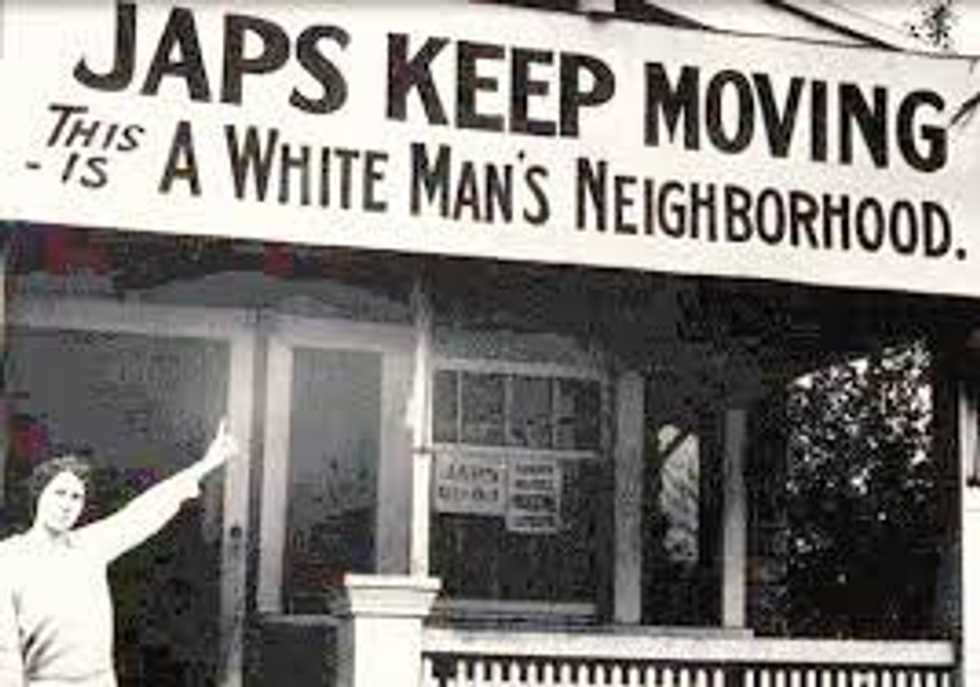
Perhaps unintentionally, people such as Rand Paul who oppose the Civil Rights Act on the basis of defending individual property rights are promoting a reality in which virtually limitless power is accorded to business owners over their wider communities. If Asian-Americans potentially can be legally discriminated against, what is stopping business owners from logically also saying their property rights permit them to deny service to members of the Libertarian Party, or to anyone who does not attend a specific church? In the America envisioned by some Libertarians, there would be nothing to stop groups of business owners from banding together to deny service to any political or ethnic group, forcing their removal. Even realtors could refuse to serve clients who are registered Republicans. This reality is much more familiar to the citizens of the former Soviet Union than it is to residents of modern Western European and North American democracies.
It is in fact not hard at all to imagine a reality in which whole neighborhoods or business centers could be closed to vulnerable minority groups, such as transgender individuals, even today if the Civil Rights Act were to be repealed.
This is not some hypothetical worst case scenario, it is what has happened over and over again in the history of the United States to many groups of people from African Americans, to Chinese, Catholics and Jews, before federal legislation was implemented.
What a sad turn of affairs that so many people who claim to support the rights of all to liberty would get behind a position that is so undemocratic, unconstitutional and immoral.
Those who advocate for an America in which it is acceptable to create groups of second-class citizens are on the wrong side of history.