


Trigger Warning: Sexual assault on college campuses.
As a Stonehill student, I am appalled at the way assaults are handled on our campus. Many sessions on receiving consent are provided, but when assaults do occur, the college does not pursue them properly. In the last eight years, there have been at least 28 cases of sexual assault reported our campus, but zero criminal charges against the accused students. This should alarm anyone, Stonehill student or not. For such a small student body, the frequency of reported assaults is too high, and the college should begin to take a greater stand against these crimes.
There are many issues with not fully following through on an assault report, especially when the victim wants it investigated. First and foremost, the guilty student is not being apprehended for their crime and faces no punishment, which is unfair and unjust. If the crime is being committed with no punishment, what factor is there to deter others and to show students that assault is a crime and will be dealt with as such? Consistently reminding people that they need consent for sexual activity is meaningless if there is no enforcement. We should also simply be reminding people that they do not have a right to any person’s body other than their own, no matter what the case or situation.
Secondly, the victim has to see their attacker and has to deal with the trauma knowing their attacker is not being punished. It is extremely traumatic to have to be near an attacker, especially if the victim will continue to see them frequently. In some instances, the victim may never come across their attacker again, but in other situations, the victim may have to sit in class with them or live in the same dorm as them. To me, this is a larger issue on small campuses like Stonehill where the student body size allows you to see a majority your fellow students on a regular basis.
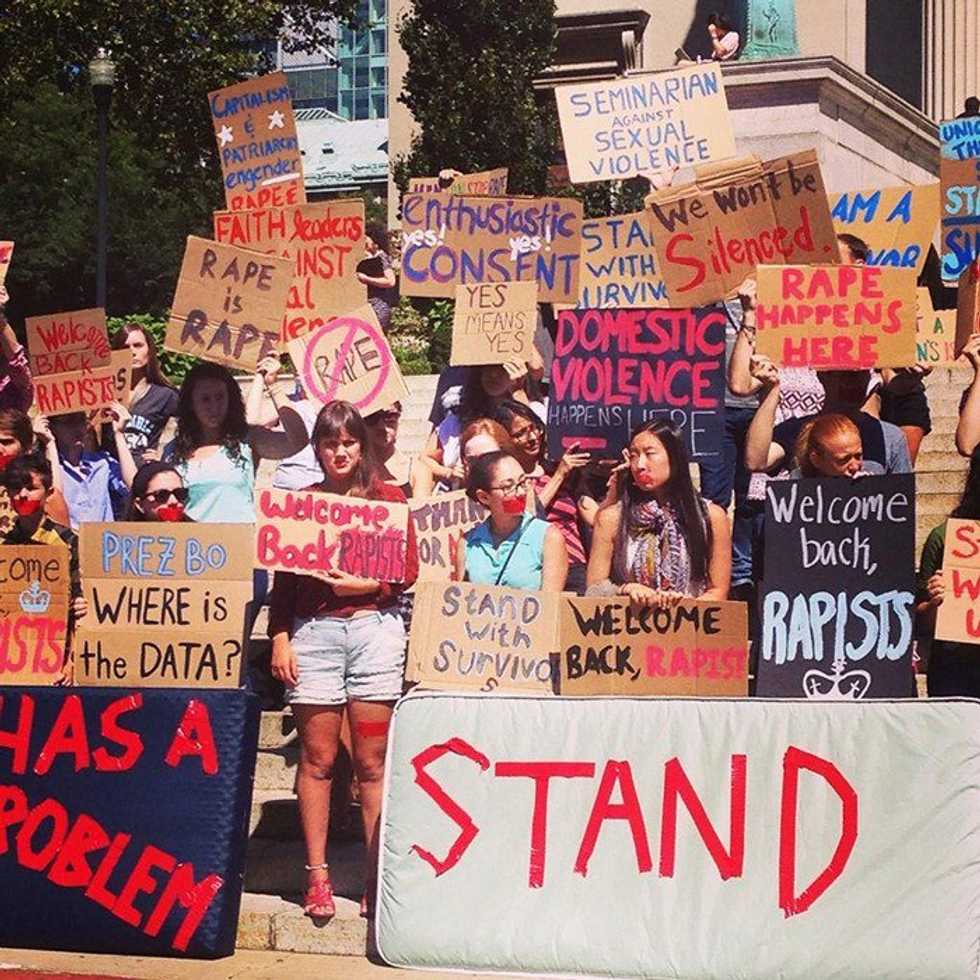
You may have heard of Emma Sulkowicz, a Columbia University student who was raped by a fellow classmate in 2012. To protest the college not punishing her attacker, she carried a mattress, similar to the one she was raped on, around campus. She stated that the protest would end once her attacker was removed from the college. Sadly, she carried the mattress with her on the day she and her attacker graduated from Columbia University.
To combat these situations, the guilty student, after being investigated, should not be allowed to continue their education at that college. It is not the responsibility of the victim to avoid their attacker during their everyday life. Also, in the most reported case that the victim is female and the attacker is male, allowing the male student to freely continue his education without being punished for or charged with his crimes shows all female students that their college values the education of their male students over their female students. If a male student can commit a crime against a female student and still receive the same treatment as the female student, it does not reflect well on the college.
The way colleges should handle sexual assaults on their campuses has been a hot topic for some time now, and with the increasing amount of assaults occurring, I believe it is finally the time to step up and apply stricter procedures. It is absurd to have 28 reports of sexual assault with none of them resulting in charges. Sexual assaults on college campuses can no longer be brushed off and not investigated fully. Just because it happens at a college or on a campus does not mean it is somehow out of the jurisdiction of the law. To protect the education of all students at a college, the students guilty of assault need to be held accountable for their actions. Along with our seminars on consent, there should be information on the strict punishments associated with assaulting another student. If a college cannot take sexual assault seriously enough to hold guilty students accountable, or to at least support and assist their victims, it is not a college deserving of any respect.
For any college student, it may seem difficult to assist in situations involving sexual assault, but there are many ways you can do so. One of the biggest ways a student can help is to support the victim of these acts — listen to them and give them a shoulder to lean on. Too many times I have heard of students who report assault and then are disregarded by their friends or told their attacker is "too nice" or "too good" a person to do such a thing. If this happens to a friend, encourage them to report their situation to the authorities and offer them love and support. As always, be ready to remind a victim that nothing they did caused their assault and that they are not to blame. What they drank, what they wore, who they went out with are all meaningless. If they were assaulted, they were assaulted. I hope this article opens your eyes to the major sexual assault issues occurring throughout our country and reminds you to offer support to people dealing with these traumatic experiences.

















