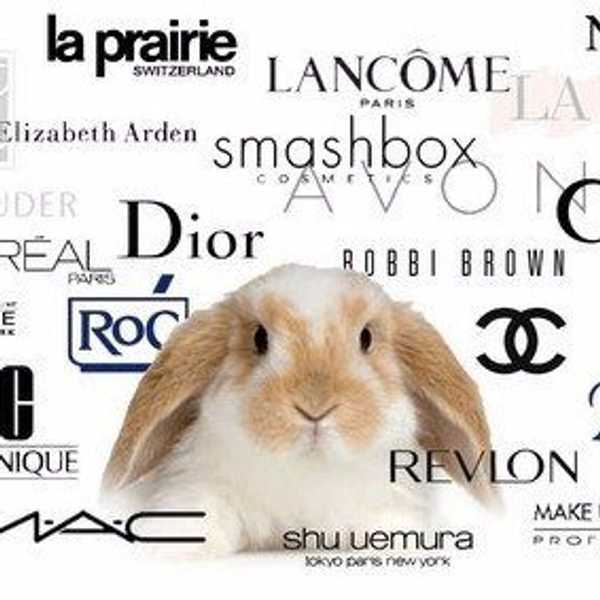
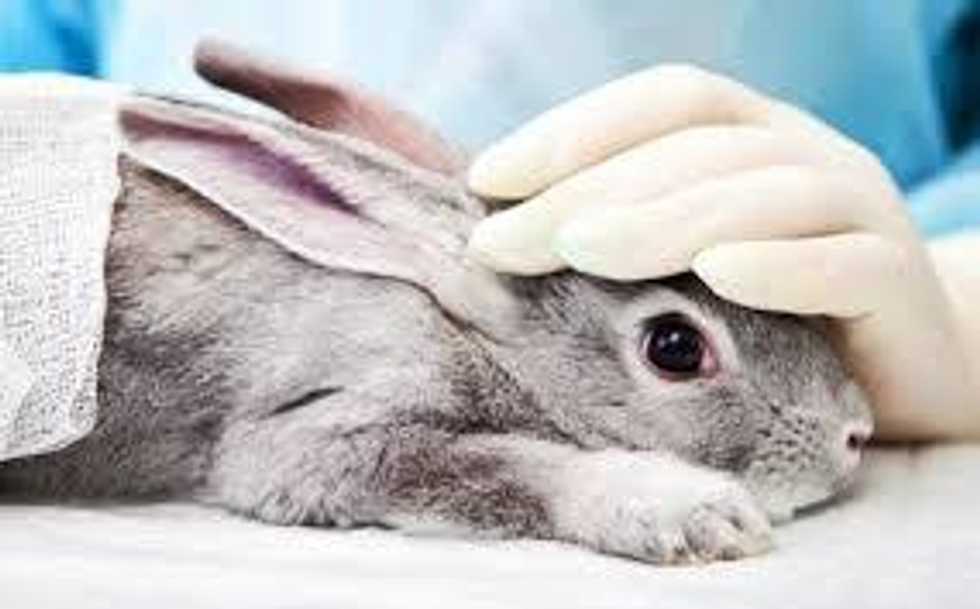
Lloyd, my 6-month-old bunny, was chewing on expensive Sephora eyeliner when I yanked it from her and checked to see if it was salvable. For those who do not own a bunny, their teeth are like blades. They have the uncanny ability to ruin anything they bite, almost immediately. As I looked at my eyeliner, now completely ruined and in shambles, I immediately saw the irony in this situation. My bunny had destroyed a product that continues to ravage her species. Cosmetic companies utilize bunnies to test their products, an evident display of unethical standards. “Beauty without Bunnies,” a slogan used to fight the battle against animal testing, states that a majority of our cosmetics (Sephora, Cover Girl, Neutrogena, etc.) all implement tests on animals. Many seem to have the notion that animal testing is primarily conducted only on mice and rats, but bunnies are actually the most prevalent victims of this cruelty.
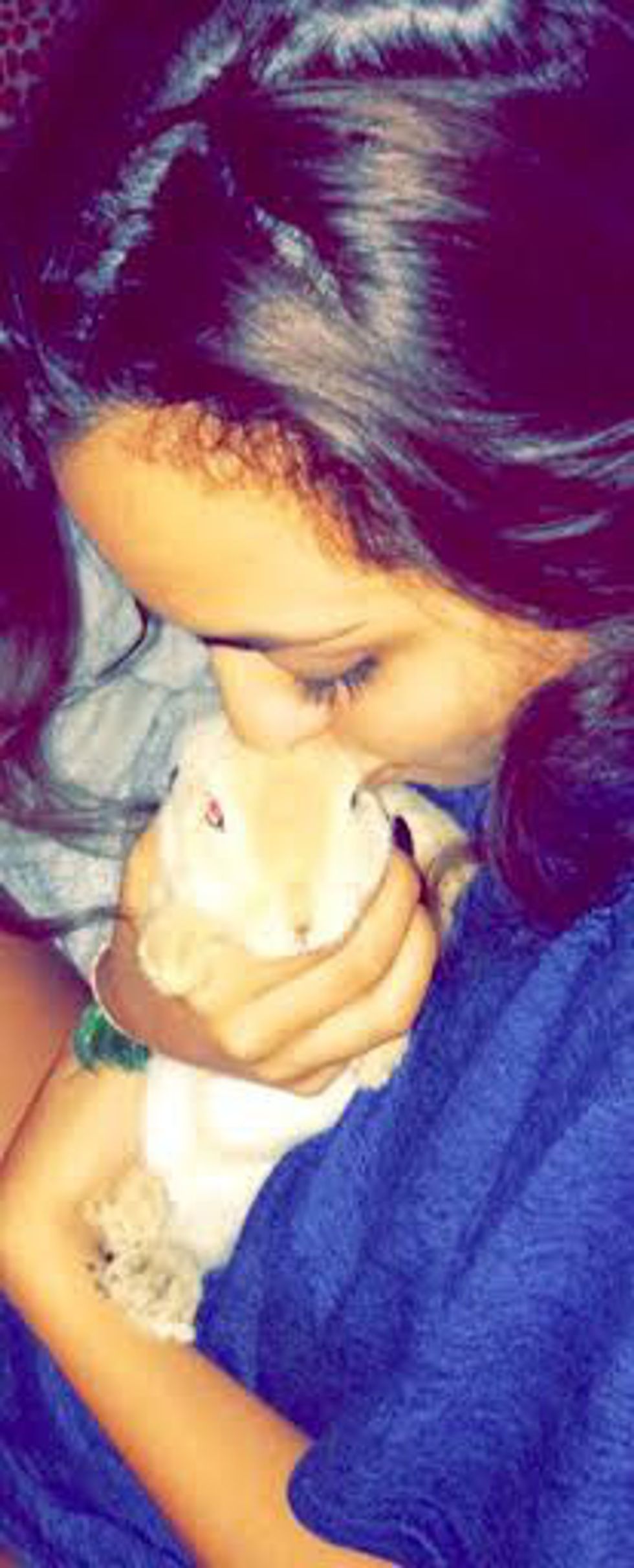 (Lloyd and I)
When looking at Lloyd in admiration, I became engulfed in discontent towards the aforementioned cosmetic companies. Notable brands continue to test on animals ostensibly because they believe to ensure the safety of the product, but also due to an underlying motive to minimize their costs. Companies build factories in emerging markets such as China, India, Thailand, and Brazil primarily to save money by exploiting their flexible labor laws and cheap sources of labor. This allows them to more quickly and affordably roll out their product lines.
L’Oreal, a prominent makeup company, is a prime example of a company whose products can be adequately used and deemed safe without having to utilize animal testing. A few years ago, L’Oreal was involved in an animal testing scandal where they pledged to not test on animals any further unless it was mandated by the government. Many people misinterpreted this message and assumed that animal testing was federally illegal in the United States. However, L’Oreal is domiciled in China, like most makeup companies, a country known for having laws that require testing their products on bunnies and other animals, even kittens. How preposterous!
Luckily, activists caught on to these deceitful tactics and discovered the loophole L’Oreal had conveniently found and exploited to their benefit. Activists began to continuously pressure L’Oreal and the Chinese government was persuaded by companies to begin to phase out their animal testing law. Currently, L’Oreal manufactures products that are completely vegan and for the most part cruelty-free, with about 1 percent of their products still associated with cruel testing activity.
So, If L’Oreal can implement this drastic change of operations and culture in their company, why can’t everybody else? Fortunately, L’Oreal and organizations such as PETA have applied enough pressure on the Chinese government to begin forcing a change in both laws and mindset and creating the possibility of a cruelty-free makeup world. Sue Leary, chair of the Coalition for Consumer Information on Cosmetics (CCIC), said, “The decisive ban on animal testing of cosmetics in the European Union certainly had an influence on this new position, because Chinese companies that test on animals are not able to market their products in the EU. In addition, the cosmetics industry, animal welfare advocates, and a global community of scientists that agree animal testing is not necessary have done great work proving this to Chinese regulators. It’s evident that Chinese officials are advancing quickly to accept alternative, non-animal test methods.”
All in all, animal testing is not ethical and should be deemed completely illegal. L’Oreal proves that a company can be both successful and cruelty-free. However, the problem is still relevant in other countries. In China and Brazil, products sold on their shelves still to this day must be tested on animals before being put on the shelves. So if a company that is cruelty-free and vegan such as Urban Decay were to sell their products in China, they would not be considered cruelty-free or vegan solely due to the fact that they hadn’t conducted any tests on animals. The animal testing these governments refer to consists of lethal injections of ingredients, the cutting of their scalp and skin, and then rubbing their eyes with the ingredients. Afterwards, they are not given any pain medicine and are killed, sometimes by cracking their neck or just being thrown out to die. This is undoubtedly an unjust, unethical, and inhumane practice that should garner more attention than it currently receives.
One reason why the European union has made animal testing illegal is because studies have shown that it isn’t even a very reliable form of testing. For example, different species react differently to certain ingredients. An ingredient that irritates a bunny’s eyes may actually relieve eye pain for a human, but we could never know! With that being said, there is simply no way of ensuring a chemical is genuinely safe until it is “tested” on a human. The European Union has come up with an advanced scientific method to test products safety without testing on animals. It requires a multitude of precautionary measures that are taken before the product is fully developed. It has been shown that one of the most viable alternatives to animal testing is using the blood of a human volunteer to test for the presence of sickness or a reaction that could occur from a product.
As one can see, animal testing is undeniably extremely unethical. Bunnies in countries like China and Brazil routinely undergo high stress and pain without any remorse. Anyone who has a bunny or has seen my bunny, Lloyd, knows that they are more intelligent, lovable, and engaging than one would think and do not deserve to live their lives in an oppressed state. This has reinforced the idea that animal testing is ludicrous, and that actions must be taken to eradicate this form of cruelty from our world.