

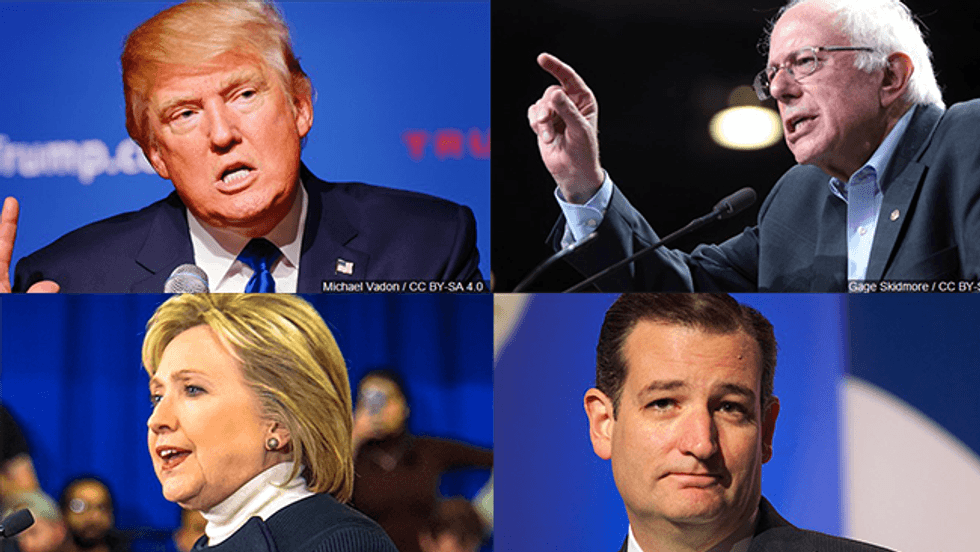
After New York’s primaries this last Tuesday, both parties will be looking closely at their delegate counts and seeing what needs to happen for their candidates to get the nomination.
Hilary Clinton had a great turnout and support from her home state against Bernie, with 58% of the vote, receiving 139 of the delegates from that state. Donald Trump also had a successful night, securing 60.4% of the vote, and 89 of the delegates, with John Kasich coming in second with 25.1% and 3 delegates and Cruz in third with 14.5% of the vote and no delegates.
Looking towards the conventions, it appears that the establishment GOP is hoping for a contested convention, which has not happened since 1976, when Gerald Ford secured the nomination over Ronald Regan. The Democratic race looks a little more secured for Clinton after her big New York win; however, the Sanders campaign still feels that they have a path to victory.
In this week’s article, I am going to look at what is going to need to happen to have a brokered GOP convention, and a Bernie Sanders nomination/brokered Democratic convention.
The Republicans
As of right now, the delegate count for the Republican nominees sits at:
In order for one of the candidates to secure the nomination for themselves, they will need to earn a total of 1,237 delegates before the convention. With those current delegates, Trump needs 347 delegates, Cruz needs 674 delegates and Kasich needs 1,090. However, with the remaining primaries left, there are still 674 delegates to be allocated to the candidates. This means that Trump needs 72.8 percent of the delegates, Cruz 100 percent and Kasich 161.72 percent of the delegates.
So it’s not really a question of who wins the nomination, but if he wins the nomination. It’s important to keep in mind, however, that according to many state laws, the delegates that are pledged to other candidates who have dropped out are no longer tied to any candidate. Adding in Rubio, Fiorina, Paul, Huckabee and Carson’s delegates, there are another 189 delegates that are going into the convention unpledged.
All of this is going to make the candidates focus on the big states coming up, including Pennsylvania, Indiana, California and New Jersey. At this point in time, if Trump continues with the popularity he’s drawing, many see his nomination as being secured on June 7th, when California and 4 other states will be voting, adding up to the 303 delegates. As long as he continues to win at the pace he does, I don’t see a contested convention being likely on the GOP’s side.
The Democrats
The Clinton Campaign is probably feeling a little stronger after their New York win, having lost the majority of districts but still pulling in 58 percent of the vote that night. This has expanded Clintons’ delegate lead to 1941 to 1240. In the remaining 19 Democratic primaries to be held, there is still 1,668 delegates to be allocated to the two candidates. In order to secure the nomination, one of the candidates will have to receive 2,283 delegates before the convention. That means that Senator Sanders needs 1,043 (62.47 percent) of the remaining delegates and Clinton needs 342 (20.5 percent) of them. The Sanders campaign still feels that they have a path to victory through the last 19 contests, perhaps with big wins in states like California, Pennsylvania and Indiana, and through persuading the super delegates to switch over to their side.
Many Sanders’ supporters feel that the remaining states all point towards Sanders winning, and New York ended his 7 state winning streak. If Sanders is going to pull out the nomination, it is truly going to be an amazing comeback, or we may find ourselves in a contested Democratic convention, even though DNC chair Rep. Debby Wasserman Schultz said that the Democratic nomination process would be done by the end of the primaries schedule.
So my predictions for this race is that we will see the inevitable nomination of Trump, and probably Clinton too. However, this is politics, and we have seen crazy things happen in primaries, like 2008 with Barack Obama and in 1976 with Gerald Ford. A contested convention would just be another interesting part of this very different presidential election.

















