Virtual Interpreters sound like a concept from a long-lost episode of Star Trek: A disembodied holographic head, floating in a room, translates a tense peace talk between two at-war alien races. It successfully interprets the message between the two delegates, and peace is restored to the universe!
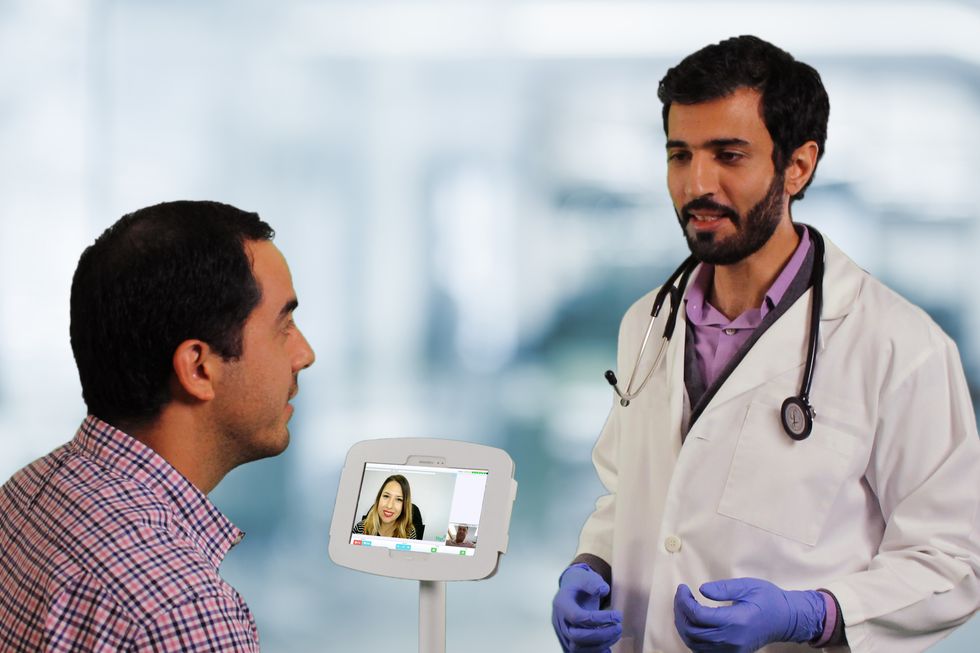
The reality is, unfortunately, less exciting. VRI (Video Remote Interpreters) is a service that provides virtual interpreting services between Deaf/Hard-of-Hearing (HOH) and hearing people1. VRI uses videoconferencing equipment and software to remotely connect an interpreter, usually located at a call station, to an interpreting situation. Currently, VRI is used in hospitals, police stations, mental health facilities, doctor offices, and many other situations.
This can be an invaluable tool: maybe you have a Deaf person from another country who broke a bone, and no one knows their country’s sign language2. Maybe the closest interpreter is an hour away, and you need someone to interpret for a woman going into labor until the live interpreter can arrive. VRI services are invaluable in these situations, but they also have the potential for abuse.
The problem with VRI is simple: technology is limited. For VRI to work, the internet connection must provide a clear, delay-free, full motion video and clear audio. If the picture freezes, or if the audio cuts out, the interpretation can be thrown off. The screen must also be big enough and close enough to the Deaf person to see subtle movements in the fingers and facial expressions. The VRI computer must be portable, as the Deaf person moves from room to room, or has to change their position. More than one person in the hospital must be able to use it, as well as an IT person to troubleshoot issues. You also must have more than one VRI equipped device, as more than one Deaf person may need it at the same time.
Additionally, the Deaf person must have good vision in order to see the screen: Deaf people with reduced vision or those that prefer tactile signing cannot use VRI. They must be seated or lying in the optimal position, so exams that require the patient to lie on their stomach cannot use VRI.
Imagine all of the physical variables line up perfectly—now you have to consider the actual use of language. Do they use American Sign Language (ASL)? Signing Exact English (SEE)? Pigeon Signed English (PSE)? Conceptually Accurate Signed English (CASE)? Rochester Method? Home signs? Do they have a solid foundation for language, or do they need a Certified Deaf Interpreter (CDI)? Are they from this area? Is the interpreter? There are so many variables that go into a successful interpretation.
If all of this sounds like a disaster waiting to happen, you’d be right. Take a look at this horror story:
A Deaf man in Rochester died from blood loss at the hospital after requesting a live interpreter repeatedly. The hospital, which had purchased VRI services, insisted that this was “appropriate access” as required by law. The ambulance called ahead, telling the hospital that there was a patient on the way who needed interpreting services. The only person in the hospital who knew where the machine was stored was on vacation. The patient requested an on-site CDI. The machine was found after several hours, but they faced another problem: the internet connection was not strong enough in the room that the patient was in, and the video was not consistent. The man again requested an on-site CDI. The staff instead moved him to a different floor, where the internet connection was strong enough. It was determined that he needed to have imaging testing done, where machines are not allowed in. The VRI cart was left behind, and the imaging procedure began. The Deaf man began to gesture and call for a nurse. The staff dismissed this as nerves, but he continued to call for a nurse and an on-site CDI for several minutes. The man’s liver had hemorrhaged, and he died from internal bleeding.
Unfortunately, this sort of story is not as rare as you may wish. VRI requires so many things to go right, and one misstep can cause catastrophic outcomes. VRI interpreters do not have the physical flexibility to be able to contort themselves into whatever position is necessary for the Deaf person, nor the ability to bring in a more advanced interpreter or a CDI if necessary. This means that severe miscommunications can happen in the worst of circumstances.
VRI has the capability to fill a crucial gap in the communication process, but should not be used as a permanent fixture. The National Association of the Deaf (NAD) firmly believes that VRI should be used as a “fill the gap” service until an on-site interpreter can arrive. The Deaf person reserves the right to request a live interpreter at any point if they feel that their communication needs are not being met.
The laws are catching up. The broad term “appropriate access” will be more clearly defined, and companies and hospitals that do not comply will be left vulnerable to lawsuits. Until then, it is the responsibility of the staff to quickly and accurately assess the needs of the Deaf person, and make the appropriate call regarding communication access.
1 It is also used for spoken-language interpretations, but this article focuses on interpreting services using sign languages.
2 Sign language is not a universal language. Different countries, provinces, and even towns may have a sign language that is unique to their region.