


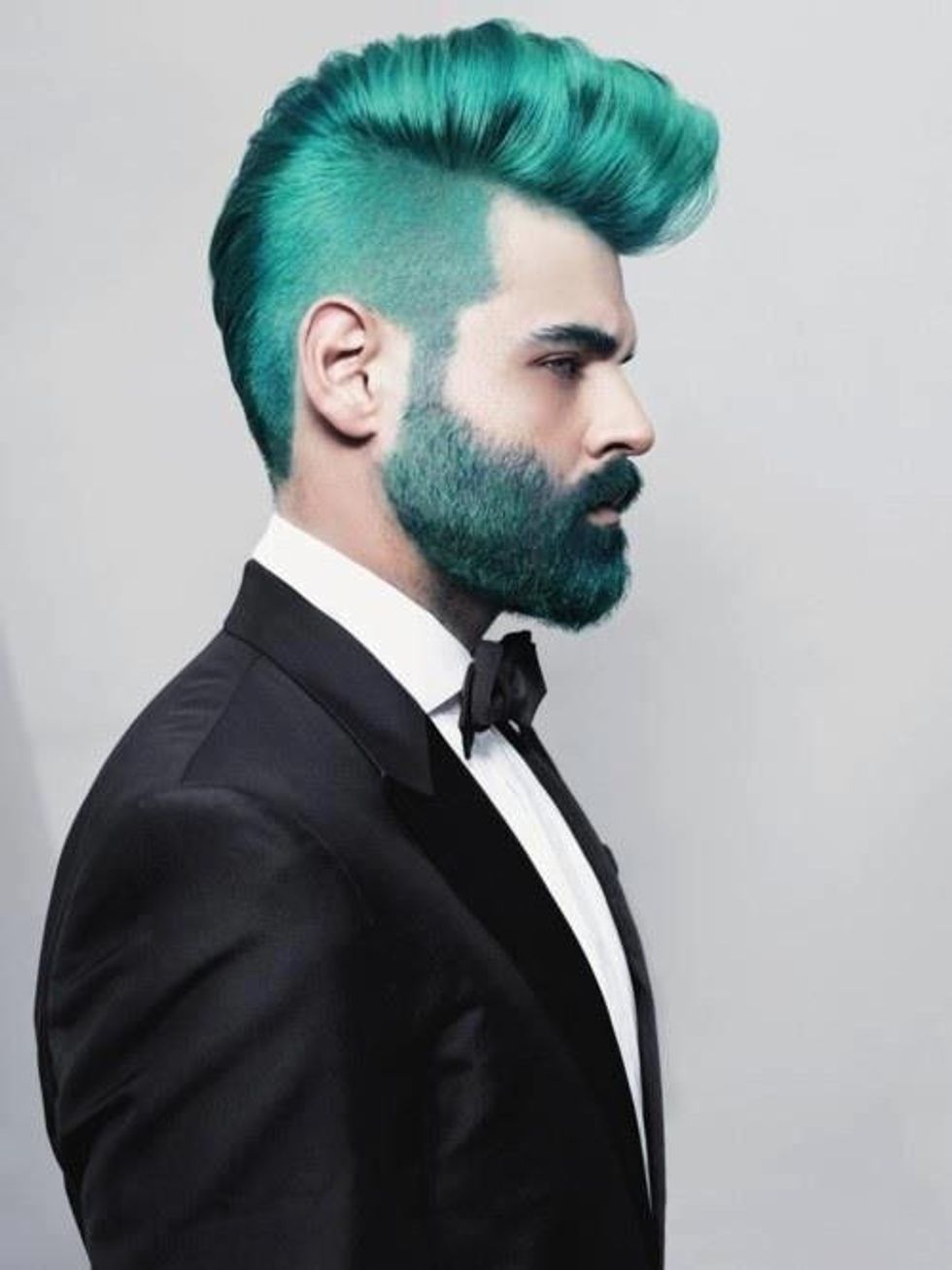
If an individual looks around a public place, they are sure to see people of all different shapes, sizes and colors. Every individual is born looking completely unique, but for many years people have been changing the way they look. Some turn to plastic surgery to entirely rearrange their looks, others lie in a tanning bed, but the most common form of self-inflicted transformation is hair dye.
According to statisticbrain.com, about 75 percent of women and 42 percent of men all around the world will dye their hair at some point before the age of 50, or the general age when hair starts to go gray. As of 2014, 47 percent of the hair dyed was dyed an unnatural color. People all over the world are dying their hair colors such as fire truck red, hot pink, cobalt blue and sleek gray. Now, perhaps ten years ago, these colors would have been considered outlandish and childish—and may still be by some people—but for the most part, it is seen as a new form of self-expression. Tattoos, piercings and funky colored hair are normal and barely even glanced at a second time. Although it may be seen as a form of self-expression, how does it look to the big bosses?
Unique appearances such as colored hair are becoming accepted in many career fields. Sorry Mom and Dad, you can no longer use the “You’ll never get a job looking like THAT” excuse. The most common fields where “alternative” looks are accepted are the following (according to emerita.com): entertainment industry, communications/journalism, culinary fields and fine arts fields such as photography, graphic design and theatre. However, these so-called alternative styles are still frowned upon in fields such as corporate business, education and politics and law.
It is obvious that outlandish hair colors and styles are definitely on the brink of integration into many different career fields. “I actually like getting a candidate with a funky hair color, it shows me that they’re not afraid to take risks,” days Leahanne Raaz, the owner of a small photography company in North New Jersey (www.madamenoire.com). But it seems that industries that run more on the corporate side, as I listed above, are still putting their foot down when it comes to anybody who isn’t a completely natural looking specimen. In a chart presented by www.afb.org, business and law firms allow “nontraditional hair color” to negatively affect their decision on an applicant from about 37 to 52 percent. That means that more than half of the people who are using hair color as a form of expression are being penalized for it, instead of being considered for a position based solely off their credentials. However, on the opposite end of the spectrum, about 48% to 59% of employers in fields like graphic design and the music industry believe that when an applicant boldly showcases their individuality through their hair color, they give the impression of being more creative than those with a completely natural look to them (www.afb.org).
So it seems that in contemporary society, those with more unique looks have their foot about halfway in the door. No individual should ever feel afraid to express themselves through any means of appearance because of a job. I believe that I speak on the behalf of many when I say that I one day hope that people will be evaluated strictly for their qualifications and personality when interviewing for a job, and not what they look like. That is discrimination in its most obvious form, and we have enough of that in this world already.















