
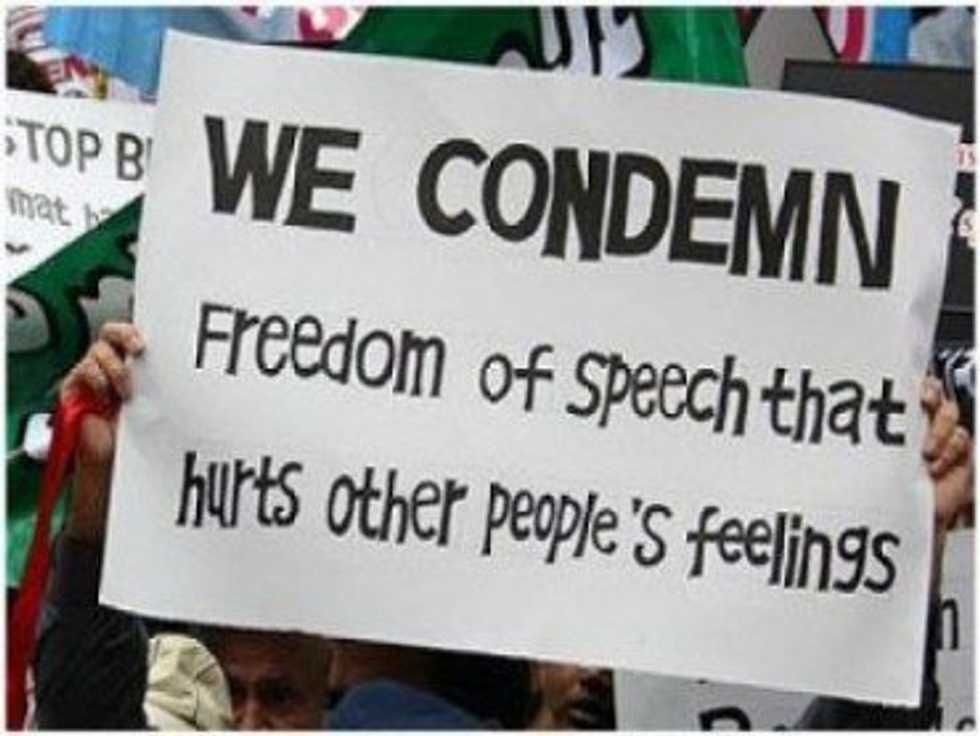
Contrary to popular belief, colleges these days are not about freedom of expression. It is odd to see institutions which were the birthplace of many protests and safe havens of controversial ideas have essentially become a black hole of free speech. So what do I mean by this?
It would seem to me as though freedom of speech is now being restricted on college campuses. This sentiment appears to come from the more liberal students, although I don’t think they’re entirely to blame.
I’ve had this concern about college for a while, now, but it has been highlighted in the past years with events like the Missouri University protest, and the Yale safe space incident. As someone who considers themselves to be a liberal, I cannot understand how these students can call for censorship and still somehow claim to stand for liberal values.However, these students are not entirely to blame. Even at my own college, Troy University, portions of the free speech code have a “red light” designation by the Freedom for Individual Rights in Education, or FIRE for short. “Troy University has been given the speech code rating Red. A red light university has at least one policy that both clearly and substantially restricts freedom of speech,” FIRE’s website says.
Trust me when I say our college campus isn’t filled to the brim with liberal students. Despite this difference, our college has very restrictive policies when it comes to freedom of expression.
According to the Troy University Handbook, “Cruelty, obscenity, crudity, and offensiveness, for the sake of offensiveness, have no place in the public discourse of a University community. As members of the University community, we are all responsible to one another and to the thinking and thoughtful community of which each of us ought to be a valuable part. Each of us must be considerate of other users of University computer resources and facilities.”
On its surface, this phrase may seem harmless and probably helpful. It might even have been written with the best of intention. The only real question that remains is the possible implications of instituting such a policy. The concern that I and many others have come with the word offensiveness. What could we consider to be universally offensive? What is something that literally everyone will be offended by? The short answer is that no such thing exists.
Offensiveness also played a role in the Yale safe space incident that happened earlier this year. For the uninitiated, a professor at Yale responded to an email sent by the administration advising against wearing offensive Halloween costumes. Essentially, this professor said that the administration shouldn’t be allowed to discourage certain costumes as that diminishes freedom of speech. As a result of this email, students protested outside of an academic hall calling for what they call a “safe space.”
The common thread that connects both sides of two differing ideologies of censorship is the idea that which they find offensive must be silenced. In my mind, these people wish to turn their universities into echo chambers that reinforce ideas. This is one of the worst things that I think can be done to a college. I came to college not to have my views justified but challenged. If my views are truly based in fact, then they can stand these challenges. These people wish to build college on the premise of teaching someone not how to think but what to think and that is a scary idea.