

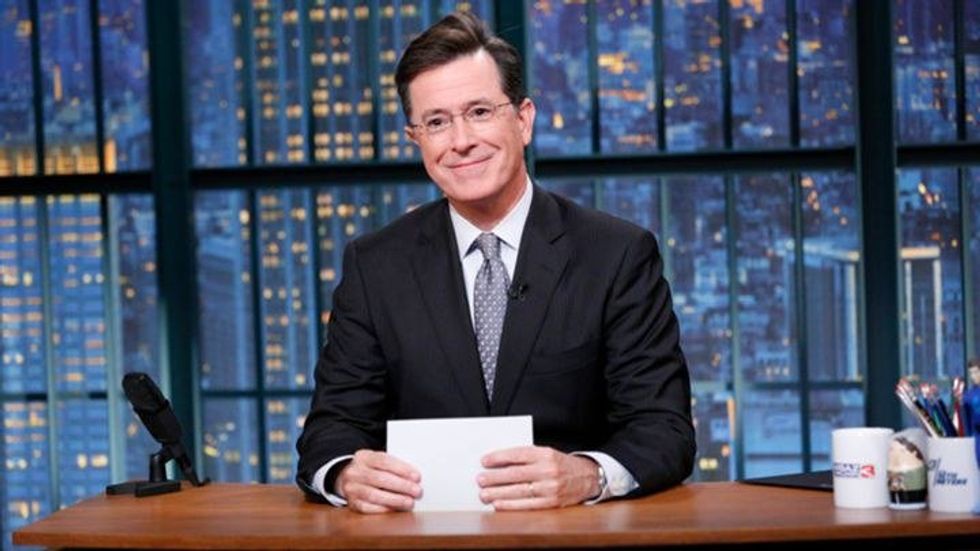
For years, Stephen Colbert was the ultimate performer of news satire, acting as a fictionalized version of himself in "The Colbert Report" on Comedy Central. Now, Colbert has wrapped up his first week without his fictional persona, beginning his run as the host of "The Late Show" on CBS.
“I used to play a narcissistic conservative pundit,” Colbert said, addressing his studio audience during the show's debut. “Now I’m just a narcissist.”
Colbert may have left behind his Comedy Central persona, but still delivers his usual brand of quick wit and topical humor. His comedy sketches are comparable to those of other late night hosts, however, Colbert's importance to television will be in his dedication to authenticity during interviews with his guests.
Much of late night television highlights celebrities, movies, and musicians. While other late night hosts excel in lighthearted, entertaining sketches with the top faces in pop culture, Colbert goes further with more genuine, hard-hitting interviews. His first show included celebrity guests, of course, including fun interviews with the likes of Scarlett Johansson, Amy Schumer, and Stephen King. Colbert also interviewed tech CEO, Elon Musk, and founder of Uber, Travis Kalanick.
Colbert's guests of diverse occupations will ensure the show's success, giving a large range of people a reason to watch. Most importantly, Colbert is continuing his fierce focus on politics. His interviews on "The Late Show" are evidence that he will continue to ask the important questions of political guests, and will continue to make a broader political conversation more accessible to the general public.
His first two weeks' guests will include several visits from politicians and presidential candidates, including Jeb Bush, Joe Biden, Ban Ki-moon, Stephen Breyer, Bernie Sanders, Elizabeth Warren, Donald Trump, and Ted Cruz.
Colbert's dedication to smart political conversation is a reminder to American voters that choices on all sides must be considered. For example, in one episode, Colbert proved how utterly unrecognizable many presidential candidates are to the average American. He seeks to remind people that while certain incompetent candidates may be getting all the press coverage, there are many more noteworthy presidential hopefuls.
His constant drawn-out comedy bits about the political elephant in the room help to make it evident that Donald Trump is not something Americans can laugh away. He can't be mocked out of existence, or even out of the presidential running.
Many people get their mind set on one candidate without bothering to learn the names or political stances of other candidates in either party. This kind of blind following has left America in a dangerous place for the next presidential election. "The Late Show" has already addressed the downfalls of several political candidates, and Colbert has plans to interview many of the leading presidential candidates.
With the end of David Letterman's reign as the king of late night television, Colbert is, once again, filling the Ed Sullivan Theater with great late night content. He is bringing intelligent thought and conversation to late night television, and seems thoroughly excited to take on his new role.