
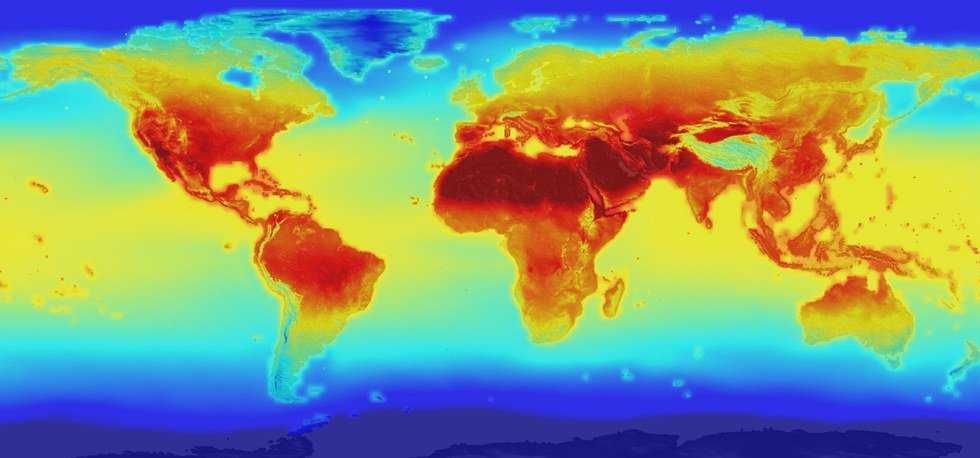
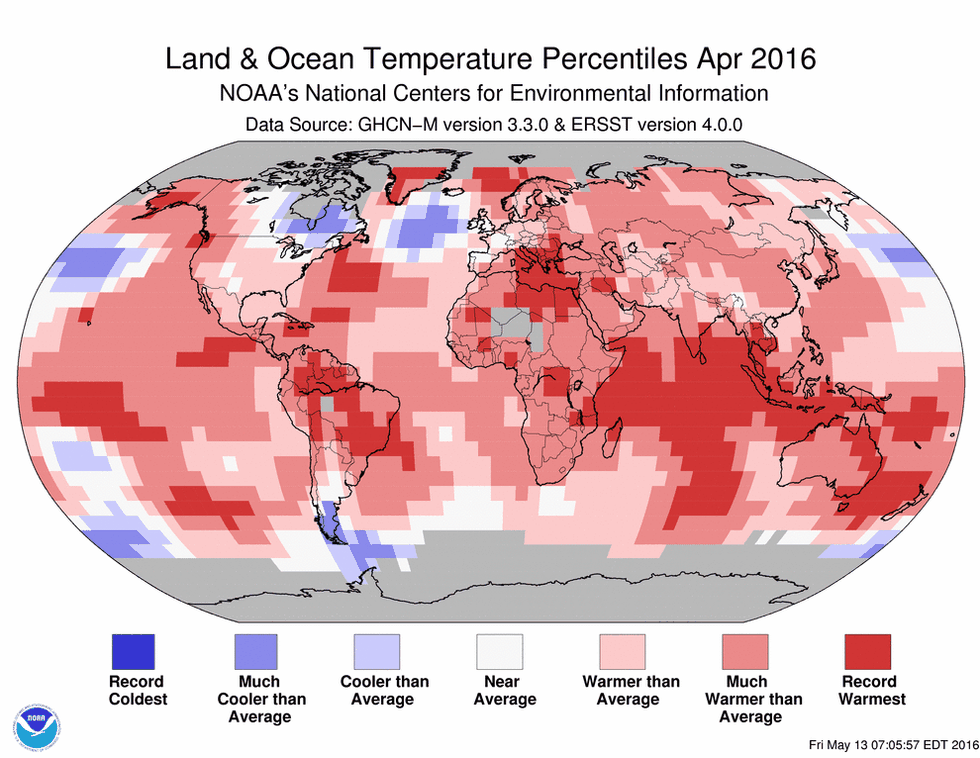
As of May 19, 2016, the National Oceanic and Atmospheric Administration (NOAA) and the National Aeronautics and Space Administration (NASA) reached a consensus that marked the month of April 2016 to be the warmest April on record. NASA released their updated Global Land-Ocean Temperature Index in mid-May. The data collected indicated that the global average temperature was 1.11 degree Celsius (1.99 degree Fahrenheit) higher than the average between 1951 and 1980, a baseline established by NASA. By NASA's calculations, April was the seventh consecutive month to exceed by a large margin the previously held temperature average. A few days later, NOAA released their monthly State of the Climate report. According to data collected by NOAA, April 2016 temperatures were 1.10 degree Celsius (1.98 degree Fahrenheit) higher than the 20th century average, and April marked the 12th consecutive hottest month on record. The collection of weather and climate data began in 1880.
(Source: NOAA)
There are minor discrepancies between the two institutions. This is due to the difference in collection methods of NASA and NOAA. To collect the weather and climate data, both institutions use weather stations all across the globe. However, there are areas where it is not possible to set up stations and therefore, no exact information is gathered. On the map above, these areas are shown in gray.
Both institutions interpolate data from these areas. By using information from stations surrounding the inaccessible land or oceanic regions, they derive an expected or likely average of figures from that land. Using interpolation, NOAA is able to accurately report data from 93 percent of the earth's land and oceans. According to an article on global temperature records, NASA describes their interpolation methods as more "aggressive," sometimes utilizing stations 1,200 kilometers away from a specific area to gather data. Such methods allow them to accurately report data from 99 percent of the earth's land and oceans. The Japanese Meteorological Agency and the UK Met Office Hadley Centre for Climate Science and Services also regularly release global climate data. However, these two institutions do not interpolate but omit areas without weather stations and instead report accurate data from 85 and 86 percent of the earth's land and oceans, respectively. Despite minute differences in data (often in labeling "hottest month"/"hottest consecutive month"), there is a consensus among these institutions: climate change is occurring at an alarming rate, and it's mostly our (as in, humankind's) fault.
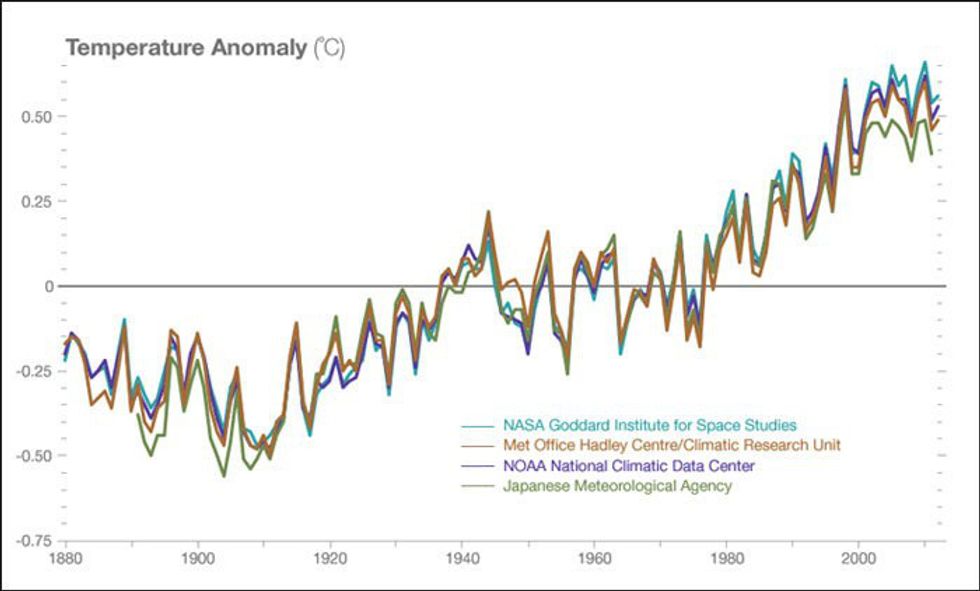 (The findings of four major climate research institutions all show a dramatic upward trend of temperature anomalies since the 1910s. Source: NASA)
Despite what big oil companies, radical evangelical Christians, GOP presidential candidates, or scientifically illiterate friends, family or peers might try to tell you, climate change is happening. NASA reports that 97 percent or more of actively publishing climate scientists agree that warming climate trends are "extremely likely" to be caused by humans activities.
"Now wait a minute!" you may be saying. "How is that remotely possible? How can one species, one that is not very big, affect the workings of an entire planet?" Well, we can thank our DNA. As a species, humans are not a physically large animal. Despite our small physical stature, we are an extremely intelligent and innovative species (and one with a population of over 7 billion!). Our brains have enabled us to rapidly improve our technology and lifestyles. However, while improving our livelihoods, we have caused irreparable damage to our planet.
Some of this damage is quite obvious. As our technology allowed us to move outward and expand away from coasts and rivers, we have leveled forests, damned and channeled rivers and paved the land. For energy, we have blown the tops off mountains for coal, have plunged deep into the earth for, and manage to spill oil over land and sea. Until recently, we piled all our waste in giant heaps or dumped them in the ocean. We have polluted land, air and water.
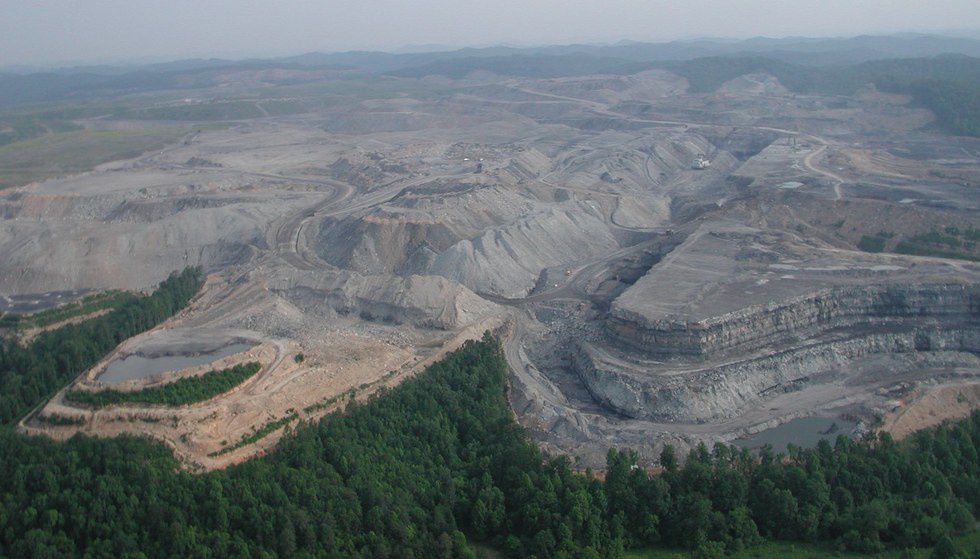
(Mountain top removal in West Virginia. Source:coalcountry.wordpress.com)
So far, the effects of climate change have been far more subtle, at least to those in the developed world. For as intelligent a species as humans are, we often suffer from "collective amnesia." A drastic event such as an earthquake, a volcanic eruption, a series of tornados or hurricanes or a severe mudslide occurs. Despite any death or destruction endured, those places are once again repopulated as if nothing ever happened. When another disaster occurs, it tends to takes the population by surprise (again). Similarly with climate change and the warming of seasons, people tend to "forget" what it was like five or 10 or 15 years ago, and how the temperatures have risen and natural events such as tornadoes and hurricanes have become more severe. It seems all it takes for some people to devise an argument against climate change is one cold day.
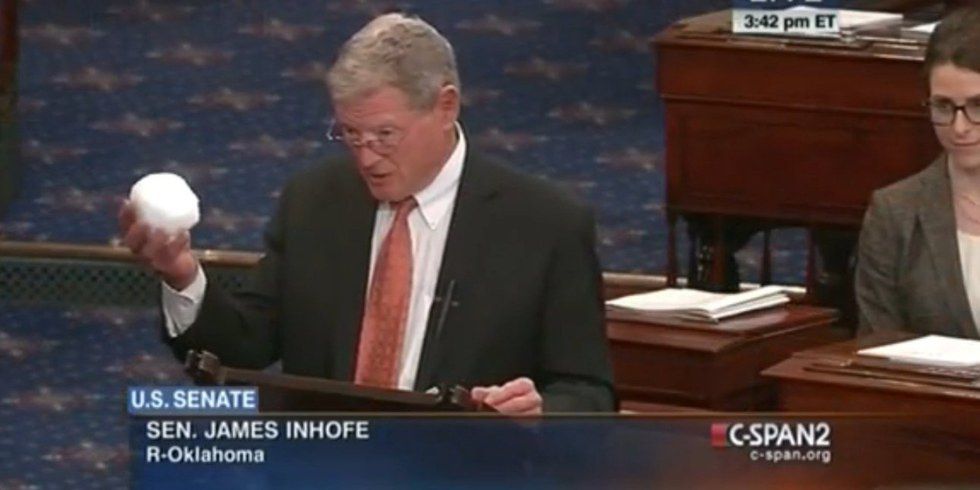
(Senator James Inhofe brought in a snowball to the Senate floor in February 2015 as an attempt to combat the "hysteria on global warming" by claiming "because we keep hearing that 2014 has been the warmest year on record, I ask the chair, ‘You know what this is? ... It’s a snowball ... So, it's very, very cold out." Source: The Huffington Post)
In addition to suffering from collective amnesia, skeptics of climate change also tend to confuse climate with weather. The distinction is surprisingly simple. It is all a matter of time. Weather is measured and reported minute-to-minute, day-to-day, month-to-month. Climate is the average of weather patterns over long periods of time (usually over 30 years). NASA put it plainly: "Climate is what you expect ... weather is what you get."
According to a report by Time, a survey that was started in 2008 revealed in late 2015 that climate denial in the United States had reached an all-time low. According to this survey, 70 percent of Americans believe evidence supporting global warming, and only 16 percent believe there is not enough evidence to prove that global warming is a real and present danger. Though it is the lowest denial percentage since 2008, it is still 16 percent too high. It also seems that members of this 16 percent exercise power in the United States government, mostly due to lobbying. The Republican-majority Congress have repeatedly blocked proposals by Democrats and President Obama for climate mitigation and clean energy growth. Presidential candidate Donald Trump, and former presidential candidate Ted Cruz have vowed to defund the Environmental Protection Agency (EPA) if elected.
The climate of Earth has changed in the past. There have been warm periods and ice ages. However, the rate at which the climate is currently changing has not occurred before. Since our records only date back to 1880, scientists are able to observe the change in climate over time using gas molecules found in ice cores drilled from packed ice in Antarctica and Greenland. It is information gained from these studies as well as current temperature records that have lead to the 97 percent of climate scientists who agree that climate change is "extremely likely" due to human activities.
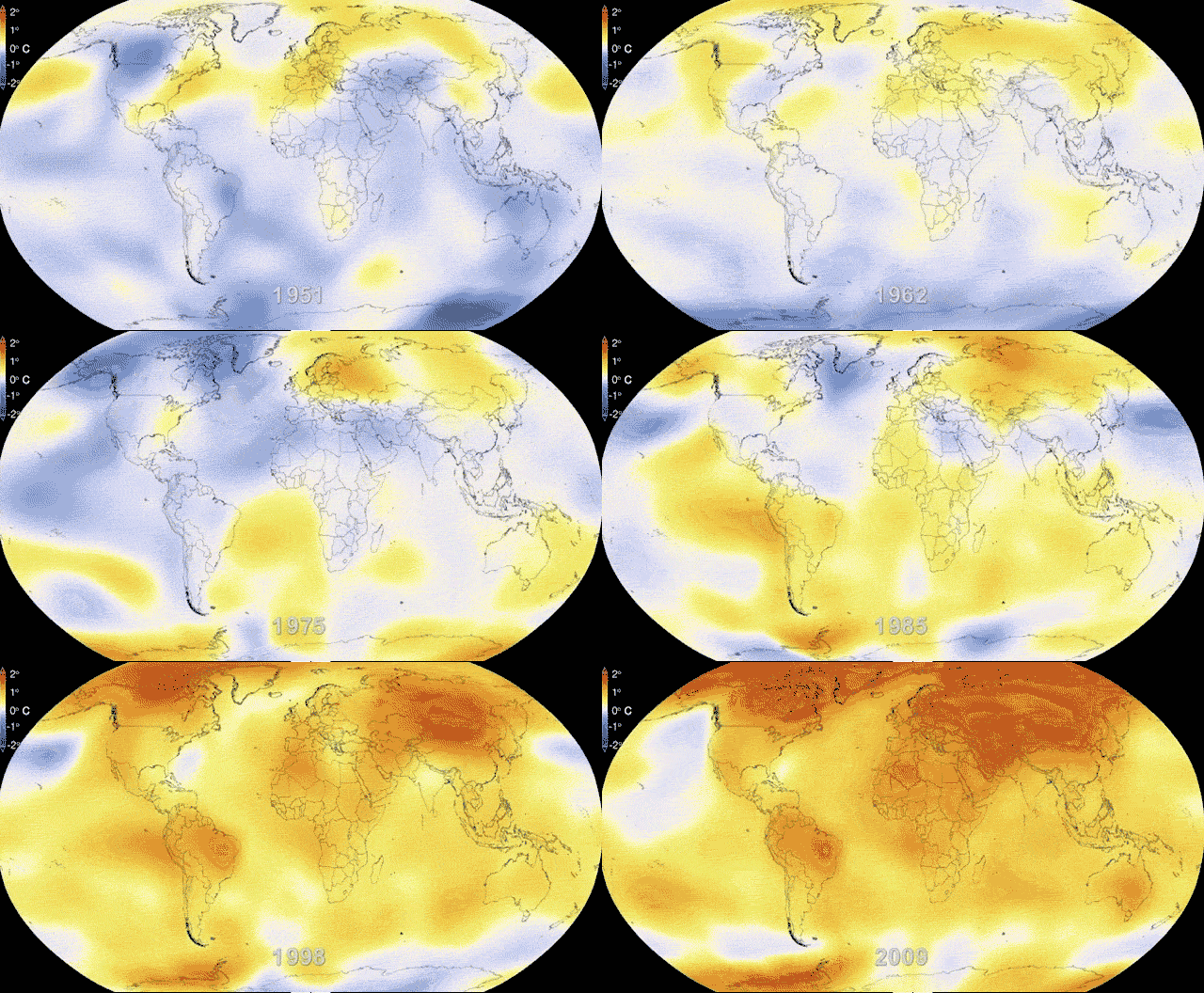
(Global climate patterns from 1953 - 2007. Source: giphy.com. Images used in gif are from NASA.)
The culprits of climate change are greenhouse gases. "Greenhouse gases" are gas molecules that naturally occur in the atmosphere. These gases both allow the heat from the sun to pass through the atmosphere as well as trap the heat within the atmosphere instead of allowing it to escape into space. To remain hospitable for life, greenhouse gases are necessary. Unfortunately, since the Industrial Revolution, humans have been adding more and more greenhouse gases into the atmosphere than would naturally occur, which has resulted in a increase of global temperatures.
There are four main times of greenhouse gases. Carbon Dioxide (CO2) is the primary greenhouse gas in the atmosphere. According to the Environmental Protection Agency (EPA), CO2 accounts for 76 percent of global emissions. Methane (CH4) is emitted in the second-largest amount, accounting for 16 percent of global emissions. Nitrous oxide and fluorinated gases account for 6 percent and 2 percent, respectively.
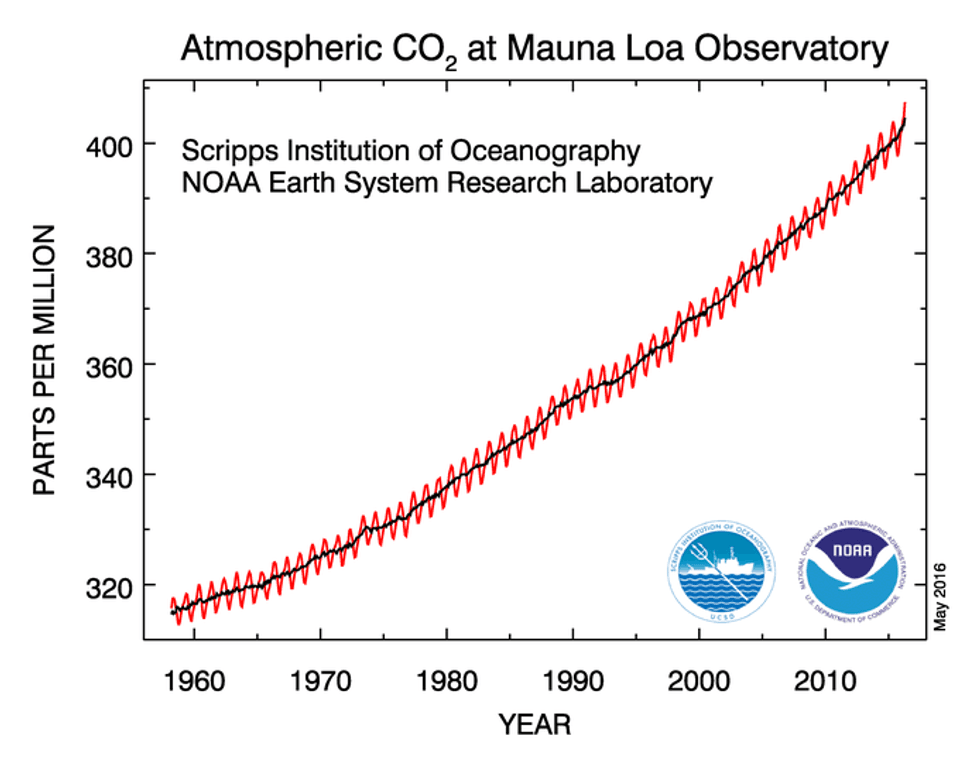
(Source: Earth System Research Laboratory, NOAA)
The above graph represents the measurements of carbon dioxide in the atmosphere as taken from Mauna Loa Observatory in Hawaii. Although levels of CO2 do oscillate during the year, there has been an overall positive trend. This trend correlates with temperature trends in the same span of time.
Carbon dioxide accounts for the largest greenhouse gas emission because it is produced by the use of fossil fuels, and the use of fossil fuels is ubiquitous in nearly every aspect of our lives. According to the aforementioned report by the EPA, 65 percent of carbon dioxide emissions are due to "industrial processes," and 11 percent is due to "forestry and other land use." Industrial processes encompass most aspects of our lives in one way or another, whether its heating and cooling your house, the fuel in your car or merely how your possessions (books, appliances, toys, furniture, food) were produced and transported to you.
Methane is emitted by agricultural activities (particularly in factory farming), waste management, burning of biomass and energy use. Agricultural activities are also the main source of nitrous oxide emissions. Fluorinated gases such as hydrofluorocarbons, perfluorocarbons and sulfur hexafluoride are emitted through industry processes and refrigeration.
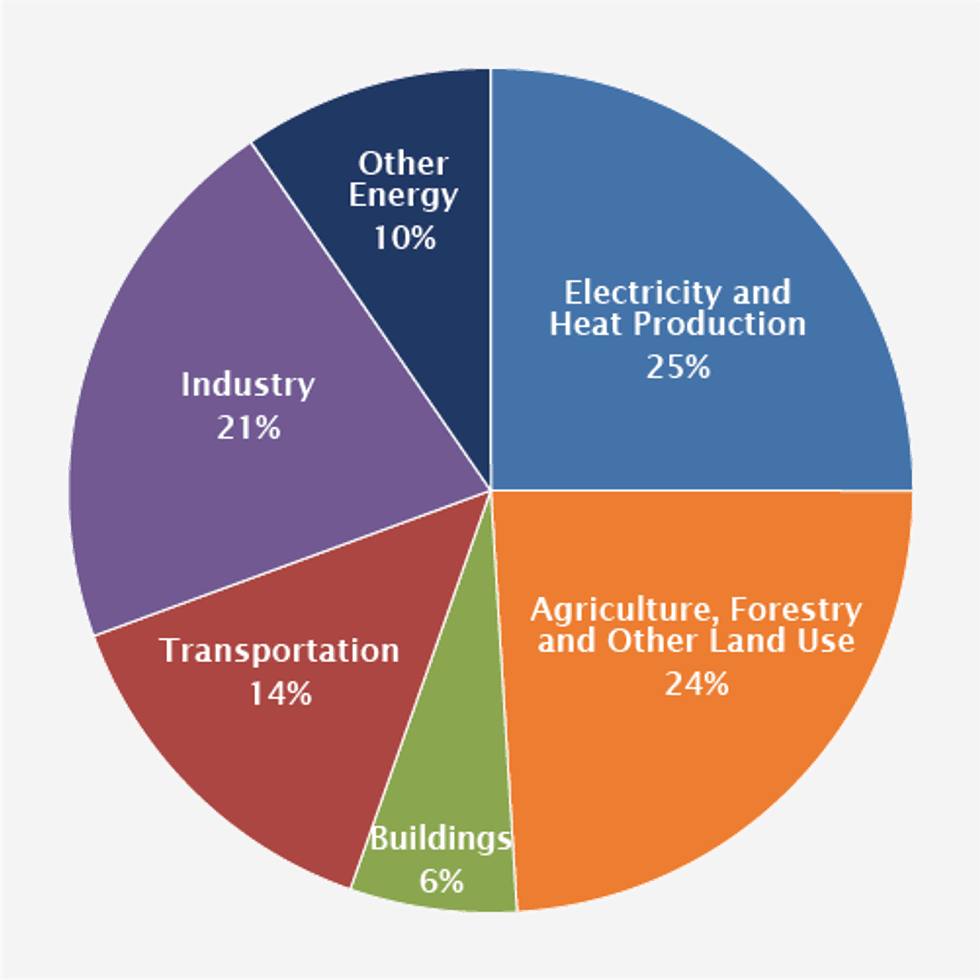
(Global Greenhouse Gas Emissions By Sector. Source: Intergovernmental Panel on Climate Change)
The consequences of climate change are an Earth vastly different to the one we are used to. NASA compiled a long list of effects that include increased drought and heat waves (which will increase the likeliness and severity of wildfires as well as decrease water supply and negatively affect agriculture), stronger and therefore more dangerous hurricanes, increased insect outbreak, warming seas (which will lead to coral bleaching and severe loss of diversity), sea level rise one to four feet by 2100 (say goodbye to coastal cities unable to adapt quickly) and ice-free summers in the Arctic (say goodbye to polar bears).
The time to change our ways was 50 years ago. Now, we can only mitigate future impacts and learn to adapt to the world we have created. We still have time to ensure a future for our children and grandchildren that is not riddled with natural disasters, drought and disease. There is still time, but we must act now, and we must act together.
"Every little bit helps" is not just a trite expression. It is cliche for a reason: it is ultimately true. If everyone in the developed world with the means to do so made small changes to their lifestyle while new clean energy resources are being developed and refined and legislation was put in place for industrial emissions, a better tomorrow would already be in the works. There are two major ways to personally combat climate change: by reducing your carbon footprint or "going green," and getting educated and excited about science.
"Going green" is both a welcoming and intimidating phrase used to encourage lifestyle changes that benefit the future of the planet. Welcoming, because one knows they'd be moving the right direction, and yet intimidating by the pressure to do it "right enough". There are social, economical, and (in some cases) religious restraints. Fortunately, "going green" is not an all-or-none deal. Even if you can't turn your lifestyle on its head, just one or two minor changes will positively affect your "footprint". Don't believe me? Utilize the EPA's Carbon Footprint Calculator before and after you make your changes.
There are 10 simple ways to lighten your footprint today, as soon as you're done reading this article. They are:
1. Turn off lights when you leave a room. Utilize natural lighting when available. Check to see if your appliances have "energy saver" options, and use them!
2. Unplug your electronics when they're not in use. Remember to take your chargers out of the wall sockets when not charging your phone or laptop to prevent unneeded energy expense.
3. If possible, drive less and walk/bike more. Save money on gas, get exercise and cut down on carbon emissions all at the same time.
4. When grocery shopping, look for locally grown products. The less that fruit or vegetable had to travel to get to your local store, the "greener" it is.
5. Soak your dishes in the sink before scrubbing them. You'll wind up using less water to clean and rinse.
6. Speaking of water, try and shorten the lengths of your showers at least a couple of days a week.
7. Try "meatless Mondays". Or Tuesdays. Or Wednesdays. Or any days. Eating less meat will drastically decrease your carbon footprint because the factory farming industry in the United States contributes for 37 percent of methane emissions. Or, try to eat meat that was locally raised, preferably "pasture-raised".
8. Ditch the brown bag lunch and plastic grocery bags. Reduce your waste by using reusable lunch bags, Tupperware containers, coffee mugs, water bottles and grocery bags.
9. Recycle! Paper, plastics, and metal cans should be separated from the normal trash. A quick Google search should fill you in on your town's recycling policies and regulations.
10. Encourage your friends and families to do the same. Half the battle is spreading the word!
Finally, the most important thing anyone could do is to be well-educated on the subject. Even if you are not convinced of climate change, having a strong scientific foundation will surely help you in all aspects of your life. Today, getting educated in "the basics" is easy and can be fun! You certainly don't have to pay thousands of dollars to a university to lay a strong foundation.
Learning about science and climate change should be fun and accessible. Netflix offers four great programs that are as engaging and entertaining as they are enjoyable. "COSMOS: A Spacetime Odyssey," "Bill Nye the Science Guy," "Planet Earth," and "The Magic School Bus" are all available. If you're looking for shorter programming, Crash Course on YouTube has short (8-15 minutes) videos on a range of scientific subjects including astronomy, biology, chemistry and ecology, as well as a series on "Big History." If you prefer reading but have no interest in picking up a textbook, there are three great "intro to science" books that are perfect for first-time readers and science students alike: "Cosmos," by Carl Sagan and "Undeniable and Unstoppable" by Bill Nye. (And both are available as audiobooks, too!)
According to 97 percent of active climate scientists, climate change occurring and it is extremely likely that it is the fault of humankind. If nothing is done immediately, we will soon live in a world we no longer recognize. That is both an intimidating and frightening thought. No matter how bleak that potentiality may seem, there is hope for a bright future. Everyone can make a difference, everyone can fight their own battle against climate change. It's just going to take some work, and there's no time like the present.