

*Note: the following article is an excerpt from a research project I conducted late last fall.
On April 1, 2014, NPR posted a link on Facebook titled “Why doesn’t
Congratulations, genuine readers, and happy April Fools' Day!
We sometimes get the sense that some people are commenting on NPR stories that they haven't actually read. If you are reading this, please like this post and do not comment on it. Then let's see what people have to say about this “story.”
NPR’s prank proved how a large amount of readers will only look at headlines and not the story as well as the importance of headlines themselves. The question remains. What makes a headline appealing enough to click on? The goal of this study is to see what headlines college students between 18-25 years old find most appealing and from what sources they most frequently obtain their news. I am targeting this demographic because I predict that due to the rapid rise in young adults receiving their news online, especially through social media sites. A 2013 Pew Research poll found that 71% of those 18-29 cite the internet as a main news source and in a 2015 poll, of the 18-34 year olds polled, 67% said they received their news from Twitter and 74% from Facebook. This research is important because online media continues to morph and change in the new digital age and with it, the emergence of “clickbait”.
Clickbait refers to online content that is tailored to be sensational, for the purpose of intentionally deceiving users to visit a specific website or to covertly promote a given product or service. Content such as this is indicative of the shifting trend to how readers consume online content and how online publications maintain profitability. With the rise in the commodification of user data, businesses that are based in the Internet are more and more liking to statistics such as “number of clicks” to illustrate real-world interest and gain in a given product. This too is true of journalism, where editors depend on real-time statistical metrics to judge the quality of their staff (Murtha, 2015).
While journalists are traditionally versed in the finer points of drawing the attention of readers, the rise of clickbait-type content indicates that journalists and other content producers may be putting more effort in drawing users in initially, than holding their attention through quality material. Speculation aside, many in the industry see the rise of clickbait as having a caustic affect on the institution of online journalism and media, as well as serving little purpose to readers other than a chuckle and the click of a mouse (Christin, 2014). Especially when a financial impetus is placed on writers and editors to generate clicks as opposed to generating quality content. In this study, I hypothesize that when 18-25 year olds given a choice, they will choose headlines for clickbait pieces before traditional news stories. And much to my surprise, and delight, I was wrong.I sought out currently-enrolled University of Texas at Dallas students between ages 18-25 to complete my survey. 32 respondents, 16 male and 16 female with an average age of 21.4, completed the survey.
The 18-question survey was separated into three sections: demographics, news sources, and headlines. The third section is the primary focus of the study. Each page presented four random and different headlines and the respondents were asked to select the headline they would most likely click on first, followed by a text entry option asking, “Why would you choose this headline?” The headlines were selected within the three days before the survey was launched and covered a wide range of topics including: local, national and global news, entertainment, lifestyle, science, technology, sports and listicles.
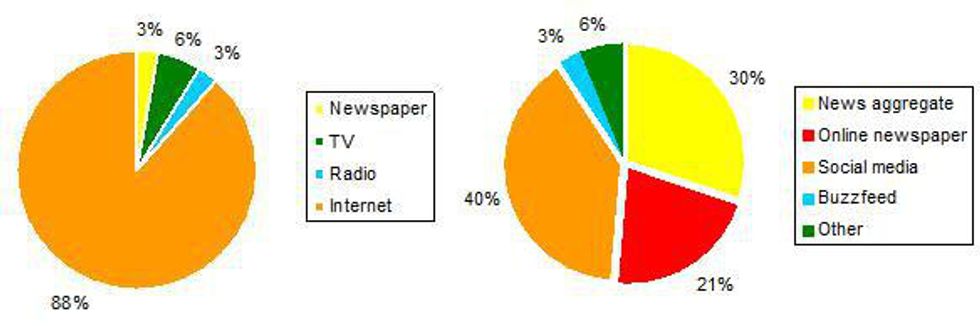
As I predicted, a vast majority of the respondents (88%) cited the Internet as their primary source of news. The sources from which respondents find their news were more diverse. The top three choices, in order of popularity, were social media, news aggregates and online newspapers. Those who selected social media all specified Facebook as their primary source and 80% of who chose news aggregates specified Google News. Nytimes.com was the most popular online newspaper, followed by cnn.com.
The purpose of this study was to determine what types of headlines attracted 18-25 year olds. I predicted that the respondents would select the less substantive or clickbait-style option when presented with multiple headlines. In only one instance did the headline I predicted would do so, yield the most clicks—“24 Tweets About College That'll Actually Make You Laugh”. While the listicle may have received the most clicks in Set III, it edged out what was the most traditional news story headline on the entire survey “Russia sending 44 planes to Egypt to repatriate tourists” by one click. It is also not surprising that “How the NSA can 'turn on' your phone remotely” received the most clicks of any single headline on the survey. It sensationalizes the already rising fear and mistrust of the NSA and the government, specifically targets cell phones, and by beginning the headline with “How,” it makes the reader want to know more. One of the respondents who chose that headline said, “My phone is an extension of my computer, as all my info is in sync, so I am interested in what the government is monitoring.” Another said, “It makes me really curious to find out how they can do it.” Like in the case of NPR’s April Fools’ Day joke, a respondent made a strong claim without ever having read the article: “It shows further proof our rights are being violated and the government is doing nothing to prevent it.”
Originally, I did not plan to take gender into account. When I saw that the participants happened to be split equally between males and females I decided to factor it in. As a whole, males tended to choose political stories such as “
What my in-depth research suggests is that writers and editors do not need to pander to the lowest common denominator in order to get clicks. In fact, often times the readers see right through it and prefer to read more substantive content. Knowing this will benefit all parties because the writers will be able to create well-crafted copy they care about and get paid for it because of the clicks from readers who crave better material. The majority of the headlines used were taken from my personal Facebook and Twitter pages and I had to actively look for traditional news stories amongst a sea of clickbait. There is nothing wrong with those who want to write or read about adorable puppies dressed as babies or 12 different ways to feng shui your linen closet but there is room for more on our Newsfeeds. When it comes to clicks, quality and quantity no longer have to be mutually exclusive.