


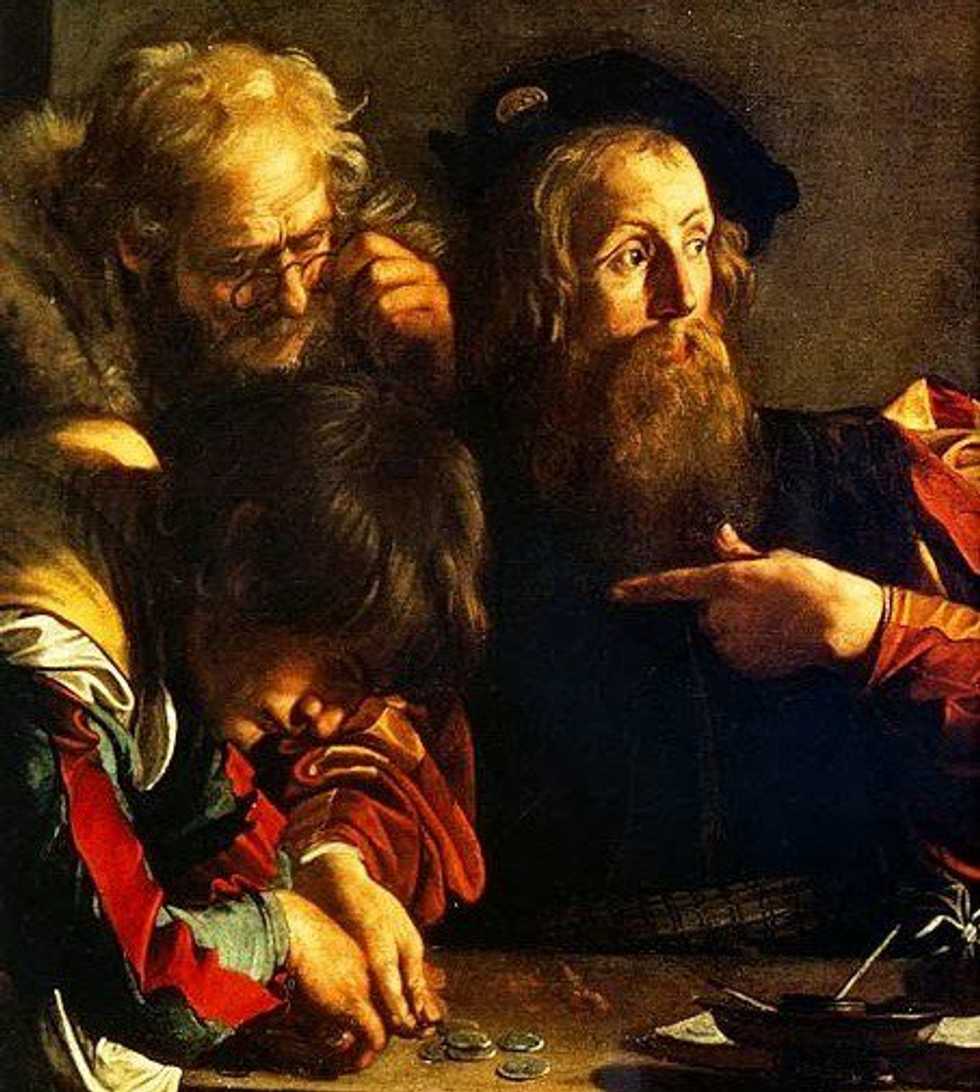
Who is Matthew in the famous painting by Caravaggio? Is it the young man with his head bowed collecting money?
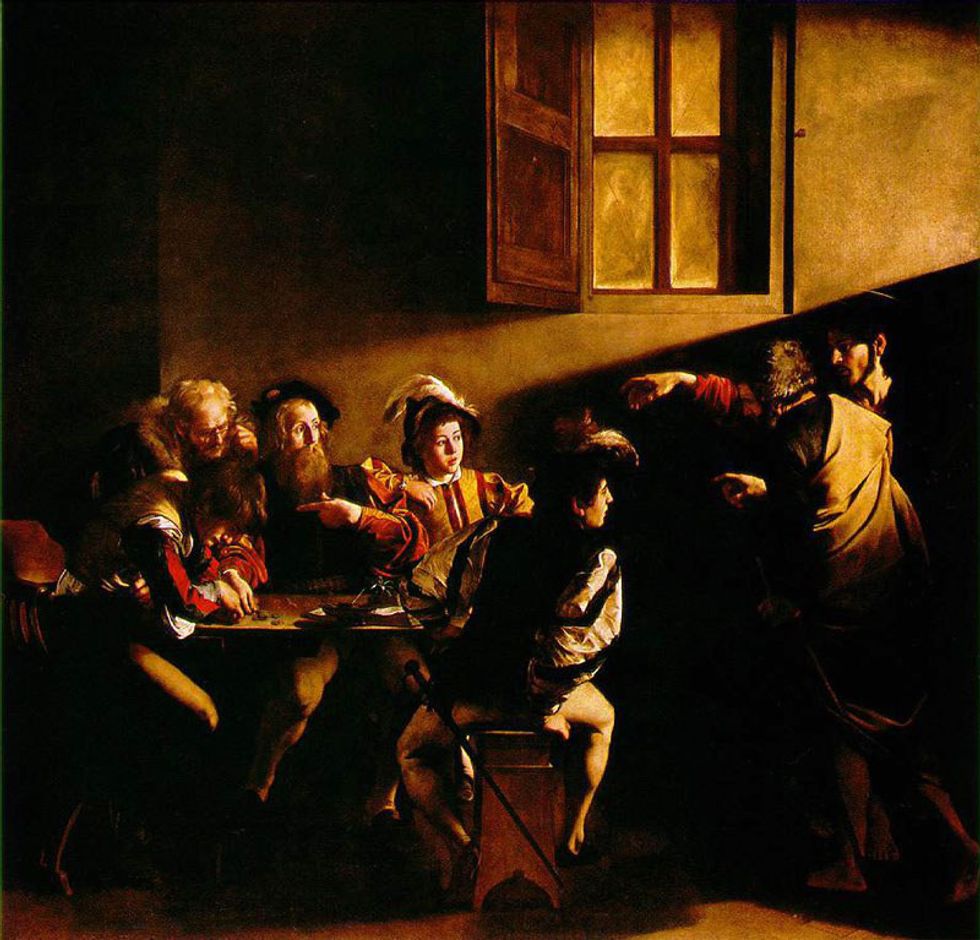
Caravaggio’s The Calling of Saint Matthew, Oil on Canvas, 1599-1600
This is the question Angela Hass’ article Caravaggio’s Calling of St. Matthew Reconsidered inquiries. Hass places Caravaggio’s The Calling of Saint Matthew in a state of controversy. Michelangelo Merisi da Caravaggio, commonly known as Caravaggio, was a baroque painter known for his realistic renderings of human form, emotion and a dramatic use of lighting. Although controversial in character, the talented Caravaggio emerged into Rome’s artistic scene, creating one of his successful early works The Calling of Saint Matthew. Commissioned by the Contarelli Chapel for a French Congregation. The painting to this day hangs in the chapel alongside the Martyrdom and Inspiration of Saint Matthew all painted by Caravaggio. Caravaggio’s painting depicts the story from the Gospel of Matthew (Matthew 9:9): "Jesus saw a man named Matthew at his seat in the custom house, and said to him, "Follow me", and Matthew rose and followed Him." Mathew, the tax collector, sits at a table with four other men. As Christ and Saint Peter enter the room, Jesus points at Matthew and a beam of light illuminates the faces of the men at the table who are looking at Jesus Christ.
Common sources identify the man bathed in light in the center of the painting to be Saint Matthew. An identification that is hardly questioned is considered false by Hass. Hass claims the man in the middle is pointing towards the young man counting his coins suggesting Mathew’s identity is the youth. Taking note of gestures, the juxtaposition of the figures, and the objects in the scene, Hass tackles the idea that scholars have misinterpreted Caravaggio’s painting. Although the theory of the youth as Matthew is reasonable, it is not persuasive. The older man in the middle is Matthew because he is attributed with a merchants dress and is clearly pointing to himself in an unquestionable gesture that speaks “Who me?” to the viewer.
Hass reveals some convincing elements which could lead one to doubt conventional ideas. She claims that the man titled as Matthew is merely a merchant pointing to the true Matthew. In her article, she reminds the reader of Caravaggio’s mastery in both the human form and skill in perspective. Due to his experience, Caravaggio would have been able to show Matthew’s index finger properly foreshortened to point to himself. Hass argues the merchant’s finger is in fact pointed right at the youth at the end of the table. On the other hand, that is the only point that Hass that’s is convincing. The figure’s gesture, however, is not self-assured. Caravaggio may have intended to portray Matthew as asking the Lord, “Me? Don’t you mean him?”
Another point Hass makes is the direct correlation of Matthew’s placement. Placing Matthew across from Christ would provide a significant amount of symbolism. The table could be viewed as a symbol of Matthew’s earthly pursuits and sins. If her claim was correct it would serve as an analogy for worldly obstacles between Christ and Matthew. When the painting is viewed from Hass’ perspective it makes logical sense, however, the painting’s main theme is about Matthew’s religious inspiration. The light in the painting stands as a visual metaphor for divine illumination. One must keep in mind that this piece is intended to portray the divine moment when Matthew is called by Christ. By connecting Matthew’s conversion to Christ’s radiance, it is clear that the man in the center of the pieced bathed in light is the Saint, and not the oblivious younger man shrouded in darkness.
Lastly, the argument against Hass is Matthew’s physical features. Hass says that the face of the bearded Saint Matthew is physically inconsistent with other depictions of the Matthew by Caravaggio. Her argument would make sense except that many of the figures in Caravaggio’s works do contain slight facial inconsistencies. Contra wise, it is more inaccurate for a young man to have acquired status as a merchant. To have a beardless and hatless publican would contradict the historical maturity that was attributed to government officials. This is the most striking piece of evidence there is for defending Matthew’s identity. Another factor is that the older Matthew is dressed in the traditional dress of a merchant. Here, the matured man wears a coin, the symbol of a merchant pinned to his hat. His apparel further defines his identity as the saint. A man who is not only the accurate age, but also has the appropriate dress for his occupation could only be Saint Matthew.
Hass makes a valid argument, however, there is only an assumption and not enough facts to support her claim. The traditional attribution of Matthew’s identity is by far more convincing. To counter Hass and others, there are the definite facts that parallel the figures in the painting. Caravaggio clearly entitled his painting The Calling of Saint Matthew because he wanted to show the merchant, Matthew, at the center of the painting bathed in the radiant light of Christ’s illuminated divinity.

















