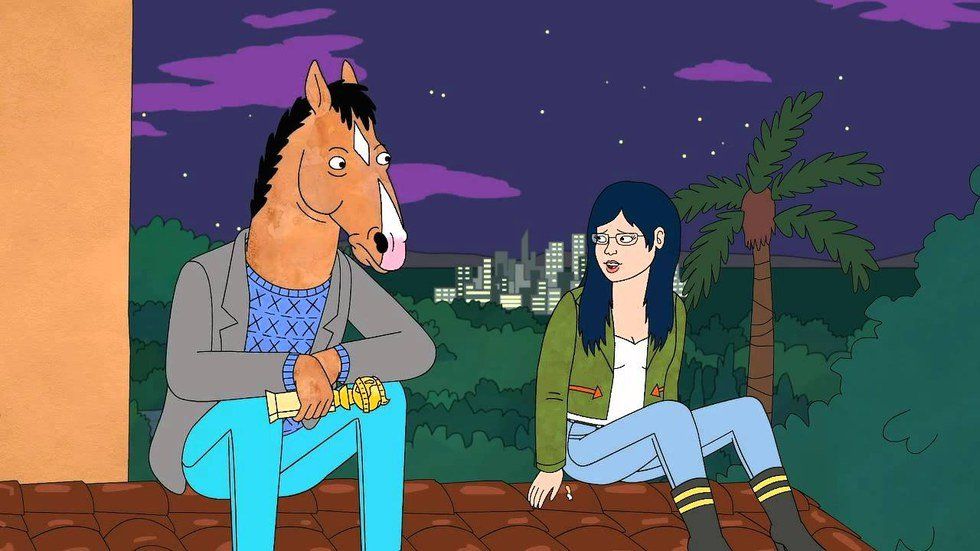
At this point, lauding the pointed social commentary of Netflix’s BoJack Horseman is, if you’ll pardon the pun, beating a dead horse. A quick internet search reveals articles on asexual representation, the mingling and/or separation of comedy and tragedy, feminism, and the delicate construction of an antihero in BoJack.
What, then, can I possibly add? Other writers have already explained the ties between a television show about an anthropomorphic horse and our very real world. Note, though, how little of it has anything to say about those of us on the ground.
I’m neither a still-famous actor or a once-famous actor, but I still feel closely tied to the characters on this show.
My connections, though, generally aren’t happy ones. When I look at BoJack and company, I see many of my negative character traits made manifest in characters so unlikeable that I love them.
But why love them? Why invest time in characters who constantly remind me how much I suck as a human being?
To me, watching BoJack Horseman is like looking in a funhouse mirror; it accentuates specific features to this point where I’m both enthralled and appalled.
For example:
Fear of Failure
At no point in the series are all of the characters satisfied with their place in life. Even though the characters are gifted and diligent, they’ve burned out.
BoJack, himself, is the easy one to pick on. “Back in the ‘90s, I was in a very famous TV show...and I’m trying to hold onto my past,” explains the song that plays during the end credits. He had it good, he was doing well, and he flopped.
Diane worked hard to escape from her abusive, constricting family....only to find herself working as a ghost writer. Despite her brilliance and depth, she’s often pushed to the side by larger-than-life characters. Even when she writes a successful book, she isn’t given the recognition she deserves.
Todd, as flashbacks reveal, hit the ground running early in life, but got swept up in a borderline-compulsive video game obsession and ended up as a freeloader living on BoJack’s couch. Despite his prowess in business and social situations, he continues to succumb to his video game addiction.
These are people who appeared to have bright futures ahead of them, but ended up “lower” than they want. For me, this can be unsettling. I know that, like Todd, I’m prone to distraction; like BoJack, I tend to coast; like Diane, I’m not the young adult my younger self-thought I would be.
Sometimes I wonder if my childhood teachers are disappointed in who I am at 19. I know that I could have done better. I look at my interests, my potential employment, my work ethic, and my mental health and genuinely worry about where the hell I’ll be in five or ten years.
Excuse Making
When BoJack is in the wrong, he often shifts the blame: Sometimes he’s a product of society who is, himself, a victim. Sometimes he’s justified because of X, Y, and Z circumstances. Sometimes he’s drunk and not in control.
These excuses are shown as illegitimate. For example, BoJack frequently missteps while drunk. BoJack is also the one who chooses to get drunk rather than accept basic responsibilities. Therefore, BoJack’s missteps are BoJack’s fault.
Can circumstances and state of mind influence his choices? Of course! However, BoJack makes BoJack’s decisions: not society, not alcohol, not his abusive parents.
This refusal to justify the antihero is part of the show’s brilliance, as The Mary Sue points out. By implication, though, no one is let off the hook because of motives, circumstances, or state of mind.
As one who has blame shifted more than he ought, I pale a bit when BoJack addresses this topic. I don’t know about you, but I’d rather see myself as the victim than the perpetrator. BoJack serves as a (sometimes shocking) reminder of this tendency to shove blame away from myself. More importantly, though, it reminds me that no matter where I elect to place blame, I am, ultimately, the one at fault for my actions.
Forgiveness
Even though he likes to pretend that things aren’t his fault, BoJack never forgives himself for his cruelties, his failures, and his inadequacies. He carries them around with him, rarely deciding to acknowledge his guilt, ask forgiveness, accept forgiveness, and forgive himself.
The result is a vortex of unresolved conflict, suffocating guilt, and failing relationships.
Todd, on the other hand, is relentlessly forgiving of both himself and others. Though other characters have sabotaged his career, his friendships, and his credibility, Todd has generally let them slide. Only in recent episodes has he realized that he’s something of a doormat.
Like these characters, I tend to swing to one extreme or the other: unforgiving or total doormat. The writers of BoJack Horseman obviously advocate for a balance of forgiveness and responsibility. BoJack points out that it’s possible to forgive people while still holding them responsible; one without the other is not conducive to a healthy human relationship.
Despite his equine appearance and extravagant life, BoJack should feel close to home. He’s neither angel nor demon; he’s the most human horse I know.
As painful as it can be at times, I’m glad to see my less-than-desirable character traits on television. If someone else thought it and someone else wrote it, then someone else felt it. BoJack Horseman, by virtue of its simple existence, reminds us that none of us are uniquely horrible. As disgusting as we can be sometimes, we’re not alone. We’re human. We’re redeemable.
As much as we fear failure, we fail all the same. Though we shift blame and attempt to justify our misdeeds, we can hold ourselves responsible and seek forgiveness. Oftentimes, there’s forgiveness to be found--enough for me, enough for you, and enough for BoJack.