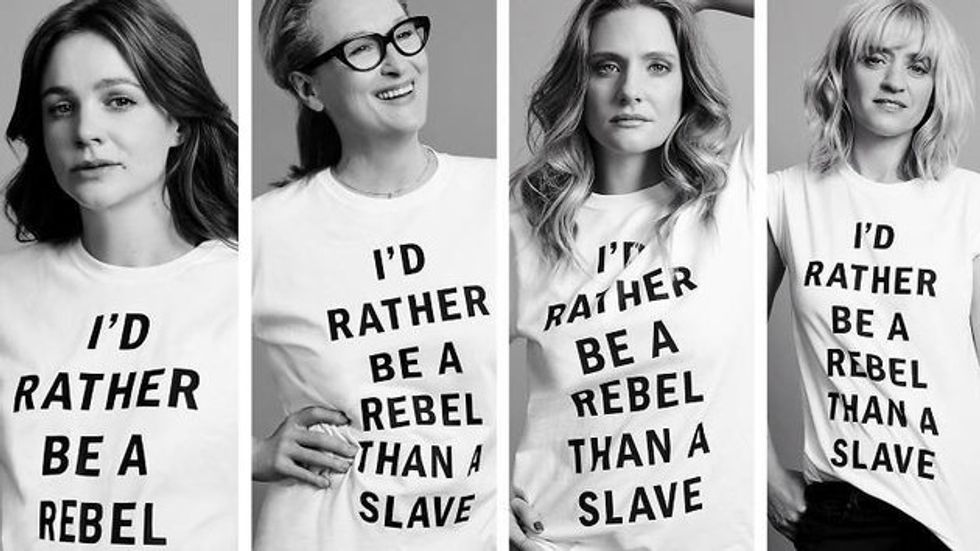
"I'd rather be a rebel than a slave."
This quote is present on a T-shirt worn by Meryl Streep and her co-stars for the upcoming movie "Suffragette." The quote is a line of Meryl Streep's character, Emmeline Pankhurst a pioneer in the women's suffrage movement. Many black feminists have responded to the quote and some white feminists have countered their responses by saying, "We need to look at the bigger picture of the message." While this is a valid argument, this does not make this quote acceptable to be plastered on a T-shirt with white women smiling and promoting their movie.
As a feminist and a black woman, here is my response to the use of the quote.
This quote does a lot of ignoring, downplaying, and disregarding. First, it references slavery. The fact that this wasn’t seen as a problem before the shirt was made goes to show that in their mind their reference to slavery wasn’t a big deal. But it is indeed a big deal. This by no means is acceptable. I mean, what would these white feminists know about the times of slavery and Jim Crow? What do they know about being oppressed for years? What do they know about continued oppression?
Second, it compares racism to sexism, but at the same time it downplays one. Currently, when it comes to women, race and gender should be a part of a conversation that includes the issues surrounding both types of discrimination, not highlighting the issues of one. The presence of this quote on a T-shirt with smiling white women shows me, as a black woman, that you don’t care about my struggles as an African-American or as a woman.
And this brings me to my third point, which is that this quote brings out the issue of white feminism. According to Zeba Blay and Emma Gray's video, white feminism is feminism that ignores intersectionality. A white woman as the face of women being rebels ignores the fact that women of color are, in fact, rebels against inequality and were rebels during the time of the suffragette movement. Women like Sojourner Truth and Ida B. Wells were rebels against gender inequality and fought for women’s rights. Because they aren’t Emmeline Pankurst, should their hard work be disregarded?
Fourth, this is not only a problem between white and black women but a problem between white women and women of color. This quote and the upcoming movie disregard the struggles of women of color during the time, and the omission needs to be called out. In Zeba Blay’s HuffingtonPost article she states, “Of course the efforts of the movement, on the whole, should be celebrated. And yes, the quote was said 100 years ago, in a very different time and context. But that doesn't negate the fact that to put it on a t-shirt today is to reinforce its underlying message …”
This by no means is a platform for a race war, but it is a platform to reconstruct and change the conversation regarding feminism and the inclusivity of all women. White feminism will continue to be a problem because many view that feminism is a representation of all feminists, and that isn’t true. Feminism is something that needs to be talked about because it cannot go down as a male-bashing, white woman-talking session, but a session of equality and representation of women, which is what it stands for. I believe that this movie is important, but it isn’t inclusive, and that is a problem. Obviously, it isn’t seen as a problem because it is just a line from a speech and was geared toward breaking down patriarchal systems. But how can we just say OK to this line and move on when it is evident that it displays a division of white women and women of color? The answer is that we cannot and we mustn’t disregard this line. It needs to be talked about because it is time to be inclusive in our discussion on feminism and gender equality.