


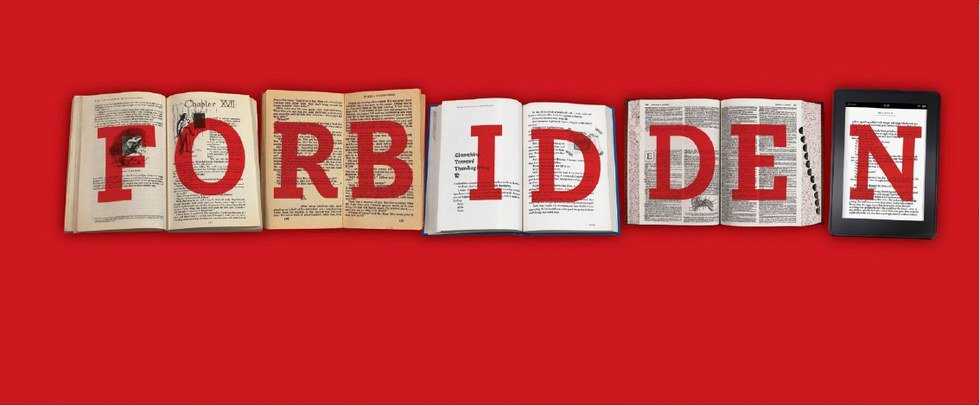
Banned Books Week is the national book community's annual celebration of the freedom to read. Hundreds of libraries and bookstores around the country draw attention to the problem of censorship by mounting displays of challenged books and hosting a variety of events.
The 2015 celebration will be held September 27-October 3. Banned Books Week was launched in 1982 in response to a sudden surge in the number of challenges to books in schools, bookstores and libraries. More than 11,300 books have been challenged since 1982 according to the American Library Association. There were 311 challenges reported to the Office of Intellectual Freedom in 2014, and many more go unreported. Hundreds of books have been either removed or challenged in schools and libraries in the United States every year. ALA estimates that 70 to 80 percent are never reported.
This year the theme of Banned Books Week is Young Adult fiction. Here is a list of the most frequently challenged YA titles from the past year:
1. “The Absolutely True Diary of a Part-Time Indian” by Sherman Alexie
2. “Persepolis” by Marjane Satrapi
3. “The Bluest Eye” by Toni Morrison
4. “The Kite Runner” by Khaled Hosseini
5. “The Perks of Being a Wallflower” by Stephen Chbosky
6. “Drama”, by Raina Telgemeier
7. “Chinese Handcuffs” by Chris Crutcher
8. “The Giver” by Lois Lowry
9. “The House on Mango Street” by Sandra Cisneros
10. “Looking for Alaska” by John Green
By focusing on efforts across the country to remove or restrict access to books, Banned Books Week draws national attention to the harms of censorship. The American Library Association promotes the freedom to choose or the freedom to express one's opinions even if that opinion might be considered unorthodox or unpopular, and stresses the importance of ensuring the availability of those viewpoints to all who wish to read them.
Recently, in yet another dispute over Sherman Alexie’s young adult novel “The Absolutely True Diary of a Part-Time Indian,” a group of Idaho parents succeeded in getting the novel pulled from a school’s 10th grade curriculum. In response to the banning, supporters of the book started a fundraiser to buy a copy of Alexie's novel for each of the 350 teens that wanted to read it. Teaming with local bookshop Rediscovered Bookshop, they handed out 315 copies as part of a World Book Night event. But the giveaway didn't go off without interference. Police arrived after getting a call from "someone concerned about teenagers picking up a copy of the book without having a parent's permission," local news station KBOI reported. Police talked to student organizer Brady Kissel and found there was nothing wrong with distributing the book. Alexie's publisher, Hachette, received word of the incident and sent an additional 350 copies to Rediscovered, free to any student who wanted one.
Just last year, at a high school in Strasburg, Colorado, a group of parents created a petition to “cleanse” the book list for a Young Adult literature course, claiming that the majority of the books on the curriculum, “are profane, pornographic, violent, criminal, crass, crude, vile and will result in the irreparable erosion of my students’ moral character.” The novels “Paper Towns” and “Looking for Alaska” by the critically acclaimed YA author John Green were targeted in particular. The majority of book bans and challenges often come from “concerned” citizens who fail to understand that young adult authors are not out to corrupt teenagers and further misunderstand the importance of reading books critically and thoughtfully as a whole, rather than focusing on individual scenes ripped from their context.
The vast majority of some of the most important literary works ever, such as “Animal Farm,” “The Catcher In the Rye,” “The Grapes of Wrath” and “The Great Gatsby,” have either been challenged or banned. In 1865, because of his novel “Leaves of Grass,” Walt Whitman lost his job as a clerk with the Department of the Interior, when his supervisor found the annotated copy, on display, among Whitman’s possessions at work. George Orwell's classic dystopia “1984” explores a future of totalitarian regime control. Originally published in 1948, it has been banned and challenged repeatedly on social and political grounds, as well as sexual content. It ranks as high as #5 most challenged book of all time. It was banned and burned in the U.S.S.R. under Stalin's rule for its' negative attitude toward communism, and reading it could've resulted in your arrest.
I can remember the YA novel “The Giver” being a hot topic of debate among the parents in my hometown. Coincidently, I had just finished the book and was very excited to join their conversations and express how much I enjoyed the book. However, I quickly learned I was on the offensive side of the matter, and was even questioned how I could possibly think such a “dark” piece of writing could be good for students. On her website, Lois Lowry addresses this question of possibly banning “The Giver” (or any book, really) in her “FAQ” section. She answers the following:
“Question: A parent from my school wants to ban The Giver. What do you think about that?
Answer: I think banning books is a very, very dangerous thing. It takes away an important freedom. Any time there is an attempt to ban a book, you should fight it as hard as you can. It’s okay for a parent to say, “I don’t want my child to read this book.” But it is not okay for anyone to try to make that decision for other people. The world portrayed in The Giver is a world where choice has been taken away. It is a frightening world. Let’s work hard to keep it from truly happening.”
I stand with Lois Lowry. I stand with John Green, Sherman Alexie, Khaled Hosseini, Stephen Chbosky and all those authors whose novels are subjected to the injustice of censorship. So, support your libraries, stand up for your freedom, and join the many who proudly stand up and proclaim, “I read banned books.”
















