

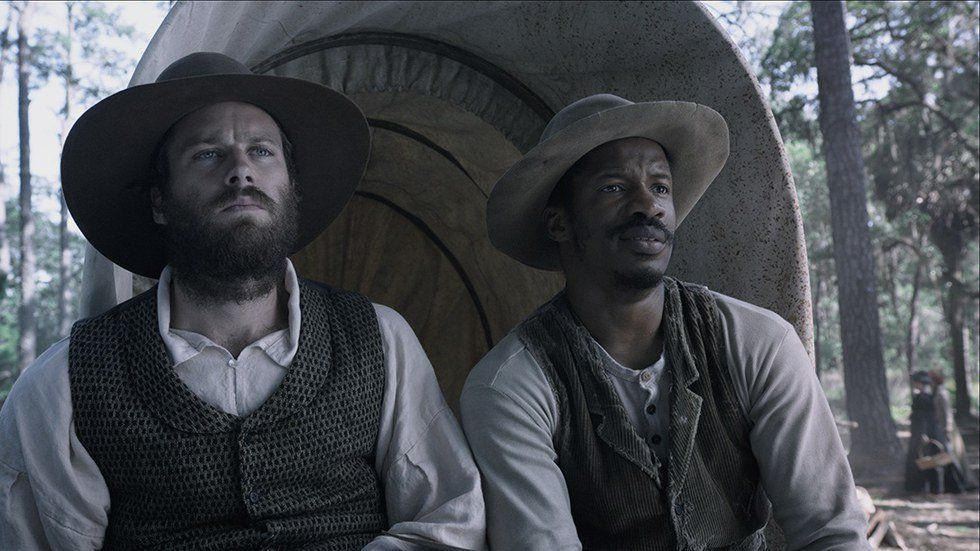
After seven years in the making, "The Birth of a Nation," a story about a slave revolt and the ensuing massacre, just won The Sundance Film Festival. The premiere of this film comes at a critical juncture, as African American actors and actresses are beginning to take a stand against a film industry waking up to the fact that it is sorely lacking in diversity.
Yet this film points to a broader and more influential issue, the fact that much of the American public has never heard of the slave revolt led by Nat Turner. This huge watershed event has been labeled as the "Southampton Insurrection of 1831" instead of labeled under the rightful name of the slave who organized it. Written, directed, and produced by Nate Parker, the film tells the story of Nat Turner (played by Parker).
Turner was born and raised a slave, yet he was taught to read the Bible so that he could one day become a preacher; however, he learns quickly that his talent for controlling a room can be used to amass a different kind of following. He grows up alongside Samuel Turner (played by Armie Hammer,) the son of the plantation owner who, once his father dies, becomes Turner's new owner. Samuel Turner has to try to control a slave that was once his playmate and is now capable of leading one of the biggest slave revolts in our nation's history.
I spoke with Armie Hammer to glean his perspective on the film's success and to learn a little bit more about his approach to a character with such depth and emotional conflict of interest:
K: As an educated man who grew up with Nat Turner, how does you character deal with the duality of being, both his friend, and his owner?
AH: That's really the crux of what Samuel Turner's conflict in the movie is and that's what Nate is going for in this movie. You know, this movie is not only about the slaves. All of the slave owners in this movie are not sort of crazy arch-villains who are these sadistic, kind of frothing at the mouth characters. These aren't those guys. For Sam Turner their main cash crop was cotton and they didn't have a conceivable, cheap way (because this was before the cotton gin) to harvest that much cotton in a cost effective way, to then sell it up North at a reasonable price. They were going to buy the cotton anyway and [Samuel] needed the money down there to support the lifestyle.
So, by the time Samuel, inherited his plantation, the system was in place. These were [his] slaves. So he didn't have a choice, he was a victim in this system. Obviously, in a very different way than Nat was, himself. As a person, he saw the problems here. He grew up with Nat. They were buddies and actually, white children and slave children, at the time, grew up together until the age of, about, eleven.
That's when it was [pseudo-scientifically] 'determined' that white children would continue to grow, develop, and mature while slaves would not. Their brains [according to, what is now known, as eugenics] would stop developing. So, [Samuel] remembers being Nat's friend, but when his dad dies, the society dictates that he inherits Nat as part of his property. It adds a complexity to their relationship, and, ultimately, ends up driving Samuel to the dark side.
K: What drew you to this production, upon reading the script?
AH: The script was definitely one of the key elements. It was a great script and I was in awe of the fact that Nate was starring in, directing, and producing a film he wrote himself. Actually, I finished the script and googled it and realized that, this is a real person. This is a real historical event that changed the course of a lot of things. Why did I not know about this beforehand? I got kind of mad at my own education. Then I got mad at the things they decide to teach you and the things that they don't. I thought, this is an important story to tell and this is a huge part of our history as a country. The fact that I never heard of Nat Turner or the revolt, was crazy to me.
I've never met anyone as passionate as Nate. He showed up and he basically talked about the script like it was one of his children and he was directing for the first time. I would ultimately love to direct, myself, so to go onto set and see a first time director who comes from an acting background, is really kind of analogous to what I see myself doing.
So I was interested in seeing what catches him off guard and surprises him, but my plan didn't really work because he showed up on the first day and it was like he had directed 100 movies before. He knew exactly what to do on set. It was amazing. It looked like he was doing it his whole life.
K: Why do you think Nate Parker decided to tell the story of Nat Turner now?
AH: Well he started working on this project in college with his college roommate because Nate is from Virginia near where the Nat Turner rebellion actually took place. He grew up less than 100 miles from where it happened and nobody there was talking about [the area's dark history].
He learned about Nat Turner through an African American studies course in college and was so influenced by the story that he and his roommate decided to write a script. So, he's been working on this a long time. The timing of it seems pretty relevant right now especially in terms of what's going on with the Academy Awards. It seems very serendipitous that our movie would be coming out right now when it's already a part of the dialogue.
K: Actually, that leads into my next question: do you think some of the movie's success is actually due to the current national climate on race and the underrepresentation of African American actors at the Oscars and on the big screen?
AH: I don't know, but what I think Nate would say is that he wants this movie to affect how people talk about current race relations in this country and our history of race relations. He wants this to be something that opens up a dialogue. He says 'the door's already been opened' he just wants to push it open a little more and show a more human side to this [story] in a way that many people haven't seen before.
I think that was really on the top of his priority list and, for all of us, we just wanted to help him bring his creation to life. I read this script and thought: 'this is an amazing movie that tells an amazing story and it's being made by amazing people.' If this movie does go on to really affect change in anyway, even just the way we talk about something for a month, that would be great. I think it would be icing on the cake for us as performers, but it's really Nate's vision and his idea. He's the one that's got sort of a plan with all this, and I just played the part he created.
After winning Sundance, this film has created a dialogue within the film industry, but the real hope is that it will affect the way that we discuss the issue of race in this country. Yes, it premiered at a time when race is a hot-button issue and is constantly in the news, but it also serves as a reminder that history needs to be remembered accurately.
Our nation cannot simply erase an unsightly blemish in its formative years. It was born on the backs of slaves and immigrants and the more American citizens remember our history, the more we can improve our future.















