


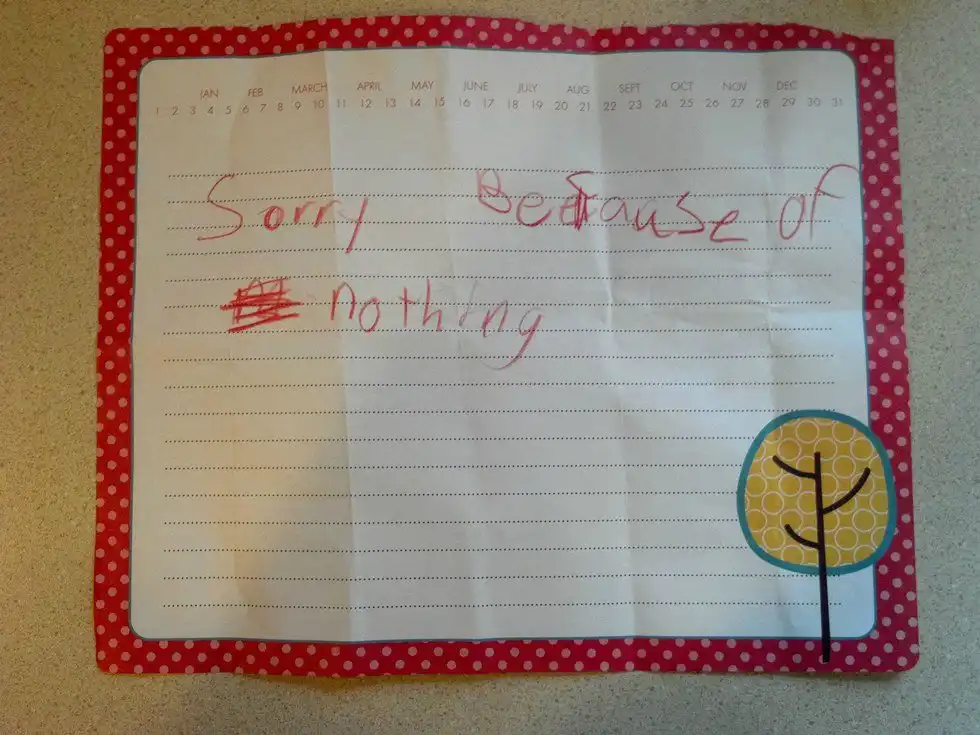
“I’m sorry, I know this isn't really relevant!” “I’m sorry if this is a stupid question, but—” “I’m sorry to be a bother…”
Once, I apologized to a waiter after she got my order completely wrong after, of course, I spent an agonizing ten minutes debating whether I should just resign myself to a kale salad rather than ask—again—for the sandwich I had actually ordered.
On another memorable occasion, I apologized to a woman who bumped into me in a crowded 7-11 and spilled half a can of Mountain Dew over my shirt. She apologized in return. I apologized again, presumably for making her feel like she had to apologize to me, even though she was technically the one who should have apologized in the first place. Needless to say, it was awkward.
For the most part, I use "sorry" as a reflexive filler word when I feel uncomfortable or hesitant, in the same way that people stumble over “ums” and “uhs” while giving a speech. These apologies usually slip by without my intention. But oftentimes it happens when I’m intentionally trying to diffuse a situation, when I’m trying not to step on toes or make anyone feel uncomfortable.
Plenty of people have framed this as a feminist issue, which intuitively makes a lot of sense. A 2010 study found that women have a comparatively low threshold for offensive behavior: we tend to be more aware of our words’ potential to hurt or upset the people around us, and to compensate for that potential accordingly.
It’s easy to dismiss social commentators who complain about women apologizing too much, because we all know courtesy isn’t a bad thing. After all, it’s good to be considerate of others! It’s good to think about people’s feelings! Shut up and let me be a good person, for crying out loud!
It’s for this reason, I think, that I find my constant apologizing such a hard habit to break. In a bizarre way, I find it comforting. Saying “I’m so sorry” in the most absurd, trivial situations reassures me that I’m a considerate person after all. That I think about other people’s feelings. That I’m not the kind of person who’s rude to the waiter.
But is that really what it indicates? Over the past few months, I’ve found myself seriously contemplating what I’m actually trying to say when I apologize. I can’t shake the feeling that it’s not actually an indication of politeness or compassion at all.
In fact, the more I think about my chronic apologizing, the more I wonder if it isn’t actually the worst kind of passive aggression: an attempt to coax an apology from the person who I think really ought to be offering it.
Take the woman in the 7-11 as an example. Why on earth did I feel the need to apologize to her? Was it because I felt genuinely sympathy for the person who had just ruined my shirt, or was it because I wanted to prompt her into acknowledging her mistake?
In a meeting, I might say “I’m sorry for interrupting,” but what I really mean is, “Why should I feel like I need to prove my right to have an opinion?” When someone cuts in front of me in line and I blurt out “Oh gosh, I’m so sorry!” (no joke, this has happened), am I really trying to ask for forgiveness or to jolt them into realizing how rude they’re being? When someone says something crass or objectifying, do I preface my “I’m sorry…” because I wish I could just yell, “Dude, that’s completely inappropriate"? Probably.
In all these situations, what I really mean is: “Well, somebody needs to apologize in this scenario, and apparently it’s not going to be you.”
Sometimes, I wish I would just say that instead.

















