So here I am on a flight from JFK to Zurich, trying to duck out of talking to this man, Amit. Regardless, he pursued dialogue with a
fierce enthusiasm I’ve only seen before on QVC. Luckily for both of us, after
small talk about our destinations, occupations, and interests we approached subjects of consequence.
My
flight happened like this: I was seated
in the middle section in economy. The window I might have seen through
from across the aisle was blocked by a large Swiss man. My traveling
buddy was seated five rows in
front of me. Determined
to reach contentment I put in headphones. As I was about to sink into music, a twenty-something Indian man sat in my row and spoke to me. My introverted plans
ruined, I answered politely, looking for a way to end the conversation as
soon as possible. I was not prepared for the depth and importance of the conversation I'd have with this stranger.
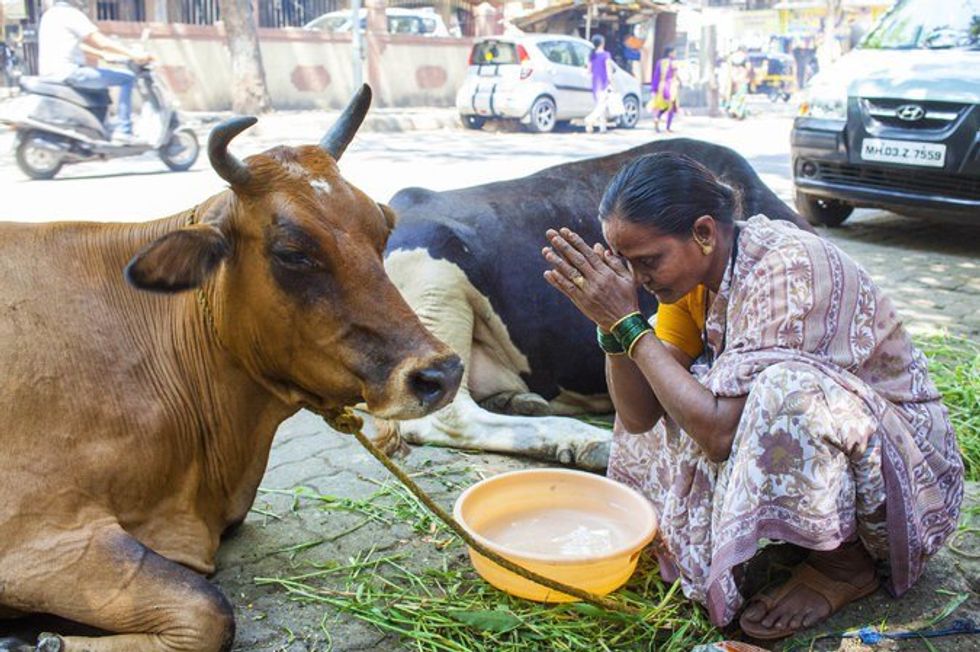
It all started with cow pee.
Let me explain: when the flight attendant walked past our row, Amit requested a vegetarian meal. I slyly put in my
headphones to signal an end to our airplane small talk. He then turned to my fully-headphoned self
(do.you.not.understand.social.cues) and explained to me that as a
practicing Taoist he does not eat flesh or roots. He went on to say that
in his culture, animals such as the cow are regarded very highly and
that the cow is considered the divine mother of us all. He said that
during famine some Indian families feed their cows with what little food they
have. The families then in turn are sustained by the cow’s milk. They
would die of hunger before eating the cow’s food or the cow itself. Amit
said that some Taoists even take drops of cow pee on their hands every
morning and rub it from the forehead to the back of the neck as a kind
of blessing.
At
that point I quietly stowed my headphones away in my backpack. His account of the famine shocked me. I was challenged
to find my own tangible equivalent to the Taoist’s cow. I am a Christian and consider myself a spiritual person, but became frustrated when I could think of nothing I experienced with that same sense of sacredness. I would not give my last bits
of famine food to anyone besides my family and surely not to a cow whose
meat would sustain with more certainty than milk. The one comparable
example that came to mind was the way some Jews refuse to say or write
the word “God” out of fear and reverence. I silently noted to adopt this
practice if possible. “I want the devotion of a Taoist and the fear of a
Jew," I thought to myself. If I am honest, most days the name of Jesus
does not make me tremble. That is a serious problem.
I
listened with interest as Amit finished his thought on urine
consecrations and blushed. “I know it must seem silly to you," he said, "but cows are very
sacred to us." I ignored his red cheeks and responded, saying religions often seem strange to those who don't practice them.
“Is
it not odd to you that Christianity should adopt the image of their
Savior’s execution weapon as their defining, sacred symbol?” I asked. He
agreed that it was quite odd. Perhaps even more odd than the cow pee.
I
ask Amit what he knew of Jesus. He knew that Jesus was a teacher
among the Jews and Gentiles of Israel. That he lived and then died on a
cross. Amit didn’t like using the term "sacrifice," but instead said
that Jesus denied himself ( or the "I") and promoted unity ( the "We"). He
also said Jesus had reached self-realization before his death and
therefore transcended the pain of the cross. Amit
seemed to think Jesus was divine, but had reached divinity through
self-realization (an act that any man, in theory, can achieve). “What is self-realization?” I inquired.
Amit
used the illustration of yoga to explain further. “It's the joining of body and soul," he explained, "When we balance ourselves in this
way we become indifferent to both pain and pleasure. This is
self-realization.” He went on to say that Taoists constantly strive to
be above emotion and human reactionary tendencies. A perfect Taoist
goes throughout life unaffected, completely unperturbed in any
situation. “When a Taoist reaches Nirvana," Amit concluded, “they
become like the wind - unfeeling, unseeing. The sole purpose is existence. This is how all things desire to be - free from the cycle of
life, the cycle of pain and pleasure.”
At
this point I was speechless. It was time for me to contribute
to the discussion and I felt unsure which way to lead. Should I argue?
He brought up plenty of points I didn’t agree with. Should I inquire
more about Taoist practices? Should I say, “Cool beans, man,” and leave it at that? That seemed trite.
One
thing that really bothered me about his answer was the Taoists’s
pursuit of Nirvana. As a Christian who has experienced depression, I
have struggled a lot with identifying the differences between apathy
and peace. I have made it a personal quest to throw off my apathetic
tendencies and care - care about people, care about
God, care about myself. I want to feel; I need to feel in order to
follow Jesus. How can I love people if I have no compassion? How can I
grieve with those who mourn if I am not willing or able to cry? This
for me has been an issue of spiritual consequence. Feeling
is being alive, not the absence of feeling. So Amit saying that he
strove to be like the wind, to exist without emotion or response,
stirred something in me that felt like anger. I felt lied to. I always
thought the purpose of yoga and Nirvana was to achieve peace, not
apathy. Perhaps it depends on who you ask. But I have tried many
times to compare apathy and peace and have come up with a rough
hypothesis: Apathy is the absence of feeling while peace is the
absence of fear. Furthermore, apathy occurs in the presence of fear
while peace occurs in the presence of God. One cannot be both peaceful
and apathetic.
I
have had a lot of time to reflect about my conversation with Amit, and
I think if I could go back, I’d ask him about his view of peace, but - alas - in the moment my brain went a totally different direction. After
his description I took the opportunity to explain the Christian view
of Jesus - a being fully human and fully God who came from Heaven to
teach and then offered himself as a sacrifice as atonement for human sin.
“Jesus was then raised to life and ascended to heaven. He is the
bridge that allows us to approach the Father. We are made clean by him
and have relationships with Him because of the cleansing
blood of Christ," I concluded. Something about telling this story I knew
so well felt funny as I explained my faith to a Taoist. The
more I thought about it the more I realized how futile the Saviors’
death must seem to someone who has no concept of sin. I began to wish
I’d asked Amit more about his religion before jumping into
Christianity.
The
concept of sin is vital to the Christian faith. There must be sin
nature. There must be something to be saved from. Without sin we have only an undulating existence fraught with pain and pleasure. From Amit’s worldview, apathy would seem a viable,
honorable method of escape. Becoming like the wind is even appealing to me
in a world without peace, a world without hope.
I
sat down on a plane to Zurich in anticipation of a
comfortable, picturesque flight, and was denied both. However, I was blessed by participating in a conversation
with someone very different from me. My interaction with Amit has
caused me to think and rethink my faith, the Gospel, and my
relationship to apathy, peace, and cow pee.
Our conversation did not end with Amit breaking down in tears
and committing his life to Christ, but I know that we connected on a
meaningful level and challenged one another intellectually and
spiritually. For me that has amounted to re-asking myself: What are we
saved from? Who are we saved by? What are we saved for?
I pray that Amit will ask the same questions.
Amit and I were thrown together on a Swiss plane. I doubt I'll ever see him again. But if I ever do, I will tell him how much it meant to me that he told me about his sacred cow.
This article first appeared on laurabethwrit.es