There’s been an ongoing battle throughout the past couple of generations, one that has particularly made its strongest assault on American culture around the 1960’s. In our generation, it has hidden itself in the woes of cognitive dissonance, and has become our strongest framework, as well as our strongest enemy. The Millennial generation has become, like some of our predecessors, a generation concerned with ideas that transcend the American dream: the white picket fence, the nice house in the suburbs, a nice car, and football on Sundays.
This generation has seen through this fog and has begun to witness the tragedies that plague the world. Our generation has witnessed species on the brink of extinction due to over hunting, climate change that has long gone ignored, and systemic racial injustice that is often scoffed at, just to name a few issues. What we’ve witnessed is the consequence of knowledge becoming a means to an end. Knowledge has become good only as long as it can be used to make money.
Higher education is now only for the sake of getting a good job that pays well and maybe gives you a semi-interesting topic for the next party you find yourself at. We’ve been systematically trained to retain knowledge for the sake of problem-solving only, and getting a reward because of it. Doing well in school leads to going to college, which leads to getting a good job – provided your field is hiring.
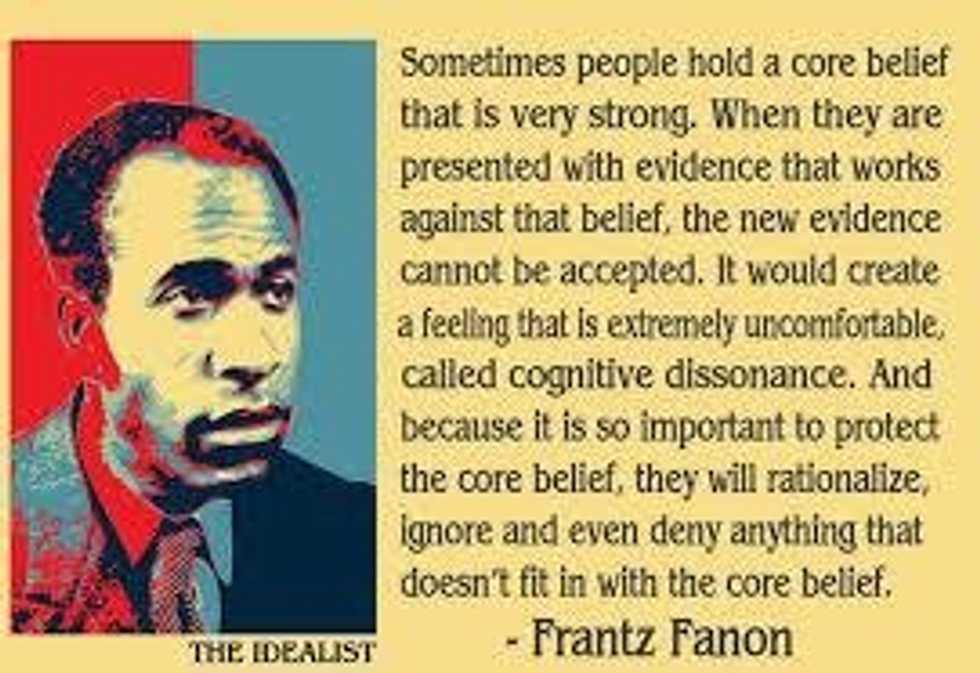
How does this play into our generation? We’ve come to realize that there is something more important in life than having money. We’ve developed a bleeding heart for the world at large and we realize that taking advantage of the marginalized, as well as the Earth itself, is wrong. But herein lies the issue: what is “wrong?” This is where anti-intellectualism applies and we can start to uncover the root of our problems. This is where cognitive dissonance comes into play as well.
We’ve been raised in a culture that has by and large denounced any notion of a meta-narrative, suggesting that there cannot be one storyline that holds true for the entire world. We’ve been told that the world is full of its own diverse narratives, and that to lump them all into one is to be disingenuous to them. While it is true that the world is full of its own diverse narratives, the problem here is that without a meta-narrative we lose any actual grounding for truth claims.
From our vantage point, we see that taking advantage of people and destroying the Earth in order to attain some level of wealth is disgusting. We intuitively know that it must be stopped. But who are we to force the morals contained within our narrative into the narrative of another group? Why are we allowed to say oppressing people is wrong across the board? In fact, in trying to vindicate the oppressed, we become oppressors of other worldviews, and become our own villain. Hopefully, we know this to be insanity. This is what I’ll refer to as “The long con.”
The systematic deconstruction of truth has led us to a place where we must accept that no narrative, no truth claim, is any more valid than the next. If that is the case, then finding truth in this life is rather meaningless. If truth claims really don’t matter, then all we have left for knowledge is its pragmatic consequences. If all that knowledge is used for is making a set of instructions to operate our newest iPad, then we no longer have to wrestle with the inherent implications of knowledge. Why is systemic racial injustice wrong universally if there’s no meta-narrative? While we can set up rules by which all narratives should operate in order to maintain some semblance of a community, there is no imperative reason to do so outside of convenience. If you can become the person that makes the rules, then why not?
As a generation, we must rebuild our narrative. I believe there is a meta-narrative for humanity, and I believe our narrative is going to be an extremely pivotal point in where the plot goes next.
As a generation, we must not settle for the dogmatic assumptions handed to us by previous generations, but instead re-evaluate, and if necessary, reconstruct.
As a generation, we must relearn what it means to think critically, and rethink the definition of truth that has been handed to us.
As a generation, we hold the fate of the world in our hands. Are we going to sit here, fill in bubbles, and remain without answers when someone questions why they should care about the lives of our oppressed brothers, why animals are dying at an alarming rate, or why the world’s climate is steadily approaching a point of no return?
We have the opportunity to re-evaluate the importance of truth, and it's implications.
We have the opportunity to become a generation that marvels at the works of Socrates, Plato, Aristotle, and heeds their plea to become people who seek truth rather than ignorantly defending our presuppositions.
We have the opportunity to become the generation that puts an end to this meaningless and rampant pursuit of wealth at the cost of our souls, and instead become a generation that aspires to love and care for its neighbor, and for its home.
We have the opportunity to be more than applicable encyclopedias, but instead to be dynamic thinkers who address more than how to get out of the red.
I urge you, become someone who takes the time to think critically about life by asking and answering the hard questions of our time. People everywhere around the world depend on it.