

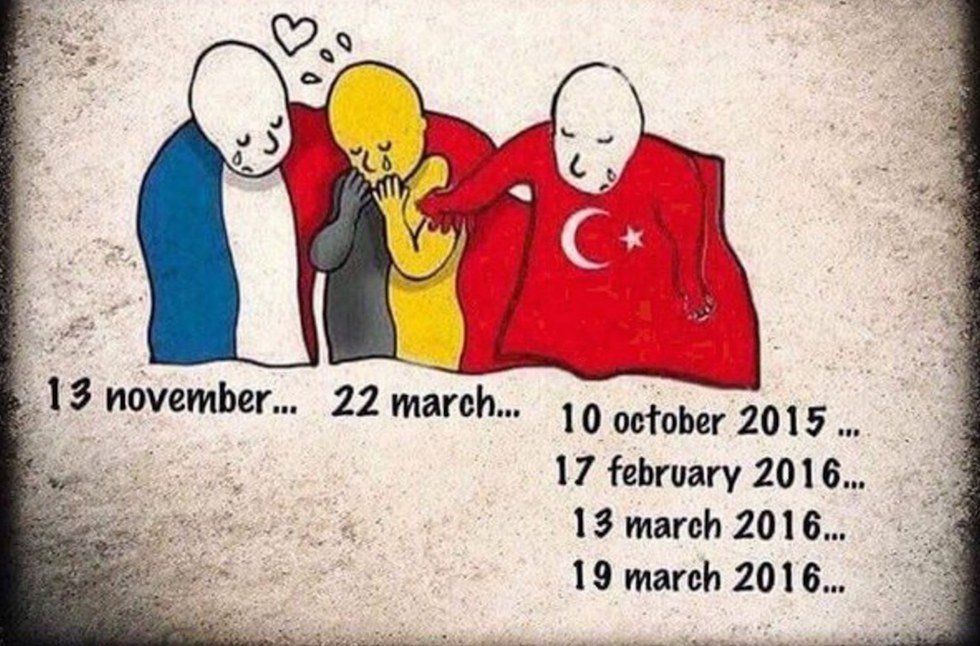
On the morning of March 22, tragedy struck the city of Brussels, Belgium, as three coordinated bombings, carried out by ISIL, killed 31 people and injured hundreds of others. The world reacted with an outpouring of support as #Brussels and #JeSuisBruxelles trended on Twitter. Leaders from over 110 countries worldwide extended their condolences to the people of Belgium, and President Obama even issued an executive order to lower all American flags to half-staff until March 25. Such a coming together across the globe truly is heartwarming and offers hope for a more peaceful and unified existence.
Yet part of me thought: "But what about Istanbul? What about Ankara?" Just three days before Brussels, a suicide bomber took the lives of four others and injured over 30 in the Turkish capital, and almost a week before that, a car bomb in Ankara killed 37 people and injured over 100 others.
Discussions like this are never not controversial, and I see why they are a touchy subject. To many, bringing up the lack of media attention on other international terror attacks seems like an affront to those affected by the ones we are currently focusing on. And by no means is it my intention to minimize the devastation and loss of life that happened this past week in Brussels.
Yet, in the same way, by deciding that terrorist attacks in places like Turkey and Nigeria do not merit the same media coverage as those in, say, France or Belgium, are we not saying to those victims that their lives don't matter as much? That their countries' struggles with terrorism aren't as valid as those of the West? That it was simply the risk they took for having lived in those places?
But what is the real harm in these American media biases? Well, forget for a minute the devaluing of human lives that we see as too dissimilar to us, and let's focus instead on the effects on American soil. In a post to his Facebook page on March 23 responding to the Belgian attacks, Senator Ted Cruz stated that "we [non-Muslim Americans] need to empower law enforcement to patrol and secure Muslim [sic] neighborhoods before they become radicalized."
While such comments would normally shock me, the current election cycle has taught me to keep my expectations low with regards to what politicians and businesspeople in the limelight say. Maybe if Ted Cruz's constituents had been exposed to the tragedies majority-Muslim nations have faced in dealing with terrorism, they would understand just how ludicrous his language is. What would Cruz's solution have been for the bombings in Turkey? Should three percent of the population patrol the neighborhoods of the other 97 percent? Well, I guess we'll never find out because American news outlets don't like to focus on that sort of thing.
Ultimately, by refusing to equally acknowledge the effects of terrorism and loss of life in other parts of the world, the American media is feeding into the 20th-century "us vs. them" mindset that many politicians thrive off of. Though this may have worked in the past, the current American population is too diverse and complex for such rhetoric to be practical.
Genuine followers of Cruz and Trump live in their own little bubbles and would be shocked to learn just how many Muslim Americans there are and how ingrained into society they have become. Instead, their ignorance is simply encouraged. Furthermore, by focusing on the narratives of White, majority-Christian nations, people are allowed to conveniently forget that our greatest allies confronting the threat of terrorism head on are countries like Turkey.
I don't have some personal vendetta against Europe and I don't think countries like Turkey and Nigeria "deserve" the most sympathy. However, by refusing to show the extent to which these nations are being hurt by the same elements we are fighting, the American media is willfully perpetuating the ignorance of its own people and permitting the spread of counterproductive hate speech; it paints complex issues in terms of black and white. And despite what the media thinks is best, the America I know and love is capable of handling a lot more nuance than is given credit for.

















