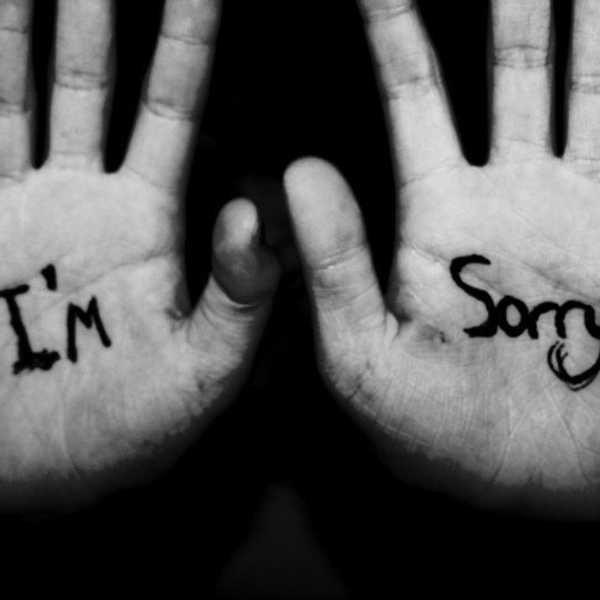
"I'm sorry."
According to the Online Etymology Dictionary, “I’m sorry,” a phrase coined in 1834, derives from the Old English
We hear this phrase every day; sometimes we honestly mean it, but most of the time, we use it as a placeholder (much like the words “um,” “like,” and “you know” have become conversation fillers), or just saying it without any meaning behind it. So when did "sorry" stop meaning that you were sorrowful or sad for someone else?
“Sorry,” in some ways, has become linked to our sense of politeness. But, the overuse of this phrase can also lead to a drop in self-esteem, which may be from the creation of guilt our minds devise from thinking we’ve done something wrong. This ultimately sends the message that you would rather be agreeable than be honest with other people.
I am one of those people who constantly apologize for unnecessary things. For me, it’s a combination of not wanting to offend anyone, something to say when I have nothing else to say, and a little (okay, so maybe a lot) of awkwardness.
I decided to conduct an experiment: I would count the number of times I apologized without having a real reason to or actually meaning the apology. The experiment took place from about 9:00 a.m. to 5:00 p.m. (about the length of my school/work day every day). Every time I said “sorry,” I wrote it down.
The grand total at the end of the school and work day? 25 times. That’s about three “sorry's” an hour for nine hours. I don’t know about you, but that seems awfully exhausting. Most of these instances were for things I definitely did not have to apologize for: like when I felt like I was “in the way” while standing in line. My response to an “excuse me” was to automatically say “sorry!”
So after my tallying of “sorry's,” I made the decision to break this habit. I wanted to go one day without apologizing (unless I truly meant it). The day started out great; no reason for me to apologize to anyone. My downfall happened about halfway through the day when I finally slipped. My awkwardness (no, my politeness) got the better of me and I blurted out the forbidden phrase to someone who accidentally bumped into me while I was walking out the door and she was walking in. I didn’t even notice that the phrase escaped my mouth until a few seconds later as I was walking across campus. I literally gasped and metaphorically kicked myself. I asked myself why I apologized to someone who ran into me: the other person was at fault, why didn’t they apologize? I didn’t do anything wrong. It wouldn’t have been rude had I not said “sorry!”
My experiment has shown me that I can break this habit if I really want to. The overuse of “I’m sorry” doesn’t affect me in a negative way (at least I don’t think it does), but it can be annoying if I’m constantly apologizing for things I didn’t do or can’t control. Hopefully, I’ll continue to keep actively trying to break this habit!