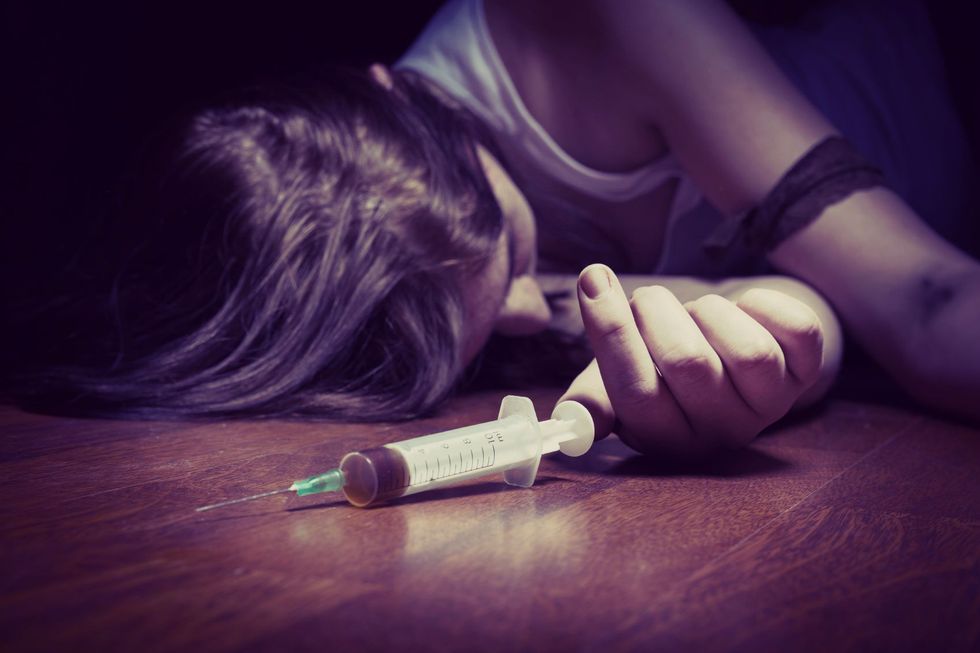
There has been a large debate circulating to determine if drug addiction is a disease or a choice. There are several reasons why this is a hot topic of conversation, but the predominant one is that almost everyone has been affected by drug use in some way.
With The War on Drugs persisting, it has become clear that certain political figures consider addiction to be a choice despite the scientific and psychological evidence that may suggest otherwise, and this particular perception on choice has led to a concept that is rather inhumane and goes against personal morality—the Three Strikes Rule.
Dan Picard, a city council member by in Middleton, Ohio, suggests that the solution to opioid overdose is to let addicts die by denying them medical treatment and inflicting fear into the community. The basic idea is that a database will be created to determine the number of times a particular person has overdosed and needed medical treatment. According to the Washington Post, Picard then goes on to state that “if it’s someone who has already been provided services twice… we’re not going to provide further services – and we will not send out an ambulance” in order to send a message to other users.
Picard’s reasoning for this concept is that someone who accidentally consumed too much of a substance “obviously doesn’t care much about [their] life” and therefore does not deserve medical treatment or the time of the city employees. As a city council member, it is understandable that Picard is looking at the financial security of his community. According to the Centers for Disease Control and Prevention, opioids led to the death of over 33,000 people in 2015, and the number of users is steadily increasing. Every time an overdose occurs, paramedics are sent to treat the patient with Narcan. This treatment does hold an expense as well as some associated hospital costs, so it makes sense that money will be saved if there are reduced amounts of overdoses.
Here is where the problem lies.
On paper, this concept may appear to be a rational decision when addiction is viewed as a personal choice over a pandemic health issue, but when it comes to our perception on the value of human life, this concept falls flat on its face. If this idea is put into action, lives will be put on the line to save a few tax dollars. For the sake of ethicality, I have to question how people who pay those taxes can be denied medical assistance when that’s what part of tax those dollars are supposed to be used for. For the sake of humanity, I have to question how people who are paid to treat those in medical need can pick and choose who deserves to live or die depending on a bias against a disease like addiction.
These lost lives go beyond just those who make a mistake and overdose. A key concept to keep in mind is that everybody is somebody’s somebody. An addict is also a mother, a husband, a best friend, a child, a co-worker, a confidant, and above all a human being. Their life matters despite the crutch they harbor. Promoting a concept like this is like saying these lives matter less than a statistic and a dose of Narcan.
Promoting the Three-Strikes Rule is also a huge slap in the face to the families of those battling addiction because addiction affects more than the addict alone. As previously stated, everybody is somebody’s somebody, and that person’s death can be detrimental to everyone associated. Think about this unfortunate, yet realistic situation:
Say a child calls 9-1-1 because her father is unconscious and that’s what she has been told to do her entire life if something goes wrong. This child’s father has succumbed to the detriment of a harsh part of the addiction recovery process—a relapse—and unintentionally overdosed for the third time. The child is depending on a medical team to help her father. After all, he did try to better himself by going to rehab. With shaking hands and a broken voice, she gives her information but is told “no” by a dispatcher. Unfortunately, the child’s father has made one mistake too many, and now the child has no option but to wait and see if he wakes up. He doesn’t. Now an innocent girl has to watch her father die.
Is that man's life and the livelihood of his daughter worth those few saved tax dollars?
Is that phone call to tell his mother her son has passed from an unintentional death worth that ambulance still sitting in the parking lot?
Is that employer struggling due to a shorted staff and loss of a friend worth that one dose of Narcan?
Is the worth of a life that easy of a comparison?
It is the responsibility of the city to help those in need of a medical emergency and fulfill their duty to the patient, not play God in a game of determining which lives are worth living due to a certain disease or accident. No person addicted to opioids has just flipped a switch and said: "I want to intentionally ruin myself and the lives of those around me by becoming dependent on a substance."
Addiction does not work that way as if it is a mere hateful choice of livelihood. Addiction is a brutal process and a psychological takeover.
Yes, drug users do choose to take that first hit, but they did not choose to fall victim to a dependency. We also have to remember that every person has a story or reason as to what started them down a path of drug use in the first place. As humans, we all struggle uniquely and cope just the same. The unfortunate part is that some chose to cope in a way that took them down a path they were not prepared to walk, and telling them that their life holds less value for choosing that path is incredibly disheartening and lacks human decency.
A city manager in Middleton posted in his online blog that they have done everything to crack down on drug abuse in the city, but nothing has worked. As long as leaders in the community promote this type of response to addiction and overdose as a free-willed choice, it is possible that abuse will continue to be an increasing problem. The solution to a health issue like addiction and overdose should not be to let those who battle what is beyond their psychological control die via dispatcher rejection based on a chart and personal bias.
Picard told The Washington Post that the solution will require some "out-of-the-box thinking," and maybe that's seeing the worth of a human being beyond the label of an addict or a tax dollar.