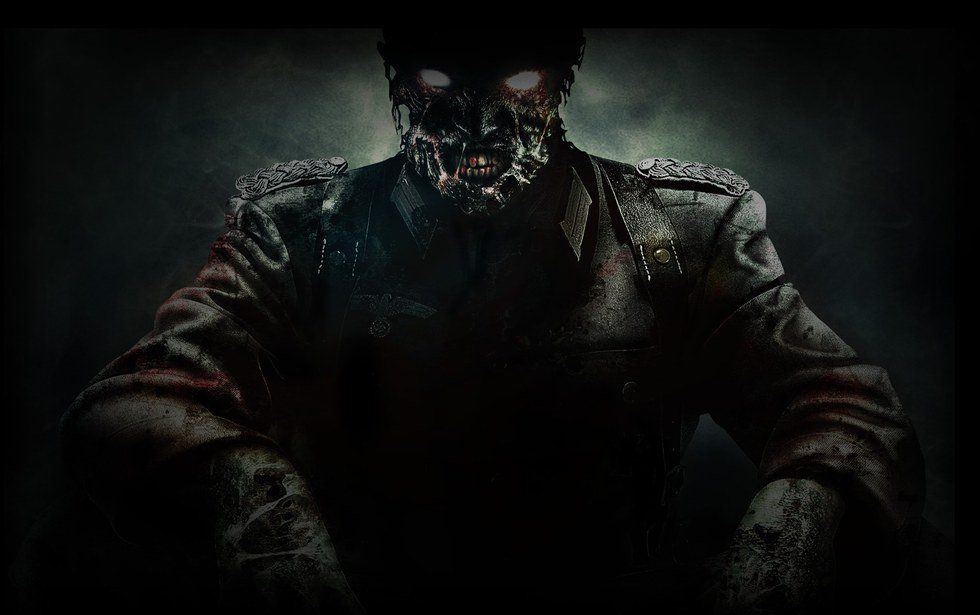
If you hear “cod” and the first thing you think of is a fish, chances are this article is not for you. No, this is for the people who, when hearing “cod”, think of CoD not cod (good luck if you’re reading this out loud to a friend)—that is to say, they think of Call of Duty, the arcade-style first-person shooter with a player demographic almost exclusively younger than its maturity rating would suggest. As anyone who has played it will know, the game is simple, repetitive, and chaotic. On good days you can feel invincible, and on bad days you might want to throw your controller through a wall. Still, somewhere among the plethora of twelve-year-olds shooting off racial slurs like xenophobic machine gunners and the far-too-serious players screaming about lag to avoid their own faults (I should know, I was one of them) this game found its way into the lives of children and young adults alike. For some, it was the short-lived clans. For others, it was beating the final campaign mission. For me though, the mode that has been with me from awkward tween to awkward adult is Zombies.
Most people who have heard of Call of Duty have also heard of their Nazi Zombies game mode, but let me summarize it for the three of you reading this who haven’t (Okay, maybe three readers is wishful thinking). “Zombies”—as it is more commonly called—was introduced back in November of 2008 as a three room house with a magic box and endless waves of the resurrected Third Reich. In the 8 years that were to follow, it would have 23 more maps released across Treyarch’s 4 games, evolving to have “wonder weapons”, a power switch, side missions, perks , a storyline, bosses, ciphers, and of course “Main Easter Eggs” (And that’s not even including the endless custom maps and mods). But as of September 6th, the final map has been released. It’s over. The last Main Easter Egg has been solved, the final boss has been killed, and the loose ends have been tied. We all knew it would come to this point, lest the series be ruined. Still to so many people, Zombies is no longer a game—it has become a way of life.
For example…
1) It's unspoken rules teach strangers play together seamlessly.
As with any game, there are certain obvious rules to be followed, including “Help your teammate”, “Don’t waste resources”, and other things that can be summed up by “Play the game” (Although, you’d be surprised by how often people can’t follow these simple requests). However, even beyond this there’s a number of rules and norms that every new player should (and will) learn quickly. Why? These silent rules both give direction even on new maps and let complete strangers play together like oiled machines. They can be as simple as “Don’t steal kills in the spawn room” and “Open some doors for your team” to the more seemingly random “Don’t kill the last zombie of the round” and “Power is the first objective. Jug is second. Always.”
Now would be a good time to assure you that “Jug” is not, in fact, slang for sex characteristics (If it were, it would probably be first objective for the Call of Duty community). Instead it’s one of many quick terms used with teammates to communicate status, direction, location, action, and just about everything besides the kitchen sink (or including it, depending on the map).
But this terminology is still reasonable compared to rules that go so far to dictate that, if you are trapped by the last zombie or two of a round, you’re expected to just die without doing so much as flipping the bird in response. And again the question is probably raised: Why? Why has enough stressed been placed on these rules to actually convince someone to just let themselves die? Simple. Players eventually stop caring about their own stats because…
2) The co-op gameplay instills a sense of brotherhood.
Sure, this sounds like an overused advertising angle for a number of different multiplayer FPS games, but I’ve played these squad-based games and (as corny as it sounds) it’s just not the same. These other games are often chaotic to the point where you feel insignificant, especially when your death leads to respawning as if nothing happened at all.
But in Zombies there is a legitimate sense of fear in death and failure (Okay, maybe “fear” is a bit much, but tension is certainly there). Dying in a game of Zombies isn’t usually met with an “Oh well” and a quick recovery. No, there are penalties. Individually, there’s the cost of having to regain everything while running around like a headless chicken, but this is small compared to the consequences of a game over, which involves restarting on an endeavor that might have literally been going for hours. When you have as much time hanging on the line as it takes to write a short essay, you tend to get pretty thankful if your friends get you back up, and if they can’t manage it, you’re not mad at them; You’re just hoping they stay alive.
As melodramatic as it sounds, you really do start empathizing with your fellow players, and when you get four people who understand the importance of each member of the team, selfish chaos turns into automatic, organized effort. Furthermore, if you get used to playing with the same friends this sense of comradery leaks out into your normal life, somehow strengthening friendships. Truth be told, 75 percent of my close friendships were based on this mutual sense of duty (Maybe I played a lot of zombies, or maybe I only had 4 friends: I’ll never tell).
This idea of brotherhood becomes almost unconscious, which is important because…
3) You can’t pause and it forces you to mature.
Remember that save-the-last-zombie rule? Well this is the reason it exists. If you aren’t playing solo, you can’t pause the game, and when the undead are only seconds away from eating you at all times, the potential for issues arises. The community’s solution to this is to keep a single zombie and have one person essentially babysit it until everyone has caught their breath and verbalizes that they are ready to move on. It’s a simple trick, yes. But it quickly teaches you how to communicate with others and consider their situations
This time crunch doesn’t just apply to the gameplay itself either. I’m no doctor, but I’m certain the kidneys start producing 115 percent more urine after round one starts (I’m currently awaiting funding to confirm this hypothesis ). Of course, you can’t just run to the bathroom and abandon your friends. No, you hold out until your friends can get you the chance to go, and you’re thankful when it happens (Nothing brings people together quite like mutual urinary discomfort).
Still, sometimes things come up out of nowhere, and part of what this game teaches you is how to go that extra mile when it’s needed, which is important when…
4) The “Main Easter Eggs” requires professional level teamwork and dedication.
Most gamers will understand the meaning of the term “Easter Egg” as some hidden feature or object in a product, and certainly Zombies is absolutely riddled with them (Pun intended). However, starting at the third map of Treyarch’s second game including the Zombies mode, each map started coming out with a “Main Easter Egg” that involved completing a series of difficult, cryptic, and tedious steps for a reward. By the second Main Easter Egg, morse code and a number puzzle had already been implemented, as well as a series of other time-consuming, multi-person steps. Needless to say, a well-organized team became pretty important. The Main Easter Eggs only got harder from there, though. Soon it was necessary to have a guide printed off with a key to certain steps, but you can’t dodge zombies while reading a walkthrough.
Long story short, playing zombie bait became a much more frequent task, and if you wanted to progress with the Main Easter Egg, you did what you had to. How long does one usually have to mindlessly run in circles for? Depends. Could be five minutes to check a key. Could be ten minutes to watch a video. Or, if you’re especially unlucky like me, it could be for an entire hour (Side note: I learned that running in a circle and sprinting every time you hear a growl isn’t a whole lot different than Chinese water torture).
But that’s honestly just part of the experience. These Main Easter Eggs are arguably the pinnacle of a zombie player’s efforts and skill, so you’ll go a long ways to accomplish them, both in and out of the game. For me, it was not uncommon to meet up with friends solely to make it easier to communicate during these laborious endeavors, nor was pulling an all-nighter out of the question either (but I suppose that was pretty normal for my caffeine-fueled gaming circle). Nevertheless, come morning as we shambled out the door with the sleep-deprived likeness of—dare I say it?—zombies, we still regretted nothing, even if the entire night was a failure. It was simply who we were, and for many of us, it is yet who we are today.
Some players are even more dedicated though. Fortunately (or unfortunately, depending on your point of view) they still play a vital role in the zombies community because…
5) The storyline’s community could rival the military in intellect and passion.
The Main Easter Eggs are pretty easy when you just have to follow steps, but those “keys” and “guides” I mentioned a little while back? Yeah, those weren’t official releases by Treyarch or Zombies mode director, Jason Blundell. Instead, they were created by a dedicated community of players working together to solve pure chaos so others didn’t have to. Every Main Easter Egg has been given to us by Treyarch with about the same care as a Spartan parent giving their son to the state training regiment, leaving it up to the individual players to spend dozens of hours analyzing clues and trying insane tactics to slowly solve the Main Easter Egg bit by bit. These people have trained themselves not to think reasonably or restrictively, and if “No, we shoot him twice with the bow and then knife his left leg” seems like a reasonable thought, only then are you thinking on par with these players (or you should be institutionalized. One of the two).
However, randomness is not their only advantage. With the storyline that is mostly contained within hidden radios scattered about the maps, scribbled on torn up pieces of paper, hinted at by passing dialogue from the main characters, and converted into ciphers, forcing the community to come forward with digital graphic’s professionals to rebuild torn messages, audio experts to find messages in manipulated audio, and even military and history nuts to solve jumbled letters. As simple as this started out, what every solution lead to was usually both answers and more questions as the storyline deepened and Jason Blundell’s laugh echoed over the torment community while he stepped up the difficulty, going so far as to include two artificial languages in the game that (I am amazed and shocked to say) at least one Zombies expert actually learned.
It has become something of a war between the Zombies community and Jason Blundell. He always steps up the limit, always tries to keep at least one carrot dangling in front of us. He has even taunted the community with hints of “unsolvable” Easter Eggs, which would seems crazy when this community has solved ciphers created using literal World War II Nazi encrypting technology in a matter of weeks. Crazy… that is until you realize an Easter Egg hidden in the very first game wasn’t brought to light until 7 years passed.
Over time, this war has revealed a multi-universal, multi-plot, supernatural, mind-bending storyline that, even when learning directly from the community members themselves with the same focused effort you read a textbook, takes upwards of 6 hours to learn.
So the question remains: Why did we do it? Why did the Zombies community chase riddles and Easter Eggs that would only ever lead to more riddles and Easter Eggs? Why did we spend hours learning information they knew would be incomplete for months or years? And most importantly, why do Zombies players spend literal days working toward completing Main Easter Eggs or setting new personal records against the infinite waves of zombies when they know that, in the end, a Game Over is the only option? Well, it’s simple: We do it because we can.
6. Zombies taught us to chase the impossible.
There is really no other reason we try so hard to accomplish grand feats or raise our personal record or follow the storyline. For the majority of us, there is no money involved. There is no special medal or extraordinary in-game unlock. No. There is only the feeling of satisfaction in doing what you set out to accomplish, and the longer and more difficult it is, the better it feels when it is finally overcome. The Zombies game mode has revealed to us this thrill of the chase, this euphoria of the impossible. It has taught us that anything is possible with time, determination, and teamwork, and if that is the only thing I take away from this game mode, it would still make every hour, every bladder pain, every sleepless night, and every raging-inducing death worth it.
So from every Zombies player, I would like to say “Thank you, Zombies.” Thank you for everything you have given us, for everything you have made us into. I would also say ”Goodbye,” but I’m smarter than that. The main storyline may have ended, the last official map may have been released, but I know that the Zombies legacy will live on, whether through playing old maps, remakes, or the hundreds of custom maps and mods that are sure to follow. I have no doubt that Zombies will be around for years to come…
…And I’m looking forward to it.