
1. The whiplash-like beginning.
This is to be expected of any book, but the beginning really hooked me into the story. Sometimes I have to wait until the third chapter, and more for some books, before I really get invested in the plot and the characters. I didn’t even make it past the first page of "Traitor's Blade" before I knew I was in this story for the long run.
It gave me a quick glimpse at what exactly I was reading. Sebastien De Castell starts the story off by making the reader feel good, fills their stomach with warm happy feelings, and maybe spreads a small smile on their face. I know it did for me.
And then you reach the end of the second paragraph. The second paragraph! De Castell did not hesitate to make it clear that this story is not for those who are faint of heart, or were looking for a story that was going to have an ending filled with flowers and cake and weddings and maybe some fireflies and everyone’s happy and no one is dead. Ha! No.
Now, I won’t spoil anything, but those warm happy feelings? Yeah, they just die, right there, right then, and you’re left sitting there thinking, “What? Hold on. Did I read that right?”
So you go back to read it. And yeah, you read that right. Those three words were all I needed to know that I was about to hop on a hilarious, mature, thrill-ride that I wouldn’t forget, and never want to get off.
2. The plot.
The story follows Falcio Val Mond, a man with more burdens than he needs (not that that he didn’t put them on his shoulders himself), and the First Cantor of the Greatcoats. Well, he used to be. The Greatcoats have been disbanded for a couple years by now, and to make matters worse, their king is dead. That leaves Tristia to be ruled by the Dukes, who are selfish and capricious enough to surprisingly not start a civil war with each other, but to slowly bleed their own duchies dry.
It doesn’t help the fact that someone is going around killing people, important people, using the already hated Greatcoats as their scapegoats. Because who’s going to trust the word of those who sat back and watched the king they were supposed to protect die? And the whole mess of trying to clear the Greatcoats name and reform them becomes even messier when a young, innocent girl, who Falcio feels he must protect, gets involved. And somehow, Falcio, Brasti, and Kest, end up upsetting the entirety of Tristia in the process. (Meaning there’s literally armies being sent after three men and a little girl-and it’s amazing.)
3. The amazing world of Tristia.
The story takes place in this land called Tristia, which ends up sounding a little like the earlier days of Europe. But honestly, what story that has honorable, swashbuckling ex-magistrates-- all three of whom are the best of friends by the way-- doesn’t sound a little bit like the early days of Europe. Especially when there are Kings and Dukes involved. Oh, and the Knights. Let’s not forget them.
It may sound like I’m bashing on Sebastien De Castell for making a world already similar to one we’ve seen, but there’s only so much you can do when we’re talking about the foundation of a story. The land itself isn’t where the true majesty lies. It’s in the religion and ideals of the people who live in it. Setting up a feudal society is pretty two-dimensional, but it’s that simplicity that allows for the real gems of the story to shine.
This world, conveniently, even has a fun bit of magic some characters get to play around with. Which only adds to the distress of a certain main character. It’s nothing grandiose like the "swish and flick" of "Harry Potter." It’s more subtle, usually in powder form too, which is always fun. Nothing says fun like literally choking on air, maybe hallucinating too-let’s just add being paralyzed to the list while we’re at it. But, what else are you going to do when you have ninja-like assassins trying to kill you?
These ninja-like assassins are called the Dashini. The Dashini are six-parts crazy, five-parts loyal, and about 100 and half-parts deadly. Their whole deal is that no one is not killed by them. If you’ve got Dashini looking at the target painted on your back, then you’re as good as dead-if you’re not dead already.
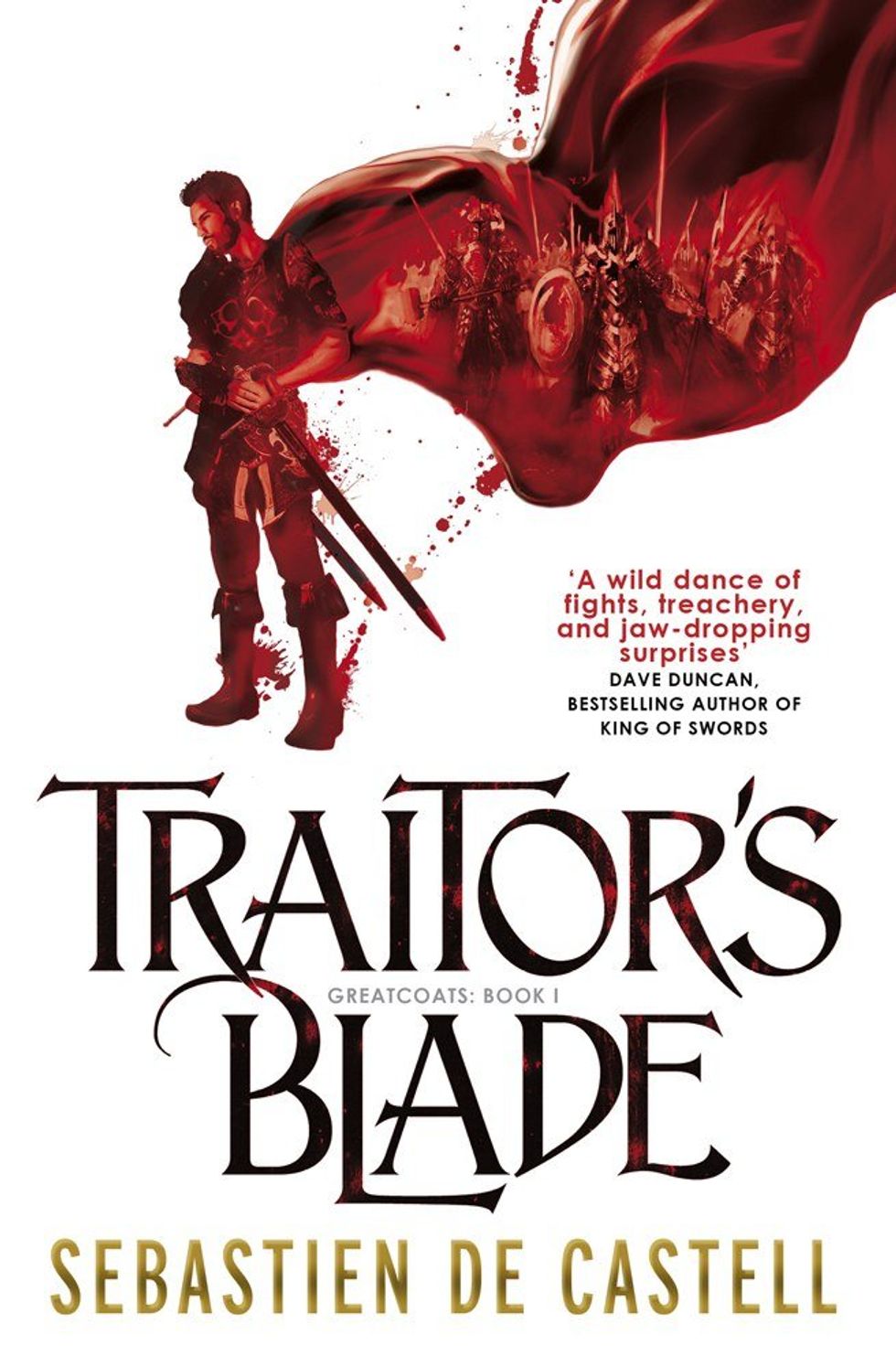
And before I make this section too long, I’ll address the Greatcoats, because that’s what this book is all about. The rise, the fall, and the revival of the Greatcoats. The coat they wear is, funnily enough, called a Greatcoat. Now, the Greatcoat has many deceptively light plates of bone woven into the fabric to prevent the wearer from getting stabbed, which is pretty nifty, I think. And the inside is lined with what’s rumored to be thousands of pockets, which hold the Greatcoats’ tricks and toys, and candy that they use to survive when traveling.
4. The whiplash beginning doesn't end there.
Throughout the book, the words will draw you in into thinking that finally, everything is OK. And then there’s a comma. Now, after the comma all the relief, or joy-maybe a bit of both-that you felt is incinerated. You might be asking yourself, “Why would I want to read something like that?” Well I answer you this, to quote Ron Weasley, “You’re gonna suffer, but you’re gonna be happy about it.”
A good book wouldn’t be a good book if everything went well for the main character all the time. My favorite analogy for how to write a good storybook character is to think of them as a geode. They’re boring and plain on the outside, very generic looking. The best way to get to the pretty, glimmering gem inside is to break them.
De Castell does a wonderful job of that, and usually when you’re least expecting it.
5. The fight scenes.
Any decent book about overthrowing a corrupt government is bound to have that one good fight scene that gets your heart racing. There’s probably around ten, at least, of those fight scenes in "Traitor's Blade." There’s enough danger and wit woven into each fight that it’s almost impossible to stop in the middle and not keep turning pages until you reach the end. We’re not necessarily subject to, “they fought like cats, circling and striking at opportune moments, etc.” We get to read, “Because he had (x weapon) I decided it was best to use (x stance) because it has a better defense against (x weapon). Here’s why."
Each fight is described, from the type of weapon to the benefits of whatever attack Falcio or any other character just used. We’re not kept in the dark about how the characters fight or why they fight that way-except for Kest. The only thing we know about him is that he’s fast, unfairly skilled, and that he makes Falcio feel like an infant with a stick.
There’s even the fights where they literally talk their way out of it. I’m pretty sure you couldn’t call yourself a magistrate if you didn’t have a way with words, especially since the Greatcoats had to sing their verdicts (-that way they’d be remembered by the common people.) And for these modern day Three Musketeers, it’s probably a good thing they’ve got something of a silver-tongue on them.
6. The antagonist.
Even the kindest, most forgiving person on the planet couldn’t possible bring themselves to try and forgive the antagonist of "Traitor's Blade." Why? Because they have no redeeming qualities. They are an all-around terrible person. They’re like Maleficent--the old Disney Maleficent, not the new watered down one--in the sense that they are bad simply because they are. Because they think it’s hilarious to break down people’s sanity, to get under their skin, to conquer the world and make it their toy.
I wish I could just say you’ll dislike this person simply because they’re "bad." I do, I really do, because then maybe we could all just laugh it off and frolic into the sunset knowing that this person is definitely conquerable, and everything is going to be okay, and it’ll all be pretty easy because they have feelings in there somewhere.
No.
Not this person.
As someone who usually ends up liking the villains in stories, it’s always both refreshing and incredibly irritating when I come across a villain I can, and do, legitimately loath. There have only been two antagonists where that has been the case, and this person is one of them. I won’t give names, I won’t spoil who it is, because, if you [the reader] do decide to read "Traitor's Blade" after reading this, then I want you to feel the same amount of frustration and anger that I did. It’s only fair.